Introduction
If your office break room ice maker has ever smelled “off,” or you’ve noticed that weird film on the ice scoop, you already know why this matters. Office ice machines sit untouched for days, get topped up with whatever water comes out of the tap, and then everyone reaches in with their hands. That’s a recipe for bacteria, mold, and the dreaded pink slime that nobody wants in their afternoon coffee.
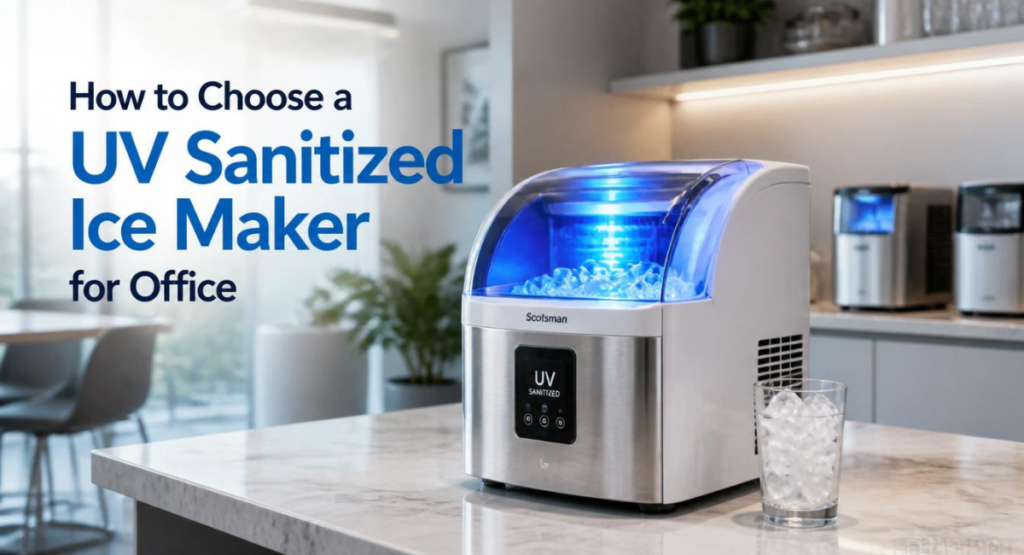
A UV sanitized ice maker for office use solves this problem quietly, automatically, and without chemicals. In this guide, I’ll walk you through exactly how UV sanitation works, what to look for when buying a UV sanitized ice maker for office break rooms, and which features actually matter versus which ones are just marketing fluff. By the end, you’ll know exactly what to buy — and what to avoid.
Table of Contents
Why Office Ice Makers Need UV Sanitation
Most office break rooms run on a simple cycle: someone fills the water tank on Monday, the machine runs all week, and nobody thinks about it again until the ice tastes funny or the machine starts smelling musty. That gap between cleanings is exactly when bacteria, mold spores, and biofilm get a foothold inside the ice-making chamber.
Unlike a home kitchen where one or two people use the ice maker, an office machine gets touched by dozens of hands using the same scoop, day after day. Combine that with standing water, dark enclosed spaces, and room-temperature air circulating through the unit, and you’ve got near-perfect conditions for microbial growth. Health and food safety experts have pointed out that ice machines are frequently overlooked during regular office cleaning routines, even though ice is classified as a food product under the FDA Food Code, which means it falls under the same hygiene scrutiny as anything else served to people.
A UV sanitized ice maker tackles this problem in the background. The UV-C light continuously neutralizes bacteria and mold spores inside the ice chamber, so the machine stays cleaner between deep cleans — which matters a lot in an office where “deep clean the ice maker” is rarely on anyone’s to-do list.
If you’ve ever dealt with a machine that smells like mildew or produces ice that tastes a little “off,” our guide on why ice tastes like fish from an ice maker breaks down exactly what’s causing it — and a UV system is one of the best ways to prevent that issue from coming back.
How UV Sanitation Works in an Ice Maker
UV-C light is a specific wavelength of ultraviolet light that disrupts the DNA of bacteria, mold, and other microorganisms, preventing them from reproducing. According to the EPA, UV-C light in this range is widely used for disinfection in water treatment, hospitals, and air purification systems — just scaled down to fit inside a countertop appliance.
In a UV sanitized ice maker, a small UV-C lamp is positioned inside the ice-making chamber or above the water reservoir. As the machine cycles water and produces ice, the UV light continuously treats the air and surfaces inside the unit, killing bacteria and mold spores before they can build up into biofilm or that pink/orange slime you sometimes see in poorly maintained machines.
The key advantage for an office setting is that this happens automatically, 24/7, without anyone needing to remember to run a cleaning cycle or add chemicals. The light simply stays on (or cycles on a timer) while the machine operates.
UV Sanitation vs Other Cleaning Methods
| Method | How It Works | Best For | Maintenance |
|---|---|---|---|
| UV-C Sanitation | Continuous light exposure kills bacteria/mold in the chamber | Office, home, low-effort environments | Bulb replacement every 6-12 months |
| Self-Cleaning Cycle | Runs a rinse/descale cycle using water or vinegar solution | Removing mineral scale buildup | Manual trigger every 1-2 weeks |
| Manual Cleaning | Physical scrubbing with cleaning solution | Deep cleaning, removing stubborn buildup | Monthly, time-consuming |
| Ozone Systems | Infuses water with ozone before freezing | Large commercial machines | Cartridge replacement, higher cost |
For an office setting, UV sanitation paired with a built-in self-cleaning function is the sweet spot. It’s low-maintenance, doesn’t require chemicals near a food-contact surface, and works continuously without staff having to do anything extra. Ozone systems are effective too, but they’re typically built into larger commercial units and overkill for a break room serving 10-50 people.
7 Things to Check Before Buying a UV Ice Maker for Office
1. Confirm It’s Genuinely UV-C, Not Just “UV Light” Marketing
Some listings use “UV” loosely to describe a blue indicator light that has zero sanitizing effect. Look specifically for “UV-C,” “UV-C LED sterilization,” or a stated wavelength (around 254-280nm is the germicidal range). If the product description doesn’t specify UV-C, contact the seller or skip it.
2. Check NSF or ETL Certification
Certifications like NSF (National Sanitation Foundation) or ETL indicate the unit has been independently tested for food-contact safety. For an office machine where dozens of people will be consuming the ice, this isn’t optional — it’s your baseline for trust.
3. Ice Production Capacity for Your Headcount
This is where most offices get it wrong — either buying something too small that can’t keep up, or something oversized that wastes counter space and energy. We’ll cover exact numbers in the sizing section below.
4. Self-Cleaning Function
UV light handles bacteria and mold, but it doesn’t remove mineral scale from hard water. A self-cleaning cycle (usually a button-press that runs a rinse/descale routine) handles the mineral side, so the two features work together rather than overlapping.
5. Noise Level
Office break rooms are often near open-plan seating or meeting rooms. A compressor-based ice maker running at 40-45dB is generally unnoticeable; anything above 50dB can become a background annoyance during quiet hours.
6. Ice Type — Cube vs Nugget
Nugget (chewable) ice has become a popular office perk because it’s gentler to chew and absorbs drink flavor well — it’s the same style used in places like Chick-fil-A and Sonic. Cube/bullet ice is more traditional and melts slower, which some people prefer for water coolers. If your office leans toward iced coffee and flavored drinks, nugget ice tends to be the crowd favorite.
7. Drainage and Water Source
Countertop units need manual refilling (check the tank size against your office’s daily ice demand), while built-in or plumbed units connect directly to a water line and drain — better for high-traffic offices but requiring proper installation. Make sure whichever option you choose matches your break room’s plumbing setup, or be ready to refill a tank multiple times a day.
How Much Ice Capacity Does Your Office Need?
Sizing is one of the most overlooked steps, and it’s the difference between an ice maker that keeps up and one that runs out by 2pm every day. As a simple rule of thumb based on daily office headcount:
| Office Size | Daily Ice Need | Recommended Capacity |
|---|---|---|
| Small office (1-10 people) | 10-20 lbs/day | 26-28 lbs/day countertop unit |
| Medium office (10-30 people) | 30-50 lbs/day | 33-44 lbs/day with larger basket |
| Large office (30-60 people) | 60-100 lbs/day | Undercounter or built-in unit, 100+ lbs/day |
| Multi-floor / corporate | 100+ lbs/day | Multiple units or commercial-grade machine per floor |
If you’re unsure where your office falls, it’s almost always better to size up slightly — a machine running below its max capacity lasts longer and produces ice faster than one that’s constantly maxed out trying to keep up.
Where to Place a UV Ice Maker in an Office
Placement affects both performance and hygiene. Keep these in mind:
- Avoid direct sunlight and heat sources. Placing a unit near a window or next to a coffee machine forces the compressor to work harder, reducing ice output.
- Leave ventilation space. Most countertop units need at least a few inches of clearance on all sides for the compressor to vent heat properly.
- Keep it away from high-traffic walking paths. Reduces accidental bumps and spills near the water tank or drain.
- Position near (but not directly under) the break room sink. Makes refilling and draining far easier without creating a tripping hazard with hoses.
How to Maintain a UV Sanitized Ice Maker
Even with UV sanitation running continuously, a small amount of routine maintenance keeps the machine performing well:
- Run the self-cleaning cycle weekly if your unit has one — this clears mineral buildup that UV light doesn’t address.
- Replace the UV-C bulb annually (or per manufacturer guidance) — the bulb can still emit visible light after it loses its germicidal effectiveness, so don’t rely on “it’s still glowing” as a sign it’s working.
- Use filtered water if your office has hard water. This dramatically reduces scale buildup and extends the lifespan of both the UV system and the compressor.
- Wipe down the exterior and scoop holder weekly — this is the part everyone touches, and it’s separate from the internal UV sanitation.
For a deeper troubleshooting walkthrough if your machine starts acting up despite regular maintenance, see our guide on why an ice maker suddenly stops working and the most common fixes.
Common Mistakes to Avoid
- Buying based on “UV” in the title without checking the wavelength or certification. As covered above, not all UV claims are equal.
- Undersizing for headcount. A machine that can’t keep up will run constantly, shortening its lifespan and frustrating staff.
- Ignoring water quality. Hard water causes scale buildup regardless of how good the UV system is — pair it with filtered water in hard water areas.
- Forgetting the UV bulb replacement schedule. An expired bulb gives a false sense of security while providing zero sanitization.
- Placing it somewhere with poor ventilation. This silently reduces ice production and shortens compressor life — something we cover in more detail in our guide on how to increase ice production in a countertop ice maker.
Frequently Asked Questions
Does UV sanitation eliminate the need for manual cleaning?
No. UV-C light continuously reduces bacteria, mold, and biofilm growth, but it doesn’t remove mineral scale or physical debris. You’ll still need a periodic self-cleaning cycle or manual descale, just far less often than a machine without UV protection.
Is UV light safe near food and ice?
Yes. UV-C sanitation systems used in food-contact appliances are designed so the light treats the air and internal surfaces, not the ice directly in a way that affects safety. Look for NSF or ETL certification to confirm the unit meets food safety standards.
How long does a UV-C bulb last in an ice maker?
Most UV-C bulbs are rated for 6-12 months of continuous use before their germicidal effectiveness drops significantly, even if the bulb still produces visible light. Check your manual for the manufacturer’s specific replacement interval.
What size ice maker is best for a small office?
For offices with 10 or fewer people, a countertop unit producing 26-28 lbs of ice per day is typically sufficient. For larger teams, refer to the sizing table above and consider an undercounter or built-in unit for offices over 30 people.
Nugget ice or cube ice for an office?
Nugget ice is increasingly popular in offices because it’s soft, chewable, and works especially well with iced coffee and flavored drinks. Cube or bullet ice melts more slowly and is a safer bet if your office mainly uses ice for water coolers or general drinks. If your team can’t decide, our guide on what type of ice is Sonic ice explains the differences in more detail.
Can a UV ice maker run constantly without issues?
Yes, most UV-C systems in ice makers are designed for continuous 24/7 operation, similar to UV systems used in water treatment. If you’re wondering about leaving any ice maker running around the clock, our guide on whether you can leave a portable ice maker on all the time covers this in detail.
Final Verdict
For an office environment, a UV sanitized ice maker isn’t a luxury feature — it’s a practical fix for a problem most offices don’t realize they have until the ice starts smelling musty or someone notices pink residue in the bin. The combination of genuine UV-C sanitation (verified, not just marketed), a self-cleaning cycle for mineral buildup, and the right capacity for your headcount will keep your break room ice clean, fresh, and low-maintenance for years.
Before you buy, run through the 7-point checklist above, size the unit to your team, and make sure water quality is factored in if your office is in a hard water area. Get those basics right, and your office ice maker becomes one of those appliances nobody thinks about — which is exactly how it should be.
Related reading from IceMakerReviews.com:
- Why Is My Ice Maker So Slow? 11 Real Causes and Fixes
- How to Increase Ice Production in a Countertop Ice Maker
- Why Does My Ice Taste Like Fish? 10 Proven Fixes
- Portable Ice Maker Keeps Saying Add Water? 9 Fixes
- Can You Leave a Portable Ice Maker On All Night?
Affiliate Disclosure: As an Amazon Associate, IceMakerReviews.com earns from qualifying purchases at no extra cost to you.