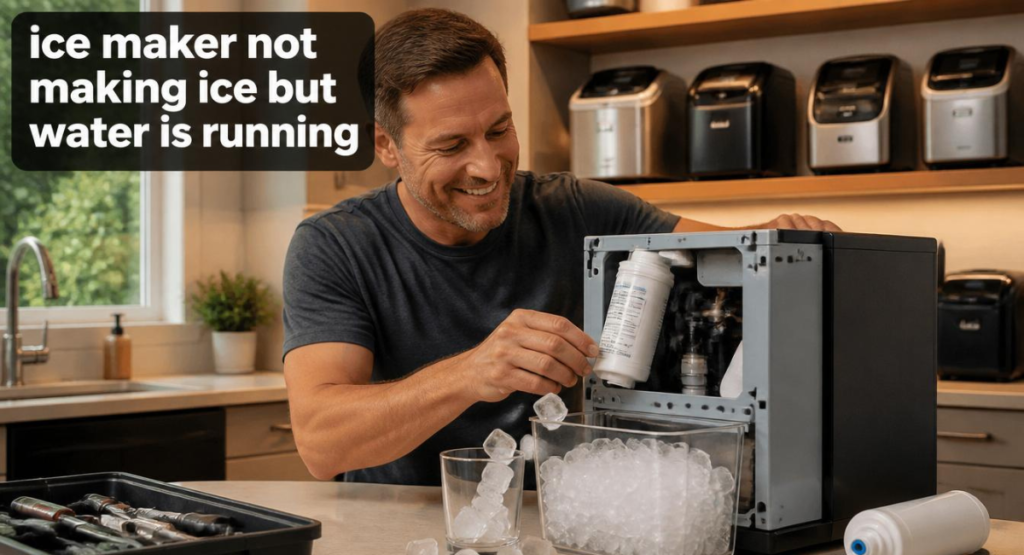
You open the freezer expecting a full bin of ice, but instead, you find a puddle, a half-frozen mess, or nothing at all, even though you can clearly hear water running into the machine. This is one of the most confusing ice maker problems because, on the surface, everything seems to be working. Water is entering the system. The ice maker has power. So why is your ice maker not making ice but water is running?
I have seen this exact issue happen with different ice maker models, and after troubleshooting the problem and learning from appliance technicians, I found that it usually comes down to seven common causes. The good news is that you usually do not need to replace the entire ice maker, and most problems can be diagnosed yourself in less than 15 minutes using basic tools.
In this guide, we will cover the real reasons why your ice maker not making ice but water is running, from frozen fill tubes and temperature problems to faulty valves and damaged components. We will also explain the exact steps to check and fix each issue so you can get your ice maker working again.
Table of Contents
Quick Answer: The 7 Most Common Causes
- Ice maker switched off or set to the wrong mode
- Frozen or kinked water supply line
- Clogged or overdue water filter
- Faulty water inlet valve
- Ice bin sensor or thermostat misreading the bin as full
- Low household water pressure
- Dirty condenser coils causing the compressor to overheat
Let’s go through each one properly, because “check the filter” alone won’t cut it if the real problem is somewhere else entirely.
1. The Ice Maker Is Switched Off (or the Shutoff Arm Is Stuck)
This sounds too simple to be the answer, but it’s genuinely the most common cause — and the one people skip because they assume they’d have noticed. Most ice makers have either a digital on/off toggle or a physical wire shutoff arm inside the bin. If that arm gets bumped upward by a bag of frozen peas, or ice buildup pins it in the “off” position, the machine will happily keep pulling in water for internal functions while never actually cycling to make ice.
Pull the bin out, check the arm is sitting down, and confirm the ice maker isn’t accidentally in “off” or child-lock mode on the control panel. One appliance repair guide notes this exact shutoff arm issue as a top cause of ice makers that stop producing ice despite everything else looking normal.
2. Frozen or Kinked Water Supply Line
Water running but no ice forming is the classic symptom of a partially frozen supply line. Water is getting through, just not consistently or in the right amount, so the machine either skips the freeze cycle or produces tiny, broken pieces instead of full cubes.
Pull the fridge away from the wall and inspect the plastic or copper line running from the shutoff valve to the back of the unit. Look for a sharp bend, a section pressed against the wall, or visible frost along the tubing. A guide from Flamingo Appliance Service points out that a kinked or frozen supply line is one of the two most common water-supply issues behind this exact complaint. Cody’s Appliance Repair lists this alongside clogged filters as one of the most overlooked causes of ice makers that seem to be getting water but never actually produce anything. If you find a kink, straighten it gently and give the line a few hours to thaw before testing again. Long-term, reroute the line so it isn’t pinched behind the appliance.
If your unit is a portable countertop model rather than a built-in with a water line, this specific cause won’t apply — but a similar issue can happen with the internal pump line freezing over, which is worth keeping in mind if you also use it for outdoor entertaining in cold weather.
3. Clogged or Overdue Water Filter
A saturated filter restricts flow rather than stopping it completely — which is exactly why water still seems to be “running” while ice production drops off or stops. Most manufacturers, including Whirlpool, recommend replacing the filter roughly every six months to keep flow and filtration performing properly. If you genuinely can’t remember your last filter change, that alone is a strong reason to swap it before doing anything else on this list.
Signs your filter is the culprit: smaller or hollow cubes, a noticeably slower dispenser, or a metallic/musty taste in your water. If you replace the filter and notice ongoing scale buildup afterward, it’s worth running through our full descaling guide as well, since mineral buildup and filter issues often show up together.
4. Faulty Water Inlet Valve
The inlet valve is what actually opens to let water into the ice maker on command. If it’s stuck partially closed, weakened, or has debris caught inside it, you’ll get water dribbling in — often enough to hear or see — but not enough pressure or volume to trigger a normal ice cycle.
You can test this without a multimeter in many cases: if you hear the valve clicking or buzzing but very little water actually reaches the tray, that’s a strong sign the valve itself is failing rather than anything upstream. This is one of the more common internal points of failure appliance technicians flag when troubleshooting refrigerators that aren’t producing ice despite water clearly reaching the unit. Inlet valves are a relatively inexpensive part, and replacement is usually more practical than repair.
5. Ice Bin Sensor Thinks the Bin Is Already Full
Some machines, especially models like the GE Opal, use an infrared or mechanical sensor near the ice chute to detect when the bin is full. If that sensor gets coated in mineral deposits or ice dust, it can misread an empty bin as a full one — so the machine keeps circulating water but never actually drops a new batch.
A Parts Town troubleshooting guide for the Opal line specifically calls out blocked sensors as a cause of false “bin full” readings, and recommends gently cleaning the sensor area with a vinegar-dampened cotton swab. It’s a two-minute fix and worth trying before assuming anything electrical has failed. If your machine is due for a deeper clean anyway, our self-cleaning nugget ice maker review covers what a proper internal flush cycle should actually remove versus what it misses.
6. Low Household Water Pressure
This one catches people off guard because their kitchen faucet feels totally normal. Ice makers, especially models with a water filter installed, typically need somewhere between 20–120 PSI depending on the appliance, with most manufacturers wanting pressure on the higher end of that range once a filter is in the line — GE’s own appliance support documentation lists 40 to 120 PSI for refrigerators with a water filter installed. If your home’s pressure is borderline, the filter can be enough to drop flow below what the ice maker needs to complete a cycle, even though water is technically still coming through.
A basic gauge from any hardware store attached to an outdoor spigot will tell you where you stand — Chas Roberts has a simple walkthrough on how to test your home’s water pressure correctly if you’ve never done it before. According to EPA guidance on residential systems, most plumbing codes expect pressure-regulating valves once incoming pressure exceeds 80 PSI, and a normal healthy range for a home sits comfortably between 40–60 PSI. If you’re consistently testing below 40 PSI at the tap nearest your fridge, that’s very likely limiting your ice maker even if every other part is fine.
7. Dirty Condenser Coils Causing the Compressor to Overheat
This is the cause people miss most often because it feels unrelated to water at all. The condenser coils (usually underneath or behind the fridge) release heat as part of the cooling cycle. When they’re coated in dust and pet hair, the compressor has to work harder and can overheat or cycle inconsistently — and an ice maker won’t complete a freeze cycle if the surrounding compartment isn’t reaching a cold enough temperature, even while the water fill portion of the cycle runs normally.
Unplug the unit, vacuum the coils with a brush attachment, and give it a few hours to stabilize before judging results. This is a maintenance step worth doing on a schedule regardless — it also extends the life of the compressor itself. It’s a similar principle to why insulated storage bins matter so much on countertop units, which we cover in our piece on countertop ice makers that actually keep ice frozen.
Step-by-Step Troubleshooting Order
If you don’t want to guess, work through these in order — each step takes a few minutes and rules out one possibility before you move to something more involved:
- Check the shutoff arm and confirm the machine is actually switched on
- Inspect the visible water line for kinks or frost
- Check the date of your last filter change and swap it if it’s been 6+ months
- Listen for the inlet valve clicking, and watch how much water actually reaches the tray
- Clean the bin sensor with a vinegar-soaked swab
- Test your home’s water pressure at the nearest outdoor spigot
- Vacuum the condenser coils and let the unit run for a few hours before rechecking
According to one appliance repair resource, roughly 30% of “no ice production” calls come down to nothing more than simple, easily overlooked causes like the ones at the top of this list — so it’s worth being patient and going through them in order rather than jumping straight to a valve or sensor replacement.
When to Call a Repair Technician Instead of DIY
Commercial-grade machines like the ones we broke down in our Chick-fil-A ice maker guide have dedicated service contracts for exactly this reason — home units don’t have that safety net, so knowing when to stop DIY-ing matters more. If you’ve gone through every step above and the machine still isn’t producing ice, it’s a reasonable point to call in a technician — particularly if you suspect the inlet valve, the control board, or anything involving refrigerant. Water pooling inside the unit, a compressor that clicks and shuts off repeatedly, or any burning smell are also signs to stop troubleshooting yourself and get a professional involved. Repairs at this level usually aren’t expensive relative to replacing the whole appliance, so it’s rarely worth pushing further on your own once you’re past basic maintenance checks.
Frequently Asked Questions
Why is my ice maker filling with water but not freezing it?
This usually points to either insufficient cooling in the compartment (dirty coils, a door not sealing properly) or a bin sensor incorrectly reporting the bin as full, which stops the freeze cycle from completing even though water is still cycling in.
How do I know if my ice maker’s water inlet valve is bad?
Listen closely during a fill cycle. A healthy valve opens with a short click or hum and delivers a steady stream. A failing valve often buzzes continuously, delivers only a trickle, or doesn’t fully shut off between cycles, leading to slow leaks.
Can low water pressure really stop an ice maker from working?
Yes. Most ice makers need enough pressure to fill quickly and fully within the cycle window. If pressure is too low — commonly below 40 PSI — the fill can be incomplete, and the machine may skip or delay the freeze step entirely.
How long should it take for a new or reset ice maker to start producing ice?
Give it roughly 24 hours to produce a first batch after installation, a reset, or a power outage, and up to 48–72 hours to reach full, steady production. If you’re past that window with zero ice at all, move through the troubleshooting steps above.
Final Thoughts
An ice maker that fills with water but never actually makes ice is frustrating precisely because it feels like it should be an easy fix — and most of the time, it actually is. Start with the shutoff arm and the filter, work your way down through the water line and pressure, and save the inlet valve or sensor replacement for last. If you’re maintaining a countertop or portable unit rather than a built-in model, a lot of the same root causes apply — our guide on properly emptying and storing an ice maker is worth a look if you’re dealing with a unit that’s been sitting unused for a while, since old water left in the lines is a common trigger for exactly this kind of issue.
And if you’re troubleshooting a specific model and want the manufacturer-level detail, our GE Profile XPIO13BCBT manual breakdown covers wiring, resets, and part numbers in more depth than most general guides.
Still stuck after working through everything here? Browse our full troubleshooting and buying guide library, or if you’re shopping for a replacement machine entirely, our crushed ice maker comparison and nugget ice guide are good starting points depending on the ice style you actually want.