Introduction
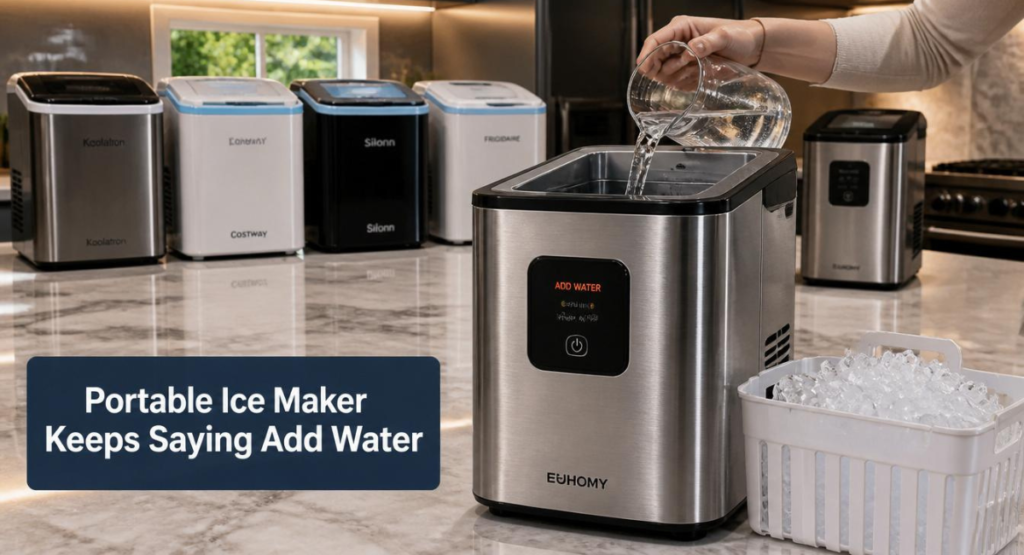
You filled the reservoir to the top. The water is right there. But your portable ice maker keeps saying add water — and you’re standing in the kitchen wondering if your machine is broken.
Take a breath. In 9 out of 10 cases, this is not a broken ice maker. It’s a small sensor, a clogged filter screen, or an air bubble in the pump line — and you can fix it yourself in under 15 minutes without any tools.
I’ve helped hundreds of readers troubleshoot this exact issue across every major brand — Opal, Insignia, Igloo, Frigidaire, Gevi, Ionchill, NewAir, and the unbranded countertop units from Amazon. The fixes below work on all of them because they share the same internal parts.
Table of Contents
Let’s get your ice maker running again.
Why Does My Portable Ice Maker Keep Saying Add Water? (Quick Answer)
Your portable ice maker keeps saying “add water” even when the reservoir is full because the machine cannot detect the water — not because the water isn’t there. The most common causes are:
- A clogged filter screen at the bottom of the reservoir
- A dirty or stuck float switch/water level sensor
- An air-bound water pump that needs priming
- Mineral buildup from hard water (limescale)
- The unit is not level on the countertop
- The reservoir is filled with water that’s too pure (distilled or RO)
- A control board glitch that needs a hard reset
- A kinked or blocked internal water line
- A failed water pump (rare)
Below, I’ll walk you through each fix in the exact order you should try them — starting with the easiest (30 seconds) and ending with the more involved ones.
Fix #1: Confirm the Water Reservoir Is Filled to the Max Line (Not Just “Almost Full”)
This sounds obvious, but it’s the #1 reason readers email me about this problem. Portable ice makers — including Insignia, Igloo, and Opal — will not start a cycle until the water hits the upper fill line, not just below it.
Pour water slowly and check that it reaches the molded “MAX” indicator inside the reservoir. If your unit has a removable tank (like the GE Opal 2.0 side tank), fill it to the top arrow, not the middle.
Also, check that the reservoir is seated correctly. Even a 2 mm gap can stop the sensor from registering water. Press it down firmly until you hear or feel it click into place.
Pro tip: If you’re using a measuring cup, most portable ice makers need 1.5 to 2.2 liters (about 6–9 cups) of water to reach the fill line.
Fix #2: Hard Reset the Ice Maker (Solves 30% of Cases)
A surprising number of “add water” errors are nothing more than a control board glitch. Resetting clears it instantly.
How to hard reset any portable ice maker:
- Turn the machine off using the power button.
- Unplug it from the wall outlet.
- Wait a full 10 minutes (not 30 seconds — the capacitors need time to fully discharge).
- Plug it back in and turn it on.
- Start an ice cycle.
This single step fixes the Insignia ice maker add water light staying on, the Igloo ice maker keeps saying add water error, and the GE Opal “add water” message more often than any other trick.
Fix #3: Clean the Filter Screen Inside the Reservoir
This is the single biggest cause of false “add water” alerts on portable ice makers — and almost no one knows it exists.
At the bottom of your water reservoir, in the corner, there’s a small black plastic filter screen (sometimes called the inlet screen). It protects the water pump from debris. Over time, minerals from your tap water build up on this screen, blocking water flow. The float switch then drops, and the machine thinks the reservoir is empty — even though it’s full.
How to clean the filter screen:
- Unplug the ice maker.
- Empty all the water from the reservoir.
- Locate the small filter screen in the bottom corner of the reservoir (it usually pulls straight up or twists out).
- Rinse it under warm running water.
- Soak it in 50/50 white vinegar and warm water for 15–20 minutes.
- Scrub gently with an old toothbrush.
- Rinse, replace, refill, and run an ice cycle.
If you live in a hard-water area (like much of the US, UK, and South Asia), this should be done every 4–6 weeks to prevent the error from coming back.
Fix #4: Clean the Water Level Sensor / Float Switch
Every portable ice maker has a small sensor that tells the machine whether water is present. There are two common types:
- Float switch: A small plastic float that rises and falls with the water level (used in most Insignia, Igloo, Frigidaire, and Ionchill units).
- Optical or probe sensor: Two small metal prongs on the side of the reservoir (used in GE Opal, NewAir, and some Gevi units).
When these sensors get coated with mineral scale, body oils, or biofilm, they stop reading correctly. The result: an ice maker says add water but it’s full error.
How to clean the sensor:
- Unplug the unit and drain the reservoir.
- Locate the sensor (check your user manual — it’s usually inside the reservoir wall or floor).
- Dampen a soft microfiber cloth with a 50/50 white vinegar solution.
- Gently wipe the sensor — do not scrape it with anything metal.
- For float switches, lift the float a few times to make sure it moves freely.
- Wipe dry, refill the reservoir, and try again.
Fix #5: Prime the Water Pump (The “Finger Trick”)
This fix is gold — especially for the Opal ice maker keeps saying add water problem after a cleaning cycle. If you just descaled your machine, there’s almost certainly air trapped in the pump, and the machine cannot pull water until that air is purged.
This works on every portable ice maker with an internal recirculation pump, including the GE Opal 1.0, Opal 2.0, Profile Opal Ultra, NewAir, Frigidaire EFIC, and most countertop units.
How to prime the pump:
- Fill the reservoir to the max line with tap water.
- Remove the small filter screen (from Fix #3) — you should now see a small white rubber inlet (the pump intake).
- Turn the ice maker on and start a cleaning cycle (or ice cycle).
- Press your fingertip firmly over the white rubber inlet for 10–15 seconds. You’ll feel suction pulling against your finger.
- Release your finger and watch for water movement.
- If nothing happens, repeat 2–3 times.
- Once water starts circulating, replace the filter and run a normal ice cycle for 30 minutes.
If you don’t want to use your finger, you can also use a turkey baster or syringe to push water directly down the pump inlet line. This is the technique GE’s own Opal support team recommends.
Fix #6: Descale the Entire Ice Maker With Vinegar
If cleaning the filter and sensor didn’t fix it, there’s likely scale buildup throughout the entire internal water system — not just at the inlet. A full descaling resets everything.
How to descale a portable ice maker:
- Empty all ice and water.
- Fill the reservoir with a solution of 1 part white vinegar to 3 parts water. (For very heavy scale, use 1:1.)
- Start the cleaning cycle (most units have a dedicated “Clean” button — hold for 3 seconds). If yours doesn’t, just run a normal ice cycle and let it dump the ice back into the reservoir.
- Let it run for 20–30 minutes.
- Drain the vinegar solution.
- Refill with fresh water and run two rinse cycles to remove all vinegar taste.
- Refill one more time and run a normal ice cycle.
For severe limescale (you’ll see white crusty deposits inside), you can use a dedicated descaler like Affresh, Lemi Shine, or the official Opal cleaner instead of vinegar.
Fix #7: Check That the Ice Maker Is Perfectly Level
Portable ice makers use gravity to feed water from the reservoir to the ice mold. If the unit is tilted — even slightly — the float switch can sit at an angle and trigger a false “add water” warning.
Put a small bubble level (or use your phone’s level app) on top of the machine. If it’s off, slide a folded piece of cardboard under the low side until it reads level.
This is a particularly common fix for the Igloo ice maker not working, the ” add water issue, and most cheap countertop units that sit on uneven surfaces.
Fix #8: Switch From Distilled or RO Water to Tap Water
This one surprises people. If you use distilled water, reverse osmosis (RO) water, or heavily filtered water in a GE Opal, NewAir, or some Gevi models, the “add water” light may stay on permanently — even with a full reservoir.
Here’s why: these ice makers detect water using a tiny electrical current between two metal probes. Pure water (distilled / RO) has had all its minerals removed, so it doesn’t conduct electricity well. The sensor literally cannot “see” the water.
The test: Drain the reservoir and refill it with plain tap water or bottled spring water. If the “add water” light turns off and the machine starts working, distilled water was your problem.
If you must use filtered water (for taste), use spring water instead of distilled — it has just enough mineral content to trigger the sensor.
Fix #9: Inspect the Internal Water Line and Pump
If you’ve tried everything above and your machine still won’t recognize water, the issue is likely a kinked water hose or a failing pump. This is the only fix that may require opening the unit.
- Unplug the machine completely.
- Remove the back or top panel (a Phillips screwdriver is usually enough).
- Look for the clear plastic tube running from the reservoir to the ice mold.
- Check for kinks, pinches, or visible blockages. Straighten if needed.
- If the pump is making a buzzing sound but no water is moving, the pump itself has likely failed.
A replacement pump for most portable ice makers costs $15–$40 on Amazon or eBay. If your machine is under warranty, contact the manufacturer instead.
Brand-Specific Troubleshooting
GE Opal Ice Maker Says Add Water (Opal 1.0, 2.0, and Profile Ultra)
The opal ice maker keeps saying add water error is the single most common Opal complaint. In 80% of cases, the fix is priming the pump (Fix #5). Here’s the exact GE-recommended procedure:
- Start the Opal and switch it to Cleaning Mode. If you have the side tank, detach it.
- Remove the small black screen filter from the bottom corner of the reservoir to expose the white rubber inlet.
- Make sure the Opal is not connected to the SmartHQ app during this procedure.
- Fill the main water well to the upper fill line with tap water (not distilled).
- Remove the ice bin and press the power button — wait up to 5 minutes for the pump to engage.
- Plug the small white inlet with your finger for 10–15 seconds to build a vacuum.
- Release. Watch for water flowing down the back trough.
- Repeat 2–3 times if needed.
- Once water flows, switch to Ice Mode and run for 30 minutes.
If you have the side tank, lift it 4–5 inches above the main unit until water flows down — this clears any air bubble in the connector line.
Insignia Ice Maker Troubleshooting (NS-IMP26SL0 and Similar)
The Insignia ice maker says add water but the issue almost always comes down to the float switch or the filter screen. Insignia portable ice makers (sold by Best Buy) use a simple mechanical float at the bottom of the reservoir.
If your Insignia ice maker’s add water light stays on:
- Empty the reservoir and look for a small plastic float — make sure it moves up and down freely.
- Clean it with vinegar if it’s sticky.
- Hard reset by unplugging for 10 minutes.
- Make sure the ice basket is fully inserted — Insignia units won’t start without it.
The Insignia NS-IMP26SL0 model in particular is sensitive to the ice basket sensor — if the basket isn’t pushed all the way in, the machine refuses to make ice and may show the “add water” message instead.
Igloo Ice Maker Says Add Water (ICEB26 and Similar)
The igloo ice maker keeps saying add water error is famously stubborn, but here’s the trick most people miss: Igloo units use a basic water sensor that needs minerals in the water to work. If you live somewhere with very soft water or you’re using filtered water, the sensor may not detect it.
The salt trick for Igloo ice makers:
- Drain the reservoir.
- Refill with tap water.
- Add just a pinch of salt (about 1/8 teaspoon) — this increases conductivity.
- Run a cycle.
Do not use more than a tiny pinch — too much salt damages the unit and makes the ice taste terrible.
For the igloo ice maker, where to put water: water goes into the basket where the ice will later be made. Lift the lid, remove the ice basket, and pour water directly into the well underneath up to the MAX line indicator.
Frigidaire Ice Maker Keeps Saying Add Water
The why does my Frigidaire ice maker keep saying add water question usually points to the EFIC series of portable units. These machines have a sealed reservoir with a float switch that’s known to stick after long periods of disuse.
Fix: Unplug, remove the drain plug under the unit, drain completely, refill with fresh tap water, then run two cleaning cycles back-to-back. If the float is visibly stuck, gently tap the side of the reservoir to free it.
How to Prevent the “Add Water” Error From Coming Back
Once you get your ice maker working again, follow this maintenance schedule to keep it that way:
- Every 1–2 weeks: Drain the reservoir completely and refill with fresh water. Standing water grows biofilm that clogs sensors.
- Every 4–6 weeks: Clean the filter screen and wipe the sensor with vinegar.
- Every 2–3 months: Run a full vinegar descaling cycle.
- Always: Use tap water or spring water — never distilled or RO water in machines with conductive sensors.
- When not in use: Drain the unit completely. Storing water inside is the #1 cause of long-term sensor failure.
When to Stop Troubleshooting and Replace the Ice Maker
Honestly? Portable ice makers are not built to last forever. If you’ve tried every fix above and the machine still won’t pump water:
- If it’s under 1 year old, contact the manufacturer for warranty replacement. Don’t waste time trying to repair it yourself — you’ll likely void the warranty.
- If it’s over 3 years old and a budget brand (under $200), replacement is usually cheaper than parts and labor.
- If it’s a GE Opal or higher-end unit, a replacement pump or sensor is worth ordering — these machines are repairable and the parts cost $20–$60.
Frequently Asked Questions
Can I use distilled water in a portable ice maker?
Usually no. Most portable ice makers (especially the GE Opal series) use electrical conductivity to detect water, and distilled water doesn’t conduct electricity well enough to trigger the sensor. Use tap water or spring water instead.
How often should I clean my portable ice maker?
Wipe the reservoir weekly, clean the filter screen and sensor every 4–6 weeks, and run a full vinegar descaling cycle every 2–3 months. Hard water areas need more frequent cleaning.
Why does my opal ice maker keep saying add water after cleaning?
After a cleaning cycle, air gets trapped in the pump line. You need to prime the pump using the “finger trick” — block the white rubber inlet at the bottom of the reservoir for 10–15 seconds, then release. Repeat 2–3 times until water flows.
What is the add water light on an Igloo ice maker?
It’s a warning that the float switch isn’t detecting water at the correct level. Either the reservoir is genuinely low, the float is stuck, or the sensor is dirty. Cleaning the reservoir and float usually solves it.
Why does my Insignia ice maker say add water but it is full?
The float switch at the bottom of the Insignia reservoir is stuck or coated with mineral residue. Clean the reservoir with vinegar, make sure the float moves freely, and ensure the ice basket is fully seated — the Insignia NS-IMP26SL0 won’t make ice if the basket isn’t pushed all the way in.
How do I reset my portable ice maker?
Turn the machine off, unplug it from the wall, wait a full 10 minutes for the capacitors to discharge, then plug it back in. This clears any control board glitch and works on Opal, Insignia, Igloo, Frigidaire, and most other brands.
Why does my portable ice maker say add water when it’s full?
Because the internal sensor cannot detect the water — not because water is missing. The most common reasons are a clogged filter screen, a dirty float switch, an air-bound pump after cleaning, mineral buildup, or using distilled water that doesn’t conduct electricity.
Final Thoughts
An ice maker that says “add water” when it’s clearly full is one of the most annoying appliance problems out there — but it’s almost always fixable in under 30 minutes without spending a single dollar on parts.
Start with the easiest fixes first: refill to the max line, hard reset, clean the filter screen. If those don’t work, prime the pump and descale. Nine times out of ten, one of those will solve your “portable ice maker keeps saying add water” problem for good.
Save this guide, and the next time the error pops up, you’ll know exactly what to do.