Introduction
You asked the right question — and most websites will not give you a straight answer. They either dodge the truth to sell you a product, or they say “no” without explaining your real options.
Here is the complete honest answer: Is there a countertop ice maker that keeps ice frozen? Most standard countertop ice makers do not keep ice frozen, but certain models and machine types do, and simple strategies can help keep your ice solid for hours longer than expected.
Table of Contents
The Short Answer — What You Actually Need to Know
The honest answer
Standard portable and countertop ice makers make ice fast — but they are not freezers. The storage bin is insulated, not refrigerated. Ice will last 1 to 4 hours before it starts melting noticeably. However, there ARE specific types of machines — undercounter ice makers with refrigerated bins and certain hybrid models — that actively keep ice frozen. These cost more and are larger, but they do exactly what you want.
Let’s break this down properly so you understand exactly what you are buying and what your real options are.
Why Most Countertop Ice Makers Do NOT Keep Ice Frozen
This surprises a lot of people because it seems obvious that an ice maker should keep ice frozen. Here is the real reason it does not work that way.
A standard countertop or portable ice maker has two separate jobs happening inside it:
- The compressor and evaporator work together to freeze water into ice — this is the cold side of the machine
- That same compressor generates heat as a byproduct, which is expelled through the back vents
Here is the problem: both the cold-producing mechanism and the heat-expelling vents are in the same compact housing. The heat that is expelled during ice-making warms the air around the storage bin. The bin has insulation — similar to a good cooler — but it does not have its own refrigeration system. So it slows melting, but it cannot stop it.
Think of it this way: a countertop ice maker is like a factory that makes ice cubes and drops them into an insulated lunchbox sitting next to it. The lunchbox keeps them cold for a while — but it is not a freezer.
⚠️ The truth about marketing claims: Many ice maker product listings say they “keep ice frozen” or have “insulated storage.” This is technically true — the insulation does slow melting. But it does NOT mean the ice stays rock-solid frozen the way it would in your freezer at 0°F. If a product claims to keep ice frozen without mentioning a refrigerated storage bin or compressor-cooled bin, the ice will still melt — just a little slower than in a non-insulated bin.
How Long Does Ice Last in a Countertop Ice Maker?
The answer depends on the model, room temperature, and how often you open the lid. Here is a realistic breakdown based on real-world use:
| How Long Does Ice Stay Solid | Ice Storage Method | How Long Ice Stays Solid | Room Temp Impact |
|---|---|---|---|
| Basic portable ice maker | Thin plastic bin, minimal insulation | 30 min – 1.5 hours | Very high — melts fast in warm rooms |
| Well-insulated countertop model | Thick-walled insulated bin | 2 – 4 hours | Moderate — keeps up well in AC rooms |
| Nugget ice maker | Insulated bin (nugget ice melts faster by nature) | 1 – 2 hours | High — nugget ice has more surface area |
| Undercounter ice maker (refrigerated bin) | Actively refrigerated storage | 12 – 24+ hours | Low — near-freezer temperatures maintained |
| Commercial ice machine | Refrigerated bin with insulated walls | 24+ hours | Very low — designed for long-term storage |
| Ice in your freezer (transferred from ice maker) | Freezer at 0°F | Days to weeks | None — true frozen storage |
✅ Key insight: The best strategy for most home users is a countertop ice maker with good insulation for immediate use, combined with a quick transfer to the freezer for anything you want to keep longer than 2 to 3 hours. This combination costs far less than an undercounter model and works just as well for most households.
3 Types of Ice Makers — Which One Actually Keeps Ice Frozen
Standard Portable / Countertop
Does NOT Keep Ice Frozen
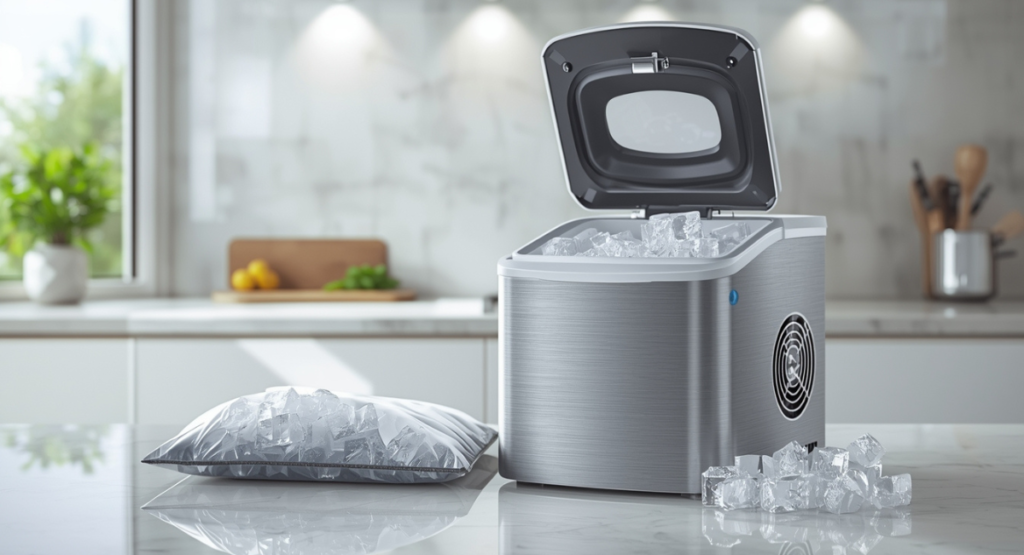
Makes ice fast (6–15 min per batch). Storage bin is insulated but NOT refrigerated. Ice lasts 1 to 4 hours, depending on room temperature. Ice melts back into water, which is recycled to make more ice automatically. Best for: immediate use at parties, daily drinks, and outdoor use.
Undercounter / Built-In Ice Maker
Keeps Ice Frozen — With a Catch
Many undercounter models have a refrigerated or insulated storage bin that keeps ice significantly colder than countertop units. Ice can last 12 to 24+ hours. However, these are larger, require installation, need a water line, and cost $400 to $1,500+. Best for: kitchen bars, frequent entertainers, serious home use.
Commercial / Restaurant Ice Machine
Keeps Ice Truly Frozen
If you are asking, is there a countertop ice maker that keeps ice frozen like a commercial machine, the honest answer is usually no. Commercial ice machines use large refrigerated storage bins that keep ice at near-freezer temperatures for 24+ hours, but these are floor-standing or undercounter units rather than standard countertop models. They are ideal for restaurants, bars, offices, event businesses, or serious home bar setups, with prices typically ranging from $800 to $5,000+.
Best Countertop Ice Makers That Keep Ice Frozen the Longest
If you want the best possible performance from a countertop model — the ones whose insulation actually makes a meaningful difference — here are the top choices based on insulation quality, bin design, and real-world user reports.
Best Overall Silonn
Countertop
Silonn Ice Maker Countertop (ICEM02)
The Silonn consistently ranks at the top for insulation performance in independent tests. Its double-walled ice basket holds more ice and keeps it significantly colder than single-wall competitors. In a 70°F room, ice remains solid and separate (not clumping) for 3 to 4 hours — among the best in the standard countertop category. It produces 9 bullet ice cubes per cycle in about 6 minutes and makes up to 26 pounds per day.
✅ Best-in-class insulation for a standard countertop model | Self-cleaning | Quiet operation | Strong warranty
❌ Still not a true freezer — transfer ice to freezer for storage beyond 4 hours
Best NuggetGE Profile
Opal 2.0
GE Profile Opal 2.0 Nugget Ice Maker
The Opal 2.0 is one of the most popular countertop ice makers in the USA. It produces the chewy, soft nugget ice popularized by Sonic and Chick-fil-A. The storage bin is well insulated for a nugget model, keeping ice usable for about 2 to 3 hours before significant melting. It can connect directly to a water line for hands-free refilling and has a companion app. Nugget ice melts faster than bullet or cube ice by nature because of its greater surface area — that is a property of the ice type, not the machine.
✅ Best nugget ice quality | Optional water line connection | App control | WiFi enabled
❌ Nugget ice melts faster than other ice types | Higher price point ($500+)
Best Value Frigidaire
EFIC452
Frigidaire EFIC452-SS-CU
Frigidaire’s top portable countertop model offers excellent ice production at a competitive price point. The stainless steel exterior helps reflect ambient heat, and the insulated bin is above average for this price range. Ice stays separate and solid for 2 to 3 hours in a typical kitchen environment. Makes 40 pounds of ice per day — significantly more than most competing portable models. A great choice if you want a well-known, reliable brand with good after-sales support.
✅ High daily ice output | Good insulation for price | Frigidaire reliability | Wide parts availability
❌ No refrigerated bin | Ice still melts after 3 hours without freezer transfer
True FrozenMaxx Ice
MIMC15C
Maxx Ice Countertop / Built-In (MIMC15C) — For Serious Users
This is one of the only compact countertop/built-in models that bridges the gap between a standard ice maker and a true refrigerated unit. It produces up to 15 pounds of crescent ice per day and includes a 12-pound insulated storage bin with a sealed door — much closer to a refrigerated storage environment than any open-top portable model. The sealed door dramatically reduces heat exchange with the room, keeping ice solid significantly longer. It is larger and heavier than standard countertop units and can be built-in under a counter. Price is higher ($300–$500) but it is the closest thing to a true “keeps ice frozen” countertop solution.
✅ Sealed door storage | Built-in capable | Significantly better ice retention | 5-year compressor warranty
❌ Lower daily production (15 lbs) | Higher cost | Requires more space
What Happens to Melted Ice — Is It Wasted?
This is a really smart question that first-time ice maker owners always ask. Here is the good news: in almost all portable and countertop ice makers, melted ice is not wasted at all.
Here is how it works: as the ice in the storage bin melts, the water drains back down through a small opening in the bottom of the bin and returns to the water reservoir. The machine then uses that water to make a fresh new batch of ice. This is called a continuous cycle — and it means you can run your countertop ice maker for hours and always have a fresh supply of ice available, even if the bin never accumulates a large amount at once.
The practical result: for everyday use — drinks, cocktails, water bottles — this continuous cycle works perfectly. You always have fresh ice within 6 to 15 minutes of the last batch. You only need long-term frozen storage if you want to stockpile ice for an event, store it overnight, or use it hours after making it.
✅ Smart user tip: If you know you are hosting a party in 3 hours, run your ice maker for 1 to 2 hours beforehand and transfer the ice into freezer bags in your freezer. By party time, you will have a large supply of fully-frozen, rock-solid ice ready to go — completely free.
7 Practical Tips to Keep Ice Frozen Longer in a Countertop Ice Maker
You do not need to spend $500 more on a machine to get noticeably better ice retention. These tips make a real difference with any ice maker you already own:
1. Keep the Machine in a Cool Location
Room temperature is the single biggest factor in how fast your ice melts. A machine running in a 65°F air-conditioned kitchen will keep ice solid 2 to 3 times longer than the same machine in a 90°F garage or outdoor setup. If you use your ice maker indoors, keep it away from windows, ovens, and direct sunlight. Even moving it 3 feet away from a sunny window makes a measurable difference.
2. Never Open the Lid Unless Scooping Ice
Every time you open the lid, you exchange the cold air inside the bin with warm room air. Countertop models with lids that stay closed retain ice far longer than open-top designs. If your machine has a lid, keep it closed unless you are actively getting ice. This one habit alone can add 30 to 60 minutes to your ice retention time.
3. Pre-Chill the Ice Bin
Before you start your first ice-making cycle, fill the bin with a tray of freezer ice and let it sit for 10 minutes. This pre-chills the bin walls, so the first batch of machine-made ice drops into a cold environment instead of room-temperature plastic. The difference is noticeable.
4. Use Cold Water in the Reservoir
If you fill the reservoir with water straight from the fridge (35–40°F) instead of room-temperature tap water (65–70°F), your machine produces ice faster and the compressor works less hard. Less heat output from the compressor means a slightly cooler environment around the storage bin.
5. Transfer Ice to the Freezer for Anything Beyond 2 Hours
This is the most practical tip of all. If you need ice to last more than 2 to 3 hours, transfer it to a sealed freezer bag and put it in your freezer. Countertop ice makers are excellent at making ice quickly and continuously — they are not designed for long-term storage. Use your freezer for storage, and your ice maker for production. Working together, they are a perfect system.
6. Make Ice in Smaller, Frequent Batches
Rather than running your ice maker for 2 hours and filling the bin, run it for 20 to 30 minutes to make one or two batches, scoop what you need, and turn it off. Fresh ice from the evaporator is colder and denser than ice that has been sitting in the bin, melting and reforming. Fresher = colder = lasts longer in your glass.
7. Choose Bullet or Cube Ice Over Nugget Ice for Longer Retention
Ice shape affects melting speed significantly. Bullet ice and full cubes have less surface area per unit of volume — they melt more slowly. Nugget ice is soft, porous, and has much more surface area, so it melts faster. If your priority is ice that stays solid as long as possible, choose a bullet or cube ice maker over a nugget model.
Who Actually Needs an Ice Maker That Keeps Ice Frozen?
Before spending extra money on a machine with refrigerated storage, it is worth asking whether you actually need that feature. Here is an honest guide:
You Do NOT Need True Frozen Storage If:
- You use ice for daily drinks at home — a standard countertop model makes ice fresh on demand faster than you can drink it
- You host casual small gatherings where guests use ice within 1 to 2 hours of it being made
- You have a freezer available and can transfer ice when needed
- You use ice immediately after scooping for cocktails, smoothies, or cold drinks
You DO Need True Frozen Storage If:
- You need ice stockpiled hours before a large event — 50+ people, outdoor party, catering
- You run a home bar, restaurant, coffee shop, or food business where ice must always be available on demand in large quantities
- You want a self-contained unit that makes AND stores ice without you having to babysit it or transfer to a freezer
- You live off-grid or in an RV where freezer space is limited, and you need an all-in-one solution
Best Alternatives if You Need Ice That Truly Stays Frozen
If a standard countertop model will not meet your needs, here are the three best alternatives in order of cost and practicality:
Option 1 — Countertop Ice Maker + Chest Freezer Bag System (Best for Most People)
Run your countertop ice maker for 1 to 2 hours before you need ice, transfer batches into resealable freezer bags as they are produced, and store them in your freezer. On the day of your event, you have a large supply of rock-solid, long-lasting ice at zero extra cost. This system costs nothing beyond your existing ice maker and freezer, and it produces more total ice than almost any single machine.
Option 2 — Undercounter Ice Maker With Refrigerated Bin ($400 – $1,500)
Models from brands like Scotsman, U-Line, Marvel, and EdgeStar include storage bins that maintain near-freezer temperatures, keeping ice solid for 12 to 24+ hours. These sit under your kitchen counter, connect to a water line, and drain automatically. They are a permanent kitchen installation, not a portable appliance. This is the right choice for serious home bars, frequent entertaining, or anyone who wants a set-it-and-forget-it ice solution.
Option 3 — Commercial Ice Machine ($800 – $5,000+)
Commercial units from Hoshizaki, Manitowoc, Ice-O-Matic, and similar brands are designed for continuous production with truly refrigerated storage. They are too large and expensive for most homes, but they are the right choice for small restaurants, bars, coffee shops, and event spaces. If you are running any kind of food or beverage business, this is the category you should be shopping in.
✅ Bottom line recommendation: For 90% of home users in the USA, a well-insulated countertop ice maker like the Silonn or Frigidaire EFIC452 paired with a freezer transfer strategy covers every real-world ice need at a fraction of the cost of an undercounter unit. Only upgrade to a refrigerated-bin machine if you genuinely need ice stored and ready without any effort on your part.
FAQs
Do any countertop ice makers actually keep ice frozen?
Standard open-top countertop and portable ice makers do not keep ice frozen in the way a freezer does. They slow melting with insulation, but ice will melt within 1 to 4 hours at room temperature. The Maxx Ice MIMC15C is a notable exception — its sealed-door design and built-in capability make it significantly better at retaining ice than open-top models. True frozen storage requires an undercounter ice maker with a refrigerated bin, which costs more and needs a water line connection.
Why does ice melt so fast in my countertop ice maker?
Three main reasons: first, the storage bin is insulated but not refrigerated — it slows melting but cannot stop it. Second, the ice-making compressor generates heat as a byproduct, which warms the air around the bin. Third, countertop ice is typically produced at around 27°F — slightly warmer than freezer ice at 0°F — which makes it more prone to rapid surface melting. Keeping the lid closed, using the machine in a cool room, and transferring ice to your freezer are the most effective ways to address this.
Is it OK to leave a countertop ice maker running all day?
Yes, completely safe. Countertop ice makers are designed to run continuously. When the bin fills up, a sensor automatically pauses production and restarts when ice melts down to a lower level. The melted water recycles back into the reservoir to make fresh ice. You can leave it running all day and always have a steady supply of fresh ice available. Just make sure the water reservoir does not run dry for extended periods.
How long does ice last in a countertop ice maker before it melts?
In a room at around 70°F (typical air-conditioned US home), ice in a well-insulated countertop ice maker stays solid and separate for approximately 2 to 4 hours. In warmer rooms (80°F+), this drops to 1 to 2 hours. Basic portable models with thin bins may see melting within 30 to 60 minutes. The good news is that melted ice returns to the reservoir and gets made into fresh ice again — so you are never truly “out of ice” as long as the machine is running.
What is the best countertop ice maker for keeping ice frozen?
Among standard open-top countertop models, the Silonn Ice Maker consistently performs best for ice retention due to its double-walled insulated bin. The GE Profile Opal 2.0 is the best nugget ice option. For true ice retention that approaches freezer-level performance, the Maxx Ice MIMC15C with its sealed-door storage design is the best countertop-adjacent option. For serious frozen ice storage, an undercounter ice maker from U-Line, Scotsman, or EdgeStar is the right category.
The Bottom Line
So — is there a countertop ice maker that keeps ice frozen? Here is the complete answer in one paragraph:
Standard portable and countertop ice makers do not keep ice frozen in the true sense — they slow melting, not stop it. For most home users, this does not matter: the machine continuously makes fresh ice, melted water gets recycled, and you always have ice available on demand. If you need ice that stays frozen for hours, the best low-cost solution is to transfer it to your freezer as it is made. If you need a truly self-contained frozen ice storage solution, step up to an undercounter ice maker with a refrigerated bin — models from Maxx Ice, U-Line, or Scotsman will do exactly what you want, at a higher price and a larger footprint.
Now that you know the truth, you can make the right choice for your actual needs — not the one that sounds best in a product listing.