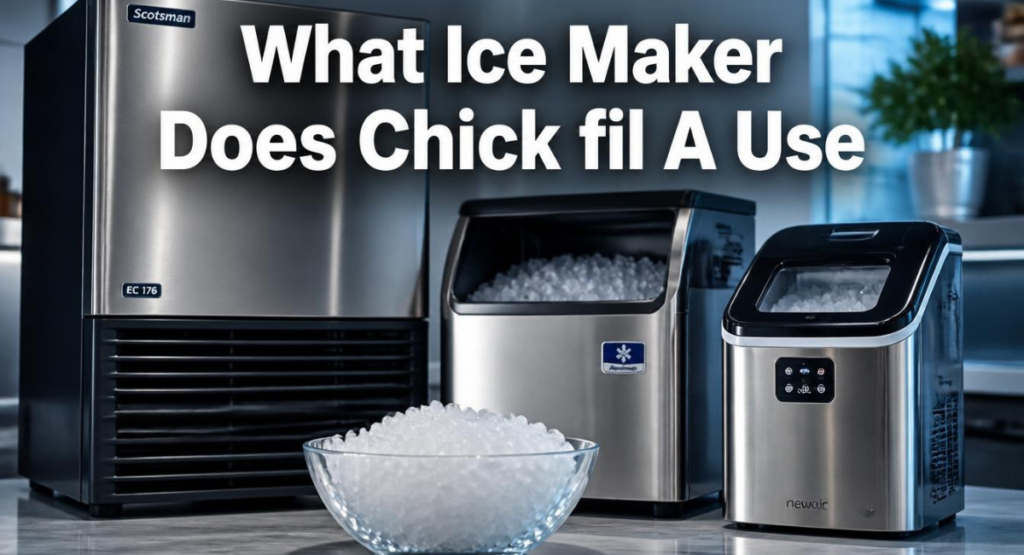
What ice maker does Chick fil A use? Chick-fil-A relies on commercial-grade nugget ice machines — a category of refrigeration equipment made by brands like Follett and Scotsman — not the countertop unit sitting in most kitchens. That’s the short answer. The longer, more useful answer is what makes that ice so different, whether you can actually buy the same machine, and which home models get closest without the four-figure price tag or the commercial-grade footprint.
Table of Contents
1. So What Exactly Is “Chick-fil-A Ice”?
“Chick-fil-A ice” isn’t its own separate product — it’s the popular nickname for what the foodservice industry calls nugget ice, a specific form of manufactured ice also known as pellet ice, chewblet ice, or cubelet ice. Sonic uses the same style of ice too, which is why you’ll often see people asking whether Sonic ice and Chick-fil-A ice come from the same kind of machine. They do: both chains run commercial nugget ice equipment, even if the exact make and model isn’t identical store to store or publicly confirmed by either brand.
The texture is the whole appeal, and it’s the real reason so many people ask what ice maker does Chick fil A use in the first place. Instead of a solid, hard cube, nugget ice is made of compressed ice flakes formed into small, soft, chewable pellets. That’s why it soaks up flavor, cools drinks fast, and doesn’t put your molars at risk the way biting a hard cube does.
2. The Machine Behind the Ice: How Nugget Ice Is Actually Made
A real commercial nugget ice machine works nothing like the ice maker in your freezer door. Instead of metal prongs dipping into a water tray to form hollow “bullet” ice, a genuine nugget machine uses a vertical evaporator — a core part of any refrigeration cycle — and a stainless steel auger that scrapes ice flakes off a frozen cylinder and compresses them through a small opening. That mechanical compression step is exactly why nugget machines cost more to build — and why cheap knockoffs marketed as “nugget ice makers” often just produce wet, clumpy crushed ice instead.
This is also the piece most articles gloss over: a fast-food chain running thousands of drinks a day needs a machine built for continuous, high-volume production — the commercial nugget category is a completely different tier of equipment from anything sold as a home appliance, closer in scale to what a hospital or hotel bar would install than what fits on a kitchen counter.
3. Can You Buy the Exact Machine Chick-fil-A Uses?
Technically, yes — but probably not the way you’re picturing. Commercial nugget ice machines from brands associated with this style of ice are sold to foodservice operators, not through consumer retail channels, and they’re priced and sized for restaurant use: think large-capacity heads paired with a separate ice bin, built for a kitchen, not a kitchen counter. If your interest is a working replica for your own home, the practical path is a residential nugget ice maker, and there are genuinely good ones — more on that below.
If your interest instead runs toward “can you buy Chick-fil-A ice” directly rather than the machine — some locations do sell bagged ice to-go, but availability varies by store and isn’t guaranteed chain-wide, so calling ahead to your local restaurant is the only reliable way to check before making a special trip.
4. Nugget Ice vs. Pebble Ice vs. Regular Cubes
These terms get mixed up constantly, so here’s the practical difference:
- Nugget / pellet / chewblet ice: Soft, compressed, chewable — the Chick-fil-A style. Melts faster than cube ice because of its high surface area, which also means faster flavor absorption.
- Pebble ice (sometimes called “sonic ice” colloquially): Very similar in texture to nugget ice and often used interchangeably in casual conversation, though pebble ice tends to be slightly larger and less compressed.
- Regular cube or half-cube ice: Hard, dense, melts slowly. The standard for spirits and cocktail bars where dilution needs to stay slow.
If you’re weighing which type fits your own setup — a home bar, an office break room, a small café counter — it usually comes down to whether you want ice that melts into the drink (nugget) or ice that just keeps the drink cold without watering it down (cube).
5. Best Home Nugget Ice Makers That Get You Close
None of these are literally the machine running behind the counter at your local Chick-fil-A, but they use the same auger-compression principle to produce a genuinely similar chewable texture at home:
| Model | Daily Output | Best For |
|---|---|---|
| GE Profile Opal 2.0 | ~24–34 lbs/day | Countertop use, side tank option for less frequent refills |
| Scotsman Brilliance SCN60 | Up to 80 lbs/day | Under-counter install, built-in control panel, higher output |
| Compact countertop nugget makers (Euhomy and similar) | 26–44 lbs/day (often less in a warm kitchen) | Budget-friendly, portable, good for smaller households |
Worth knowing before you buy: rated output on the box assumes ideal lab conditions — a cool room and chilled water. In a normal kitchen, expect meaningfully less than the advertised number, especially on the cheaper countertop units. We’ve tested a few of these directly, including a close look at a compact nugget ice maker that’s a common pick for anyone chasing this exact texture at home, so it’s worth reading a hands-on review rather than shopping off the spec sheet alone.
6. What Does Chick-fil-A Ice Actually Cost?
If you’re asking about “chick-fil-a ice price” for a bag rather than a machine: pricing for bagged ice, where offered, tends to be a low, incidental menu add-on rather than a dedicated retail product, and — again — it’s not something every location stocks or advertises. A home nugget ice maker, by contrast, is a one-time purchase in roughly the $150–$500 range depending on output and build quality, which pays for itself quickly if you’re a regular ice-in-every-drink household.
7. Maintenance Nobody Mentions
Nugget ice machines — home or commercial — are more failure-prone than standard ice makers if neglected, because the auger system has nowhere for mineral scale to hide. Commercial units also need to meet NSF sanitary equipment standards since the ice is a direct food safety concern, which is one more reason a genuine commercial machine isn’t something you can casually pick up for a house. A few practical rules for a home unit:
- Use filtered or distilled water where possible; hard water is the single biggest cause of auger seizure and premature failure, which is why a basic inline water filter is worth the small ongoing cost.
- Run the self-cleaning cycle on schedule, not just when the ice starts tasting off — mold growth inside the auger housing is a known issue with this ice type.
- Check the drain plug location before you buy if counter space is tight; some models require pulling the whole unit away from the wall for a deep clean.
If clarity and drink presentation matter as much as texture to you — say, for a home cocktail setup — it’s also worth reading up on how to make clear ice at home, since nugget ice and clear ice solve two very different problems and most people only need one of them.
Frequently Asked Questions
Does Sonic use the same machine as Chick fil A?
Both chains serve the same general style of ice — commercial nugget ice — though the exact brand and model of machine isn’t publicly confirmed by either company and can vary by location. Functionally, the ice you get at Sonic and at Chick-fil-A is the same texture and production method.
Can I buy a Follett ice maker for my house?
Follett and similar commercial nugget ice equipment is built and priced for foodservice operations, not typical home kitchens — both in physical size and cost. For home use, a residential nugget ice maker like the GE Profile Opal or a compact countertop model is the realistic option.
What is the difference between nugget ice and pebble ice?
They’re closely related and often used as interchangeable terms, but nugget ice is generally more tightly compressed and softer, while pebble ice tends to be slightly larger and a bit firmer. Both melt faster than standard cube ice.
Does Chick fil A sell bags of ice?
Some locations do sell bagged ice, but this isn’t a guaranteed, chain-wide offering — availability depends on the individual store, so it’s worth calling ahead before counting on it.
What is Chick fil A ice called?
It’s most commonly called nugget ice, though you’ll also see it referred to as pellet ice, chewblet ice, or cubelet ice — all names for the same soft, chewable, compressed-ice texture.
The Bottom Line
If you came here wanting the short version of what ice maker Chick-fil-A uses: it’s commercial nugget ice equipment, built for the continuous, high-volume demands of a quick-service restaurant, not anything you’ll find sitting on a store shelf next to a regular ice maker. If your actual goal is recreating that chewable texture at home, a residential nugget ice maker gets you 90% of the way there for a fraction of the cost and footprint. For a closer look at specific models worth considering, our ice maker reviews cover real, hands-on testing, and if you have a specific setup in mind, feel free to reach out through our contact page or browse more buying guides on the blog.