By Waseem Khan | IceMakerReviews.com | Updated: June 2026 | ⏱ Reading Time: ~8 minutes
Introduction
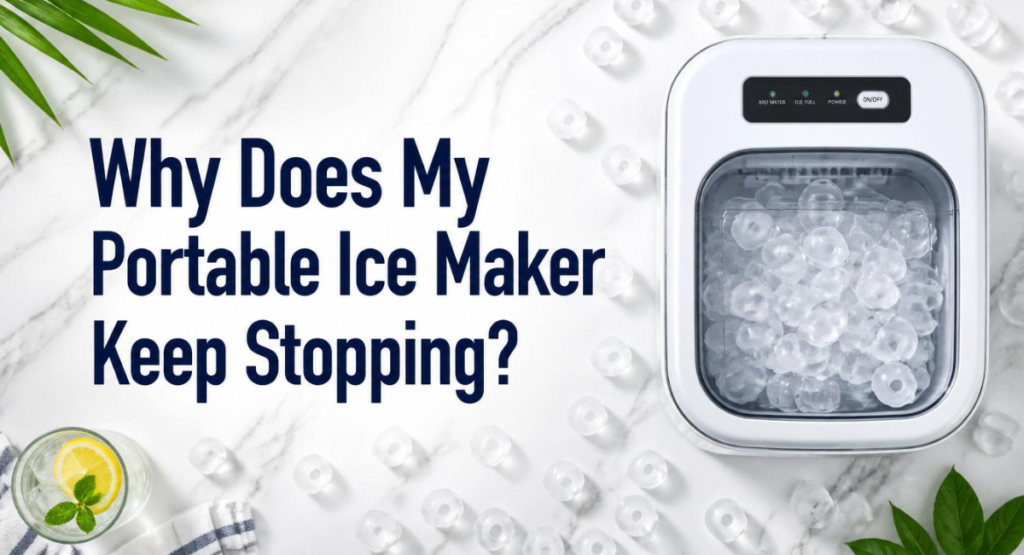
You press the power button. You hear it start up. The machine hums for a minute or two — and then… it just stops. No ice. No explanation. Just silence.
If your portable ice maker keeps stopping after a few minutes, you are not alone. This is one of the most common complaints we see from readers here at IceMakerReviews.com — and the good news is, it is almost always fixable.
In this guide, I will show you exactly why does my portable ice maker keep stopping after a few minutes, what is happening inside your machine, and how to fix it fast. No fluff, no guesswork — just real answers from someone who has tested and reviewed dozens of ice makers.
Let’s get your ice maker back to doing its one job: making ice.
Table of Contents
Why Does a Portable Ice Maker Stop Mid-Cycle? — The Short Answer
Portable ice makers stop mid-cycle for one of a handful of reasons: the water is too low, the ice bin is full, the machine is overheating, a sensor is dirty, or there is an internal fault. Most of the time it is something you can fix in under 10 minutes — no tools required.
The tricky part is figuring out which one you are dealing with. That is what this guide is for.
7 Reasons Your Portable Ice Maker Keeps Stopping After a Few Minutes
1. The Water Reservoir Is Empty or Too Low
This is the number one reason portable ice makers stop — and it is also the easiest to fix. Every portable ice maker has a minimum water level requirement. If the water drops below that line, the machine automatically shuts off to protect itself from running dry.
This built-in safety feature is actually a good thing. Running the pump without water can burn it out permanently. So the machine stops itself before any damage happens.
How to Fix It: Open the lid and check the water level. If it is low, refill it with clean, cold water up to the MAX fill line — not over it. Then press the power button to restart the cycle. The machine should begin making ice within 6–15 minutes.
💡 Pro Tip: Use filtered or bottled water if your tap water is very hard. Hard water causes mineral buildup faster, which leads to more stoppages over time.
2. The Ice Basket Is Full — Sensor Triggered
Portable ice makers are smart enough to know when the ice bin is full. There is a small infrared sensor (sometimes called the ice-full sensor) that detects when ice has piled up to a certain level. When it senses a full basket, it pauses production.
This is by design — it is not a malfunction. But the sensor can also trigger falsely if it is dirty, misaligned, or if a single large piece of ice is blocking it.
How to Fix It: First, check if the bin is actually full. If yes, empty some ice and restart. If the bin is not full, look for the small sensor window (usually two small plastic eyes on the inside wall of the machine). Clean it gently with a damp cloth or cotton swab and restart.
For more help with sensor-related slowdowns, check out our guide on why your ice maker is running slow — it covers sensor troubleshooting in detail.
3. The Machine Is Overheating
Portable ice makers generate heat as they work. They have a small compressor and a condenser, just like a mini refrigerator, and those parts need airflow to stay cool. If the machine is in a hot room, in direct sunlight, pushed against a wall, or in an enclosed cabinet, it will overheat — and shut itself down as a protection measure.
How to Fix It: Move the machine somewhere cooler with at least 5–6 inches of clearance on all sides. Let it rest for 20–30 minutes to cool down completely before restarting. Avoid placing it in direct sunlight or near a stove.
💡 Pro Tip: The ideal operating temperature for most portable ice makers is between 50°F and 90°F (10°C to 32°C). In very hot kitchens or garages in summer, performance will always suffer.
4. Mineral Buildup Is Blocking the Water System
Over time, especially if you use tap water, calcium and magnesium minerals deposit inside your ice maker’s tubes, pump, and water sensor. This buildup — called scale or limescale — can partially or fully block water flow, causing the machine to stop mid-cycle because it is not getting enough water to complete a batch.
This is a very common issue in areas with hard water. If you have never descaled your machine, there is a good chance this is your problem.
How to Fix It: Run a descaling cycle using a 1:1 mixture of white vinegar and water. Fill the reservoir, let the machine run until it cycles through, then drain and run two full cycles with clean water to rinse. Do this every 1–3 months depending on your water hardness.
Want step-by-step cleaning instructions? Visit our ice maker maintenance blog for a full walkthrough.
5. The Machine Needs a Reset
Sometimes portable ice makers just glitch. A minor software or sensor error can put the machine into a confused state where it stops mid-cycle for no obvious reason. This happens more often with budget models, but even higher-end machines can have the occasional hiccup.
How to Fix It: Unplug the machine completely from the wall. Wait a full 5 minutes — not just 30 seconds. Then plug it back in, add fresh water, and restart. This hard reset clears any error state and forces the machine to start a fresh cycle from scratch.
💡 Pro Tip: If resetting fixes it temporarily but the problem comes back every few days, you likely have an underlying issue from another cause in this list. Keep reading.
6. A Faulty or Clogged Water Pump
The water pump is the heart of your portable ice maker. It pushes water from the reservoir up to the ice tray. If the pump is clogged with mineral scale, or if it is beginning to fail, the machine may start a cycle, fail to move enough water, and then stop itself.
You can often tell if the pump is struggling because you will hear the machine start up, then go quiet earlier than expected, or you might hear a faint buzzing or clicking sound.
How to Fix It: A thorough descaling cycle (as described above) often clears a clogged pump. If the pump is mechanically failing, it may need to be replaced. For machines under $80, replacement parts often cost nearly as much as a new machine — worth keeping in mind.
Not sure if your machine is worth repairing? Check our best portable ice makers review guide to compare replacement options.
7. Power Supply or Outlet Issues
This one gets overlooked constantly. Portable ice makers draw a consistent level of power throughout their cycle. If the outlet has a loose connection, if the machine is on a power strip that is overloaded, or if there is a voltage fluctuation in your home, the machine can lose power mid-cycle and stop.
How to Fix It: Plug the ice maker directly into a dedicated wall outlet — not a power strip or extension cord. Test a different outlet if possible. Check that the power cord is not loose at the back of the machine. If you are using the machine on a boat, RV, or with a generator, make sure the power supply is stable and rated for the machine’s wattage.
Using your ice maker off-grid? See our tested picks in Best Ice Maker for Van Life 2026 — all chosen for stable performance in mobile setups.
How Long Should a Portable Ice Maker Run Before Making Ice?
A healthy portable ice maker should complete its first batch of ice in about 6 to 15 minutes after startup. Each batch after that takes roughly the same amount of time, depending on the size setting you choose.
If your machine is stopping before that window — say, after 1 or 2 minutes — that points strongly toward a sensor issue, overheating, or a water problem. If it stops right at the end of a cycle, it may just be the ice-full sensor doing its job correctly.
How to Prevent Your Portable Ice Maker From Stopping Repeatedly
The best fix is prevention. Here is a simple maintenance routine that will keep your machine running smoothly:
- Clean the machine every 2–4 weeks with a vinegar-water solution
- Use filtered or bottled water whenever possible
- Never overfill the water reservoir past the MAX line
- Give the machine 5–6 inches of clearance on all sides for airflow
- Empty the ice basket regularly — do not let it sit full for hours
- Drain and dry the machine completely if storing it for more than a week
- Wipe down the ice sensor window monthly with a damp cloth
When Should You Replace Instead of Fix?
Sometimes a portable ice maker is beyond saving. Here are the signs that repair is not worth it:
- The machine stops every single cycle even after cleaning, resetting, and checking all sensors
- You hear grinding, loud clicking, or screeching from the compressor
- The machine is more than 3–4 years old and has had repeated issues
- Water is leaking from the bottom of the unit
- The cost of repair parts exceeds 50% of a new machine’s price
If you are in the market for a reliable replacement, we have done the hard work for you:
- → Best Portable Ice Makers of 2026 — Full Reviews
- → Best Ice Maker for Van Life (Off-Grid Tested)
- → Kismile Nugget Ice Maker Review 2026
- → Igloo Handled Portable Ice Maker Review 2026
- → Samsung Ice Maker Making Noise? Here’s the Fix
External Resources & Further Reading
These trusted sources provide additional technical context:
- JustAnswer Appliance Expert: Ice Maker Keeps Shutting Off — Real Technician Q&A
- Kismile Official Blog: Why Is My Portable Ice Maker Not Working?
- Euhomy: Home Ice Maker Troubleshooting Guide
- Airlogix: My Ice Maker Stopped Working — Here’s What You Can Do
Frequently Asked Questions (FAQ)
Why does my portable ice maker stop after making just one batch?
This is almost always the ice-full sensor triggering. Either the basket is genuinely full, or the sensor is dirty and detecting falsely. Empty the basket, clean the sensor window, and restart.
Can I leave my portable ice maker running overnight?
Yes, most portable ice makers are designed to run continuously. When the basket fills up, they pause automatically. When ice melts back into the reservoir, they restart. However, if yours keeps stopping abnormally overnight, check for overheating or a sensor issue first.
My ice maker stops and shows an error light — what does that mean?
Consult your user manual for the specific error code. In general: a red or blinking light usually means the water is too low or the ice bin is full. A solid light with no ice points to a sensor or pump issue. Try a full hard reset first.
Does water temperature affect how often the ice maker stops?
Yes. Using very warm water makes the compressor work harder and can trigger overheating-related stops. Always use cold or room-temperature water for best results.
How often should I descale my portable ice maker?
Every 1–3 months if you use tap water, or every 3–6 months if you use filtered water. If you notice your cycles getting slower or the machine stopping more frequently, descale it immediately regardless of schedule.
Final Thoughts: Don’t Put Up With a Stopping Ice Maker
A portable ice maker that keeps stopping after a few minutes is frustrating — but in most cases, it is a simple fix. Work through this checklist from top to bottom:
- Check and refill the water level
- Empty and clean the ice sensor
- Move the machine somewhere cooler with better airflow
- Descale with a vinegar and water solution
- Do a full hard reset (unplug for 5 minutes)
- Check your power outlet — plug directly into the wall
If none of those work, your machine may have a failing pump or compressor — and at that point, replacement is usually the smarter investment.
We test and review ice makers so you do not have to guess. If you need a reliable machine that actually works, head over to our full reviews section:
→ Browse All Ice Maker Reviews at IceMakerReviews.com
Was this guide helpful? If your ice maker is still giving you trouble after trying these fixes, drop your question in the comments below. We read every single one and will help you figure it out.
About the Author
Waseem Khan is the founder of IceMakerReviews.com. He has tested and reviewed dozens of portable, countertop, and undercounter ice makers. His goal is simple: help you find the right ice machine without wasting money on the wrong one.