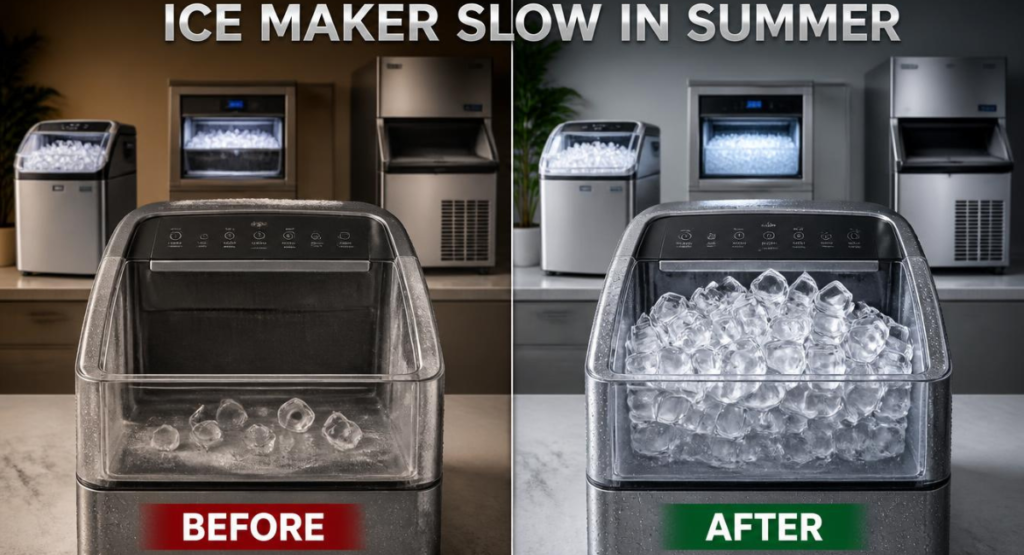
If your ice maker feels like it can’t keep up once summer hits, you’re not imagining it. This is one of the most common complaints every year between June and August, and it happens across every type of unit — fridge ice makers, portable countertop machines, and full commercial ice machines alike, as iFiX’s own summer ice maker checks also confirm. Most of the time, nothing is actually broken. Your machine is just fighting harder conditions while being asked to do more work, and once you understand what’s really going on underneath the hood — something we also cover from a different angle in our guide on ice makers that run water but don’t make ice — the whole thing makes a lot more sense.
This guide goes deep into the mechanics, the maintenance side, and the differences between appliance types, so you’ll walk away actually understanding your machine instead of just guessing.
Table of Contents
The Short Answer First
An ice maker slows down in summer because of a combination of factors working together: hotter surrounding air, warmer incoming water, higher humidity, heavier day-to-day use, and — in some cases — mineral buildup or reduced airflow that was already borderline before summer even started. None of these mean the unit is broken. They mean it’s operating at the edge of its designed cooling capacity instead of comfortably within it.
Several Things Are Happening at Once
It helps to picture summer as pressure from two directions simultaneously. On one side, the machine’s actual ice production rate drops because of heat, humidity, and water temperature. On the other side, demand goes up — more guests, more drinks, more scooping, more freezer door openings. When output drops and demand rises at the same time, the gap between “ice you want” and “ice you have” feels far bigger than either factor alone would explain.
Before assuming something’s wrong, it’s worth asking: has actual production dropped, or are you simply burning through ice faster than the unit was ever designed to replace it? Both happen constantly in summer, and they call for very different responses.
Understanding the Freeze-and-Harvest Cycle
To really understand why heat matters so much, it helps to know roughly how an ice maker works. Nearly every ice machine — countertop, built-in, or commercial — runs on a freeze-and-harvest cycle. Water sits against a cold evaporator plate or mold, the compressor pulls heat out of that water until it freezes into cubes, nuggets, or flakes, and then the machine briefly reverses or releases the ice so it can drop into the bin. Then the cycle starts over.
Every part of that cycle depends on the machine’s ability to move heat away efficiently — first out of the water, then out of the machine itself and into the surrounding air. When the air is already hot, or the water going in is already warm, or the machine can’t vent efficiently, every single stage of that freeze-and-harvest cycle takes longer. Multiply that delay across dozens of cycles a day, and a machine that made a batch every 10 minutes in spring might need 15–20 minutes per batch in August.
Why Hot Air Slows the Compressor Down
The compressor and condenser are the parts doing the actual heat-moving work, and they rely entirely on dumping heat into the surrounding air. Pushing heat into 90°F air is a lot harder than pushing it into 65°F air — it’s basic thermodynamics, not a flaw in your machine.
This is why placement and airflow matter so much more in summer than in winter. A unit tucked into a tight cabinet, a garage with no cross-breeze, or a room without air conditioning is working against itself. Manufacturers usually specify a minimum ambient operating temperature and clearance distance for exactly this reason — ignore either one, and cooling capacity drops noticeably once real summer heat arrives.
Why Incoming Water Temperature Matters Just as Much
Air gets all the attention, but the water feeding into the machine matters just as much, and it’s the part almost nobody checks.
Ice production is only mildly affected when incoming water sits between roughly 55–70°F. Once that water climbs into the 80s or higher, the machine has to remove significantly more heat just to bring it down to freezing before ice can even start forming — an extra step that adds real time to every cycle.
Common reasons incoming water runs hot in summer:
- Water lines routed through a hot attic, garage, or exterior wall
- Lines positioned near a stove, water heater, or furnace closet
- Homes in hot climates where even indoor plumbing absorbs ambient heat through the walls
- Long exposed hose runs on portable outdoor setups, like a countertop unit near a patio or grill area
If your machine seems slow even when the room itself feels reasonably comfortable, warm incoming water is worth checking before assuming a mechanical fault.
The Humidity Factor Almost Nobody Talks About
Ambient air temperature isn’t the only atmospheric factor at play — humidity matters too, especially for drainless or self-evaporating portable units. These machines rely on small evaporation trays or airflow channels to get rid of excess water instead of a physical drain line. In a humid summer kitchen, that evaporation process slows down significantly, because humid air simply can’t absorb as much additional moisture as dry air can.
The result is a system that was already working close to its limit in mild conditions, now pushed past it in a hot, humid month. This doesn’t always show up as slower ice — sometimes it shows up as a full reservoir, a faint odor, or the unit shutting off early. If your portable ice maker is drainless, keeping it in a well-ventilated, lower-humidity spot makes a real difference in summer specifically.
Hard Water and Mineral Scale Make Everything Worse
Heat and humidity aren’t the only seasonal stress. If you have hard water, mineral scale can build up on the evaporator plate and in the internal water path over time. That thin layer of scale acts like insulation — it slows down how quickly the evaporator can pull heat out of the water, which means longer freeze times even before you factor in summer heat.
This is why a machine that ran fine on the same hard water supply in cooler months can suddenly seem to struggle in summer: the existing scale buildup and the added heat load compound each other. A periodic descaling cycle, using a filtered water source, or simply staying on top of routine cleaning can meaningfully offset this effect.
Is It Actually Broken, or Just Working Harder?
Likely just normal summer strain if:
- The bin slowly catches up overnight when nobody’s using ice
- Cubes still look normal in size, shape, and clarity
- The unit or freezer still feels appropriately cold to the touch
- Production has slowed, but hasn’t stopped
Worth a closer look if:
- The bin barely refills even after several hours of no use
- Cubes are noticeably smaller, thin, hollow, or oddly shaped
- Production has stopped completely rather than just slowed
- You’re noticing soft freezer food, warm spots, unusual noise, or a strange smell
If your symptoms match that second list, something more specific than seasonal strain is likely going on. A few of the most common causes are already covered in detail on this site: if water is running but no ice is forming at all, that’s walked through step-by-step in our guide on ice makers that run water but don’t make ice. If the machine is throwing an actual error code instead of just slowing down, our ice maker error code guide covers GE, Frigidaire, Whirlpool, and Samsung units specifically. And if only one side of a dual ice maker setup seems to be working, that’s a distinct issue explained in why an ice maker only makes ice on one side.
How Summer Slowdown Looks Different by Appliance Type
| Appliance Type | Main Summer Weakness | What Helps Most |
|---|---|---|
| Built-in fridge ice maker | Frequent freezer door openings letting in warm air | Minimize openings during peak production hours, keep the door sealing tightly |
| Portable countertop ice maker | Sits directly in room temperature with little insulation | Move to a cooler, well-ventilated spot; avoid direct sun or enclosed cabinets |
| Drainless/self-evaporating unit | Humidity slows internal evaporation | Improve airflow, reduce ambient humidity where possible |
| Commercial ice machine | Peak demand during the hottest, busiest weeks; back-of-house heat | Ensure proper clearance, schedule maintenance before peak season, consider capacity vs. demand |
For businesses specifically, summer slowdown isn’t just an inconvenience — it can mean real lost revenue during the exact weeks when ice demand (and therefore beverage and food sales) is highest. That’s why commercial operators are usually advised to service and clean machines before peak season rather than waiting for a breakdown mid-summer, when repair techs are also busiest and least available.
Simple Things That Actually Help
- Give the unit more breathing room. More clearance around the machine helps it release heat, especially in a cabinet or tight corner.
- Use the coldest available water source. Cooler incoming water noticeably speeds up early cycles.
- Limit unnecessary door openings on fridge units if you’re trying to build up a reserve before a hot weekend.
- Check and replace your water filter on schedule. A partially clogged filter compounds summer slowdown.
- Set the freezer toward the colder end of its recommended range (typically 0–5°F) specifically during hot months.
- Improve ventilation around portable units, especially drainless models in humid rooms.
- Descale periodically if you have hard water, since mineral buildup insulates the evaporator and slows every cycle.
- For commercial units, schedule maintenance before peak season rather than after symptoms appear.
When It’s More Than Just the Weather
Some slowdown in summer is completely normal. A sudden, dramatic drop, total stoppage, or unusual noise usually points to something mechanical rather than seasonal. If that’s what you’re seeing, it’s worth digging into the specific symptom rather than waiting it out — browse our full ice maker guides or check our reviews section if you’re weighing whether it’s time to upgrade to a unit better suited to heavy summer use, like the picks in our budget nugget ice maker roundup or, for higher-volume needs, our Hoshizaki commercial ice maker guide.
If a machine is heading into off-season storage rather than more summer use, our step-by-step guide to emptying an ice maker before storage is worth bookmarking for when the weather turns.
FAQ
Is it normal for an ice maker to slow down in summer?
Yes. A moderate drop in output is expected and doesn’t necessarily mean anything is wrong — it’s usually driven by hotter air, warmer incoming water, and heavier use happening together.
How much does water temperature actually matter?
Quite a bit. Production is only mildly affected between about 55–70°F, but once incoming water climbs into the 80s or higher, freezing time increases noticeably.
Does humidity affect ice makers, not just heat?
Yes, particularly for drainless or self-evaporating portable units, which rely on evaporation to clear excess water. Humid air slows that process down, which can affect performance even when the room doesn’t feel especially hot.
Can hard water make summer slowdown worse?
Yes. Mineral scale on the evaporator acts as insulation, slowing heat transfer. Combined with summer heat, this compounds into a bigger slowdown than either factor alone would cause.
Does opening the freezer door really make a difference?
Yes, especially for built-in fridge ice makers. Every opening lets warm air in, and the compressor has to re-cool the space before production resumes normally.
How can I tell if it’s just summer or an actual problem?
If the bin slowly catches up overnight and cubes still look normal, it’s likely seasonal strain. If production has stopped completely, cubes are small or hollow, or you’re noticing other cooling issues, it’s worth investigating further.
Should commercial ice machines be serviced differently for summer?
Yes. Because summer combines the highest heat load with the highest demand, many operators schedule cleaning and maintenance before peak season rather than waiting for a breakdown during the busiest weeks.
Final Thoughts
A slower ice maker in July usually isn’t a sign of a broken machine — it’s the combined effect of hotter air, warmer incoming water, higher humidity, mineral buildup, and heavier use all happening at once. Understanding each piece individually makes it much easier to separate normal seasonal strain from a real problem worth troubleshooting, and to know exactly which adjustment will actually help your specific setup.
For more detailed guides on diagnosing specific ice maker issues, visit our blog, learn more about who’s behind these guides on our about page, or contact us directly with a question we haven’t covered yet.