It’s 8:40 on a Friday night. Every table is full, the bar is three deep, and your ice bin is scraping bottom. Someone’s already texted the manager: “we’re low.” That single moment — running out of ice at the exact second you need it most — is the whole reason this guide exists. We’ve spent a lot of time testing everything from tiny countertop units to full commercial-grade ice machines, and sizing questions come up more than almost anything else.
Sizing a commercial ice maker for your restaurant — the exact question behind ‘what size commercial ice maker do I need for restaurant’ — is a category of refrigeration equipment built specifically for the foodservice industry and it isn’t really about the lbs/day number printed on a spec sheet. It’s about matching a machine to your actual Friday night, not your average Tuesday afternoon. Undersize it and you’re bagging ice from the gas station mid-shift. Oversize it and you’re paying for capacity — and electricity — you’ll never touch. Below is the real math, seat by seat, plus the parts nobody else mentions: what happens when the machine breaks, what it costs to actually run, and how to build in a buffer without overpaying
Table of Contents
The Short Answer First
For a full-service restaurant, the industry rule of thumb is 1.5 lbs of ice per seat, per day, covering combined lunch and dinner service. A 100-seat restaurant needs roughly 150 lbs/day of production before you add anything for a seafood display, a bar, or banquet overflow. Add a 20% buffer for peak nights, and you land in the 180–200 lbs/day range — which usually points toward a 200–400 lbs/day undercounter or modular ice machine.
That’s the headline number. But “how much ice per person in a restaurant” actually shifts a lot by concept, and the rule of thumb falls apart fast for a bar, a hospital, or a quick-service drive-thru. Here’s how to land on your actual number instead of guessing.
Step 1: Work Out Your Real Ice Demand (Not the Average)
Most guides stop at “1.5 lbs per seat” and move on. That’s a fine starting point, but it assumes a fairly average dining pattern — sit-down service, moderate refills, no ice-heavy specialty program. Your restaurant probably isn’t average in at least one of these ways. Walk through these four questions before you even open a spec sheet:
1. What’s your seat count and turn rate?
A 60-seat restaurant that turns tables three times on a Saturday effectively serves 180 covers that night, not 60. Base your number on your busiest realistic night, not your daily average — that’s the entire point of sizing for peak instead of for a quiet Tuesday lunch.
2. What’s your drink mix?
Water and soda glasses use roughly half a pound of ice per refill; cocktails and iced tea run heavier, especially in a bar-forward concept. A restaurant with a strong cocktail program should budget closer to 2–3 lbs per seat, not 1.5 — that’s the exact gap between a plain dining-room estimate and what a genuinely busy bar burns through in ice each night.
3. Do you run a food display?
Seafood cases, salad bars, and raw bars need flake ice on top of beverage ice, budgeted at roughly 35 lbs per cubic foot of display case per day. This is the single most common reason restaurants undersize their machine: they size for drinks and forget the display case entirely.
4. Do you cater or host private events?
If catering or event ice draws from the same machine as daily service, your storage bin — not just your production rate — becomes the real bottleneck. More on that shortly.
Ice Usage Benchmarks by Business Type
Here’s a fuller breakdown than the generic “1.5 lbs per seat” line repeated everywhere. Use whichever row matches your concept, and stack rows if you run a hybrid — a hotel restaurant, for instance, needs both the hotel row and the restaurant row added together:
| Business Type | Ice Needed | Notes |
|---|---|---|
| Full-Service Restaurant | 1.5 lbs / seat / day | Combined lunch & dinner; add display case ice separately |
| Bar / Cocktail Lounge | 2–3 lbs / seat / day | Higher with a heavy nugget or crushed-ice cocktail program |
| Fast-Casual / Quick Service | 5–7 oz per fountain cup, plus drive-thru volume | High-volume drive-thrus can push past 500 lbs/day alone |
| Hotel (Rooms + Dining) | 5 lbs per occupied room / day | Budget separate capacity for the restaurant and bar |
| Healthcare / Hospital | 10 lbs per bed / day | Nugget or flake ice; NSF/ANSI standards apply |
| Café / Coffee Shop | 1–2 lbs per customer served / day | A compact low-maintenance countertop unit is often enough at this volume |
| Seafood / Grocery Display | 35 lbs per cubic foot of display / day | Flake ice is standard here — melts fast, keeps product cold |
Notice the gap between a coffee shop and a hospital ward — roughly a 5x difference per “unit served.” That’s exactly why a one-size-fits-all sizing chart gets so many restaurants into trouble.
Step 2: Do the Napkin Math
Here’s the actual calculation worked through with real numbers, instead of handing you a formula and moving on:
Example: a 120-seat full-service restaurant with a modest bar, no food display.
- Base need: 120 seats × 1.5 lbs = 180 lbs/day
- Bar adjustment: bump 20 of those seats to the bar rate (2.5 lbs instead of 1.5) → add 20 lbs
- Peak buffer: add 20% for a busy Friday or holiday weekend → (180 + 20) × 1.2 = 240 lbs/day
- Real-world derating: commercial ice machines are rated at 70°F ambient air and 50°F water — the AHRI standard test condition, which mirrors how a condenser is tested in a controlled lab, not a working kitchen. A hot kitchen running at 85–90°F produces 10–20% less than the spec sheet promises. Divide your target by 0.85: 240 ÷ 0.85 ≈ 280 lbs/day rated capacity.
That last step is the one almost every buyer skips — and it’s exactly why a “250 lbs/day” machine can leave you short even when your math said 240 was enough. Always shop for the rated spec one tier above your calculated real-world need.
Step 3: Size the Storage Bin Separately from Production
Production capacity and storage capacity are two different numbers, and mixing them up is a close second on the list of common mistakes. Rule of thumb: size the bin to hold 75–80% of a full day’s production. A machine producing 280 lbs/day pairs well with a 210–225 lb bin.
Exception: if you host events or banquets where ice needs to build up hours ahead of a single peak — a Saturday wedding reception, a big game-day crowd — size the bin at 1.5× daily production instead, so ice has time to accumulate before the rush hits.
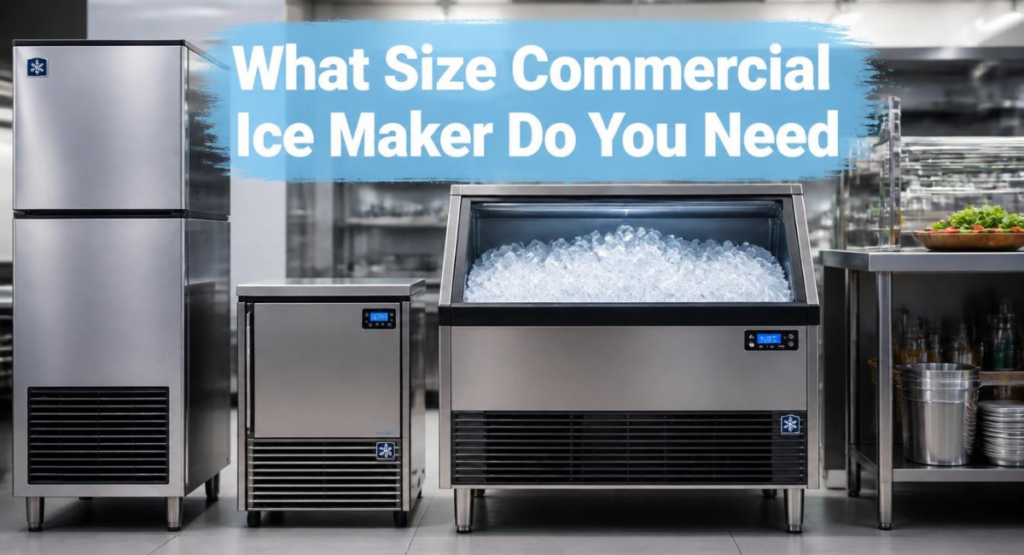
Types of Commercial Ice Machines — Which Form Factor Fits Your Kitchen
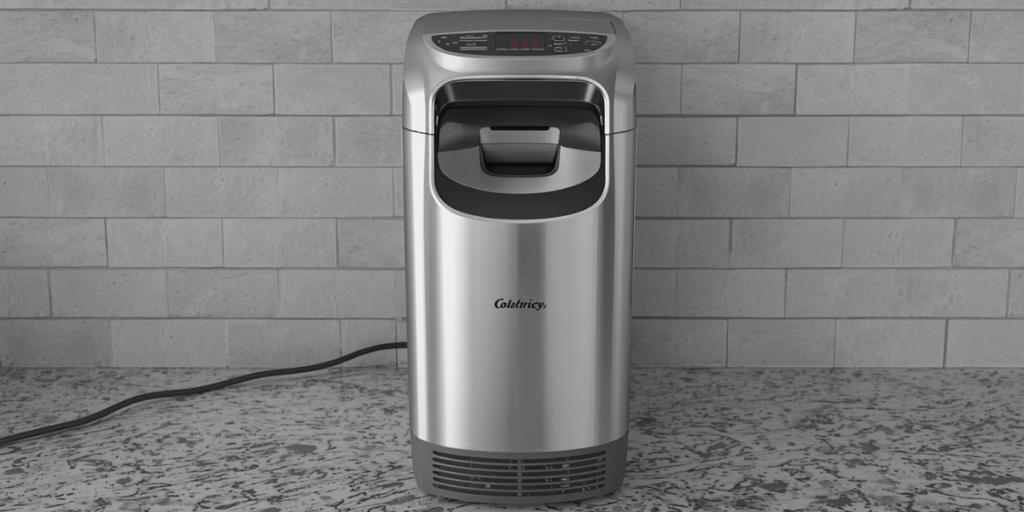
Once you know your target lbs/day, the next decision is form factor. This is where “types of commercial ice machines” questions usually land, so here’s the full lineup — worth comparing against a smaller, app-controlled countertop machine if you’re only stocking a small satellite bar or break room rather than a full kitchen:
| Type | Daily Output | Best For |
|---|---|---|
| Modular / Head Unit | 200–1,900+ lbs | Large restaurants, hotels, banquet halls — pairs with a separate bin |
| Self-Contained | Up to 200 lbs | Cafés, food trucks, small bars — head + bin in one cabinet |
| Undercounter | 28–350 lbs | Bars and restaurant service stations near point of use |
| Countertop | Up to 400 lbs | Hotel lobbies, cafeterias, self-serve areas |
| Portable | 28–35 lbs | Catering, pop-ups, temporary outdoor events |
For most full-service restaurants in the 150–400 lbs/day range, the real decision comes down to modular vs. undercounter: modular heads give you room to scale later since you can swap bins without replacing the whole unit, while undercounter units save floor space and sit right at the service station where bartenders actually need the ice.
Air-Cooled vs. Water-Cooled vs. Remote-Cooled
The condenser type affects both your energy bill and how the machine behaves in a hot kitchen — and it matters more than most buying guides let on.
- Air-cooled: The most common and cheapest to run. Needs 6″ of clearance for airflow and struggles a bit above 80°F ambient. Eligible for ENERGY STAR certification.
- Water-cooled: Performs well in hot kitchens but uses 100+ gallons of water per 100 lbs of ice — your water bill will notice.
- Remote-cooled: Condenser sits outside or in a mechanical room. No added heat or noise in the kitchen, but a bigger install cost upfront.
Bottom line: go air-cooled unless your kitchen regularly runs hot, is poorly ventilated, or noise near the machine genuinely bothers guests.
What This Actually Costs to Run (Nobody Talks About This)
Most sizing guides stop at the purchase price. Your real monthly cost has three parts, and skipping any one of them is how restaurants get blindsided by their utility bill:
- Electricity: A 300 lbs/day air-cooled unit typically draws somewhere around 300–600 kWh per month running continuously — call it $40–$90/month at average commercial rates, more in hot climates where the compressor cycles harder.
- Water: Beyond the ice itself, factor in periodic filter replacement (every 6 months) and, if water-cooled, the ongoing water draw for the condenser.
- Cleaning labor: A full clean-and-sanitize cycle every six months — more often in hard-water areas — takes staff time. Budget it into your maintenance schedule instead of letting it become a surprise.
Choosing a model built to the ENERGY STAR commercial ice machine specification can cut 10–15% off that electricity number, and pairing it with a lower-GWP refrigerant — a measure of a substance’s global warming potential — trims your environmental footprint too, an effort the EPA’s Green Power program also tracks at a national level. It adds up meaningfully over a machine’s 7–12 year lifespan.
Planning for the Day It Breaks (The Downtime Nobody Sizes For)
Here’s a scenario most sizing guides skip entirely: your ice maker goes down on a Saturday night. What’s the actual plan? Beyond lost sales, a machine failure that leaves standing water on the kitchen floor is also an OSHA-relevant slip hazard worth flagging to staff immediately.
Running a single machine with zero backup usually means buying bagged ice from a gas station at retail price while service limps along. A few practical safeguards:
- Keep a chest freezer or extra bin on hand as backup storage during a repair window, especially in a bar-forward concept where running dry mid-shift kills sales fast.
- Above roughly 400–500 lbs/day of real need, consider two smaller machines instead of one large one — redundancy beats raw capacity when a single point of failure can shut your bar down.
- Know your local repair turnaround before you need it. A same-day service contract is worth far more than it costs on the one weekend you actually need it.
Ice Type: It’s Not Just About Volume
The kind of ice matters as much as the amount:
- Full cube: Melts slowly, best for spirits on the rocks and upscale cocktail programs — and pairs naturally with a solid clear-ice technique if presentation matters to your bar.
- Half cube: The most versatile, best-selling type — general bar use, soft drinks, blended cocktails.
- Nugget / pellet: Soft and chewable, hugely popular in fast-casual and healthcare settings, though it melts fast and dilutes drinks — not ideal for a premium bar program. If a smaller nugget ice maker is enough for a satellite bar or break room, it’s worth checking one against a full commercial unit before committing.
- Flake: The standard for seafood and produce displays, not for drinks.
NSF Certification and Health Code Basics
Any commercial ice machine sold in the U.S. should carry NSF/ANSI 12 certification, part of the broader NSF food equipment standards portfolio, which governs sanitary design, materials, and construction for equipment that touches ice meant for human consumption — a core part of food safety compliance. Most health departments require it for approval, and inspectors will ask. You can also cross-check a specific model against the ENERGY STAR certified commercial ice machines database before you buy. Pair that with a documented cleaning schedule — a full clean-and-sanitize cycle every six months, more often in hard-water regions — and inspections go smoothly instead of turning into a scramble.
Do You Need a Water Filter?
Yes, almost always. Hard water minerals build up on evaporator plates and can cut production efficiency by up to 30% over time, and unfiltered water shortens a machine’s working life. An inline water filter is a small ongoing cost that protects a much larger investment — skipping it is one of the fastest ways to turn a 10-year machine into a 4-year machine.
FAQs
How many pounds of ice does a restaurant need per seat?
The standard estimate is 1.5 lbs of ice per seat per day for combined lunch and dinner service. Bar-forward concepts should plan closer to 2–3 lbs per seat, and any food display case needs an additional 35 lbs per cubic foot per day, calculated separately from beverage ice.
Do I need a water filter for my commercial ice maker?
Yes. Filtration removes chlorine, sediment, and scale-forming minerals that otherwise reduce ice clarity, cut production efficiency, and shorten the machine’s lifespan — especially in hard-water regions.
What is the most energy efficient commercial ice machine?
Look for ENERGY STAR-certified air-cooled models, which use roughly 10% less energy and 20% less water than standard units. Within that category, models using lower-GWP refrigerants such as R-290 are the most efficient long-term choice.
How do I calculate the right ice maker size for my restaurant?
Start with 1.5 lbs per seat per day, adjust up for bar seating or a heavy drink program, add food display needs separately, apply a 20% peak buffer, then divide by 0.85 to account for real-world kitchen heat reducing rated output. Round up to the next available machine size.
Should I buy one large machine or two smaller ones?
If your operation can’t afford to run dry during a repair — a busy bar, a hotel, a hospital — two smaller machines that together meet your capacity give you redundancy a single large unit can’t. For most single-concept restaurants under 400 lbs/day, one well-sized machine with a service contract is usually the more practical call.
Getting This Right the First Time
Sizing a commercial ice maker for a busy restaurant comes down to one honest question: what does your busiest realistic night actually look like, not your average one? It’s the same logic Forbes Vetted’s testers apply when rating machines for noise and output under real conditions rather than lab specs. Work out your real seat count, drink mix, display case needs, and peak buffer, then round up rather than down, and budget for the electricity and downtime nobody puts on the spec sheet. It’s a small piece of a much bigger hospitality industry puzzle, but it’s the one piece that shuts a bar down fastest when it’s wrong.
If you’d like a second opinion on a specific setup — a new bar build-out, a hotel renovation, a food truck — reach out through our contact page, or take a look at our about page to see how we test and review these machines. For catering or event setups that also need dry ice for displays, our guide on making dry ice safely covers that side of things too, and the rest of our buying guides and reviews live on the blog, including a solid budget-friendly countertop pick for smaller service points.