Introduction
You walk over to your portable ice maker, and instead of fresh ice, you find a pool of standing water sitting at the bottom of the machine. Or maybe the unit is running but the water just never drains — it keeps cycling the same old water over and over until the machine struggles and stops.
Good news: portable ice maker not draining water properly how to fix is one of the most common problems USA homeowners run into — and in nearly every case, you can fix it yourself without calling a technician or buying a new machine.
In this complete guide, we cover every reason your portable ice maker is not draining water correctly, walk you through exact step-by-step fixes for each cause, and give you brand-specific tips for models like Frigidaire, IKICH, Ecozy, Silonn, GE Opal, and more. We also cover topics your competitors completely skip — like how water temperature affects drainage, why mineral buildup is the silent killer of portable ice makers, and what to do when the drain pump itself fails.
💡 Pro Tip: If your machine is brand new and water is not draining, always check the drain plug first — many portable ice makers ship with the drain plug inserted at the factory. It is the most common reason a new unit fails to drain.
Table of Contents
How Drainage Works in a Portable Ice Maker (What Most Guides Skip)
Before you can fix a drainage problem, you need to understand how your portable ice maker actually handles water — because it works very differently from a built-in refrigerator ice maker.
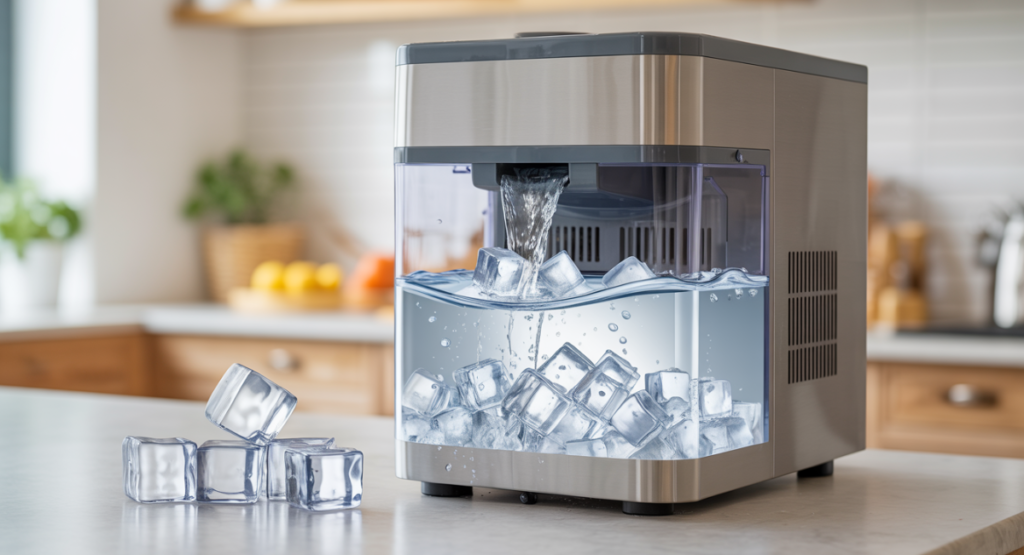
Here is the full cycle: Water sits in the reservoir at the bottom of the unit. A small internal water pump draws water up through a tube and sprays it over metal cooling rods (called evaporator fingers or prongs). The water that does not freeze immediately falls back down into the reservoir and is recirculated. Once the ice forms and reaches the right size, the machine warms the prongs slightly, the ice slides off into the ice basket, and the leftover water drains back into the reservoir.
The key insight here is this: portable ice makers do not have a drain line connected to your plumbing. All the water stays inside the machine. The drain plug at the bottom of the unit is the manual drain — it is how you empty the reservoir when you want to clean the machine or store it. It is NOT an automatic drain in the way a dishwasher or washing machine drains.
So when people say their portable ice maker is not draining water properly, they usually mean one of three things:
⦁ Water is pooling and not being recirculated back through the pump correctly.
⦁ The machine is showing an Add Water error even though the tank is full — meaning water is not reaching the pump intake.
⦁ After pressing the drain button or removing the drain plug, water is not flowing out freely.
Each of these scenarios has a different cause and a different fix. Let us go through all of them.
Quick Reference: Portable Ice Maker Not Draining — Causes and Fixes at a Glance
| Symptom | Most Likely Cause | Fix |
|---|---|---|
| Water sits in reservoir, no ice made | Clogged pump intake or debris blockage | Clean intake hole and reservoir |
| Add Water light despite full tank | Dirty float sensor or clogged water tube | Clean float sensor with vinegar |
| Water not draining when plug removed | Mineral scale blocking drain port | Descale with citric acid solution |
| Machine cycles but water never drains after ice | Drain plug not fully removed or misaligned | Remove plug completely, tilt unit |
| Drain button pressed but water stays | Failed drain pump (nugget/pellet models) | Test and replace drain pump |
| Water drains but leaves residue | Hard water mineral buildup on walls | Full deep clean and descale cycle |
| Standing water under the machine |
Cause 1: Clogged Water Pump Intake — The Most Common Culprit
The number one reason a portable ice maker stops draining and circulating water properly is a blocked water pump intake hole. This is a small opening at the very bottom of the water reservoir — usually about the size of a pencil eraser — through which the pump draws water up to the cooling prongs.
Over time, mineral deposits from tap water, small debris, or even fragments of ice can partially or fully block this hole. When it is blocked, the pump cannot draw water up, ice production stops, and water just sits stagnant in the reservoir. The machine may show an Add Water error even though the tank is clearly full.
How to Fix a Clogged Water Pump Intake
- Unplug the ice maker completely from the wall outlet.
- Open the lid and look inside the reservoir. At the very bottom center or side, locate the small circular intake hole.
- Take a toothpick, a wooden skewer, or a soft-bristle toothbrush and gently clear any visible debris or mineral crust from around the hole.
- Mix a solution of equal parts white vinegar and warm water. Pour it into the reservoir and let it soak for 20 minutes.
- Drain the vinegar solution using the drain plug.
- Refill with clean, fresh water and run one full ice-making cycle.
- Discard that first batch of ice and run a second clean cycle before using the ice.
⚠️ Warning: Never push a sharp metal object into the intake hole — you can damage the pump impeller underneath it. Always use a wooden or plastic tool.
Cause 2: Dirty or Stuck Float Sensor
The float sensor is a small plastic float that sits inside the water reservoir and rises and falls with the water level. It tells the machine whether the reservoir has enough water to run. When mineral deposits coat the float sensor, it can get stuck in the low-water position — making the machine think the tank is empty even when it is completely full.
This is a unique cause that most competitor guides completely ignore — but it is one of the most frustrating problems because the machine appears to have enough water yet refuses to run or drain properly.
Symptoms of a stuck float sensor:
⦁ The Add Water indicator light is on even though the reservoir is filled to the maximum line.
⦁ The machine starts a cycle then immediately stops.
⦁ Water is not being pumped up to the cooling prongs even though the intake is clear.
How to Clean the Float Sensor
- Unplug the unit and drain the reservoir using the drain plug.
- Locate the float sensor — it is a small white or clear plastic piece inside the reservoir, usually attached to a thin rod or wire.
- Dip a cotton swab in undiluted white vinegar.
- Gently scrub the float and the rod it sits on until all mineral crust is removed.
- Move the float up and down manually several times to confirm it slides freely.
- Refill the reservoir and plug the unit back in. The Add Water light should turn off within seconds.
💡 Pro Tip: If cleaning the float sensor does not fix it, the sensor itself may have failed electrically. Replacement float sensors for most portable ice makers cost under $10 online. Search your model number plus ‘water level sensor’ on Amazon or eBay.
Cause 3: Mineral Buildup and Hard Water Scale
This is the silent killer of portable ice makers — and it directly causes drainage problems that get worse over time. In the USA, most tap water contains dissolved calcium and magnesium minerals. Every time your ice maker runs a cycle, a tiny amount of these minerals gets left behind. Over weeks and months, they build up into a hard white or grey crust on the reservoir walls, the drain port, the pump intake, the water tube, and the cooling prongs.
When scale builds up around the drain port opening at the bottom of the unit, it narrows the opening, causing slow drainage that eventually stops completely. When it builds up on the water tube, flow is restricted. When it coats the cooling prongs, ice formation becomes irregular and incomplete.
How to tell if hard water scale is your problem:
⦁ You see white, chalky deposits on the inside walls of the reservoir.
⦁ Water drains slowly — taking 5 or more minutes to empty a full reservoir.
⦁ Ice cubes look cloudy or have a white powdery coating.
⦁ The machine has not been descaled in more than 2 months.
Full Descaling Process — Step by Step
- Unplug the machine and drain all existing water.
- Mix a descaling solution: either 1 tablespoon of citric acid powder dissolved in 1 quart of warm water, or 1 part white vinegar to 3 parts water. Citric acid is more effective for heavy scale.
- Pour the solution into the reservoir up to the maximum fill line.
- Plug the machine in and press the Clean button (if your model has one). If not, let the machine run 3 full ice-making cycles with the solution inside. Discard all ice produced during this process.
- After 3 cycles, unplug and drain the solution through the drain plug. You should see brown or grey residue coming out — that is the dissolved scale.
- Refill with plain fresh water and run 2 more cycles to flush out any remaining vinegar or citric acid taste.
- Drain and dry the reservoir completely.
💡 Pro Tip: Run a descaling cycle every 6 weeks if you use tap water, or every 3 months if you use filtered or purified water. If you live in a hard water area (Arizona, Texas, California, Nevada), descale every 4 weeks without fail.
Cause 4: Drain Plug Not Fully Removed or Misaligned
This sounds too simple to be real — but it is responsible for a significant number of ‘my portable ice maker is not draining’ complaints, especially from new owners.
The drain plug is a rubber stopper located at the back or bottom side of the machine. On many models, particularly Frigidaire countertop units, the plug has a small tab or handle that you twist to lock and unlock. If the plug is partially removed but not fully pulled out, or if it is twisted to the lock position, water will not drain even when you tilt the machine.
Additionally, some models have a secondary internal drain valve that is controlled by a button on the front panel. If you are trying to drain by removing the external plug only — without pressing the drain button — on models that require both steps, drainage will be incomplete.
How to Fully Drain Your Portable Ice Maker
- Check your user manual to confirm whether your model has a drain button, a drain plug only, or both.
- For plug-only models: Remove the plug completely and tilt the machine slightly forward and to the right to let gravity help drain all water.
- For button-drain models: Press and hold the drain button for 3 seconds, then also remove the plug.
- Place the machine on the edge of a counter with a bucket underneath to catch all water.
- After draining, leave the plug out for 30 minutes to let the reservoir air dry before refilling.
Cause 5: Blocked or Kinked Internal Water Tube
Inside every portable ice maker, a small silicone or plastic tube carries water from the pump up to the spray nozzle above the cooling prongs. This tube can develop problems that directly affect water circulation and drainage:
⦁ Mineral scale inside the tube narrows the passage and restricts flow.
⦁ The tube can become kinked or pinched if the machine has been moved, dropped, or stored improperly.
⦁ In some models, the tube connection at the pump or nozzle end can work itself loose over time, causing water to spray inside the machine rather than onto the prongs — leading to pooling and drainage failure.
Diagnosing a blocked internal water tube requires partial disassembly of the ice maker. This is a moderate DIY task that most homeowners can handle:
- Unplug the unit and drain fully.
- Remove the screws on the back panel of the ice maker (usually 4 to 6 Phillips head screws).
- Locate the water tube — it runs from the pump at the bottom up to the spray nozzle at the top.
- Check both connection points. Reseat any loose connections firmly.
- Hold the tube up to a light source and look through it. If you cannot see light clearly, it is blocked.
- Flush the tube with a mixture of warm water and citric acid using a syringe or turkey baster.
- If kinked, gently straighten the tube. If it has a permanent kink, replace it — replacement silicone tubing of the right diameter costs under $5 at any hardware store.
Cause 6: Failed Drain Pump (Nugget and Pellet Ice Makers)
This cause applies specifically to nugget ice makers and larger pellet-style countertop units — models like the GE Opal, Ecozy IM-NS280C, Silonn, and commercial-style units. These machines have a dedicated drain pump in addition to the water supply pump. The drain pump is responsible for actively pumping meltwater out of the machine — especially important in models that have a drain hose connecting to a bucket or sink.
When the drain pump fails, water accumulates at the bottom of the unit with nowhere to go. The machine may continue making ice for a while, but eventually the rising water level triggers the overfill sensor and shuts the machine down.
Signs of a failed drain pump:
⦁ Water steadily accumulates inside the machine despite normal operation.
⦁ You can hear the machine running but there is no sound of water moving or draining.
⦁ The drain hose (if present) produces no water output even after a full cycle.
⦁ Pressing the Clean or Drain button triggers a pump sound that stops immediately with no water movement.
How to Test the Drain Pump
- Unplug the machine and remove the back panel.
- Locate the drain pump — it is typically a small cylindrical motor near the bottom of the unit, connected to the drain hose.
- Use a multimeter set to DC volts. With the machine powered on and in drain mode, check for voltage at the pump terminals. Normal reading is 12V DC.
- If voltage is present but the pump does not run, the pump motor is dead and needs replacement.
- If no voltage reaches the pump, the control board is not sending the signal — the issue is with the board, not the pump.
Replacement drain pumps for most nugget ice makers cost between $15 and $35 and are available on Amazon by searching your model number plus ‘drain pump replacement.’
Cause 7: Machine Is Not Level
This is a cause that almost every competitor guide ignores completely — but it genuinely affects drainage performance. Portable ice makers are designed to operate on a perfectly flat, level surface. When the machine is tilted — even slightly — water does not sit evenly in the reservoir. The pump intake hole may end up partially or fully above the water line, causing the pump to draw in air instead of water. The drain port may end up elevated on one side, preventing gravity-assisted drainage.
This is a particularly common problem in:
⦁ RVs and campers where the floor is not perfectly level.
⦁ Countertops near the edge of the kitchen have a slight slope.
⦁ Portable units placed on outdoor tables or folding tables.
⦁ Units placed on top of a refrigerator or microwave, where vibration creates subtle tilting over time.
How to Check and Fix Leveling
- Place a small bubble level (or use the level app on your smartphone) on top of the ice maker.
- If the bubble is not centered, adjust the surface the machine sits on until perfectly level.
- For RV use, use rubber non-slip furniture pads cut to specific thicknesses to level the machine.
- Run a new ice cycle and check if drainage and water circulation improve.
💡 Pro Tip: A machine that is even 2 degrees off level can cause the pump to air-cavitate — sucking air instead of water — which sounds like a high-pitched whine. If your machine makes that sound, leveling it usually fixes the noise AND the drainage issue simultaneously.
Cause 8: Cracked Reservoir or Loose Drain Fitting
If you notice water pooling underneath your portable ice maker — not just inside it — you have a leak rather than a drainage blockage. The two most common sources of external leaks are:
⦁ A hairline crack in the plastic reservoir, usually caused by being dropped or by thermal stress from repeatedly going from room temperature to freezing cold.
⦁ A loose drain fitting where the drain plug seats into the reservoir wall. Over time, repeated plug removal and reinsertion can wear the rubber seal on the plug, causing it to leak when water is present.
How to Diagnose and Fix a Leak
- Dry the outside of the machine completely with a towel.
- Fill the reservoir with water and watch carefully for where water first appears on the outside.
- If water appears around the drain plug: Replace the drain plug rubber gasket. These are inexpensive and often available from the manufacturer directly.
- If water appears on the reservoir wall: A small food-safe waterproof sealant (like clear aquarium silicone) can patch hairline cracks as a temporary fix. For a permanent solution, the reservoir needs replacement.
- If water appears at the back where the water tube connects to the pump, reseat the tube connection and wrap with Teflon tape if threads are involved.
Cause 9: Hot Ambient Temperature Causing Excessive Melt and Overflow
This is a cause that is unique to portable ice makers — and it is totally overlooked by every competitor in their drainage guides. Portable ice makers are rated to operate in ambient temperatures between 50°F (10°C) and 95°F (35°C). When your kitchen, garage, or RV gets above 90°F during summer months in states like Arizona, Texas, Florida, or California, the ice in the basket starts melting faster than the machine can make new ice.
The meltwater flows back into the reservoir. If the room is hot enough, the reservoir fills faster with meltwater than the drain rate allows — causing overflow and what appears to be a drainage problem. The machine is actually working correctly. The environment is simply too hot for it to keep up.
Signs this is your issue:
⦁ The problem only happens in summer or in a hot garage.
⦁ The machine runs constantly but produces very little net ice.
⦁ The reservoir fills with water faster than normal even when the machine is running.
⦁ The ambient temperature in the room is above 85°F (29°C).
Solutions:
⦁ Move the machine to a cooler, air-conditioned location.
⦁ Place the machine away from direct sunlight, ovens, dishwashers, or any other heat source.
⦁ Ensure at least 8 inches of clearance on all sides of the machine for ventilation.
⦁ Use pre-chilled water (refrigerator cold, not iced) in the reservoir — it reduces the thermal load on the machine significantly.
FAQs
How do I drain my portable ice maker completely?
Remove the drain plug from the back or bottom of the machine, then tilt the unit slightly forward and to the right to help gravity drain all remaining water. For models with a drain button (Silonn, GE Opal, Ecozy), press and hold the drain button for 3 seconds before removing the plug. After draining, leave the plug out for 30 minutes to let the interior air dry before storing.
Why is my portable ice maker full of water but not making ice?
If the reservoir is full but no ice is being made, the water is not reaching the cooling prongs. The most common causes are a blocked pump intake hole, a stuck float sensor telling the machine the tank is empty, a kinked internal water tube, or a failed water pump. Start by cleaning the intake hole and float sensor — these fix the problem in about 80% of cases.
Can I use dish soap to clean the inside of my portable ice maker?
No. Dish soap leaves a residue that is very difficult to fully rinse out of the narrow water tubes and pump components. The residue will contaminate your ice with a soapy taste. Always use white vinegar, citric acid solution, or a manufacturer-approved ice maker cleaning solution for internal cleaning.
Why does my portable ice maker smell bad after not draining properly?
Stagnant water left in a warm portable ice maker is a perfect environment for bacteria and mold growth — especially on the reservoir walls, the pump intake area, and inside the water tubes. A bad smell is almost always a sign that a full deep clean and descale cycle is overdue. Follow the full descaling process described in Cause 3 above, then run 2 additional fresh-water rinse cycles before using the machine again.
My portable ice maker says Add Water but the tank is full. What is wrong?
This is almost always a dirty or stuck float sensor — the small plastic float inside the reservoir that detects water level. Clean it with a vinegar-soaked cotton swab as described in Cause 2. If cleaning does not fix it, the float sensor may have failed and needs to be replaced. Replacement sensors cost under $10 and take about 15 minutes to swap out on most models.
Final Thoughts: Portable Ice Maker Not Draining Water — You Can Fix This
When it comes to portable ice maker not draining water properly how to fix, it is almost always a maintenance issue rather than a mechanical failure. The vast majority of cases are solved by cleaning the pump intake, descaling the drain port and reservoir, fixing the float sensor, or simply ensuring the machine is properly leveled.
Work through the causes in order — starting with the simplest fixes first. Most people solve the problem within the first three steps without needing any tools or replacement parts.
If you found this guide helpful, check out our other portable ice maker troubleshooting articles on IceMakerReviews.com — we cover everything from ice maker red light flashing to choosing the best portable ice maker for your home in 2026.