Introduction
You just plugged in your brand-new countertop ice maker. You press the button, hear it hum to life — and now you are wondering: how fast does a countertop ice maker make ice, and when can I actually use it?
Great news. You do not have to wait long at all.
Most countertop ice makers produce their first batch of ice in just 6 to 15 minutes — that is faster than any freezer tray, faster than any ice bucket, and fast enough to have ice ready before your guests arrive or your drink gets warm.
But “6 to 15 minutes” covers a wide range. The exact speed depends on the type of ice maker you have, the ice shape it produces, your room temperature, and even the temperature of the water you add. In this complete guide, we break down every factor that affects how fast a countertop ice maker makes ice — and give you actionable tips to make your machine run at its absolute fastest.
Table of Contents
Quick Answer: How Fast Does a Countertop Ice Maker Make Ice?
| Ice Maker Type | First Batch Time | Daily Production |
|---|---|---|
| Bullet / Pellet Ice Maker | 6 – 9 minutes | 26 – 40 lbs/day |
| Nugget / Sonic Ice Maker | 20 – 30 minutes | 25 – 40 lbs/day |
| Clear Full Cube Ice Maker | 12 – 18 minutes | 20 – 30 lbs/day |
| Crescent Ice Maker | 10 – 15 minutes | 25 – 35 lbs/day |
| New Refrigerator Ice Maker | 24 hours (first use) | 3 – 8 lbs/day |
| After Reset (Refrigerator) | 1.5 – 2 hours | 3 – 8 lbs/day |
How Does a Countertop Ice Maker Make Ice So Fast?
Before we dive into exact times, it helps to understand why countertop ice makers are so much faster than your freezer.
Your household freezer freezes ice trays by slowly lowering the air temperature around the water. This indirect cooling method takes 3 to 4 hours to fully freeze a standard ice tray.
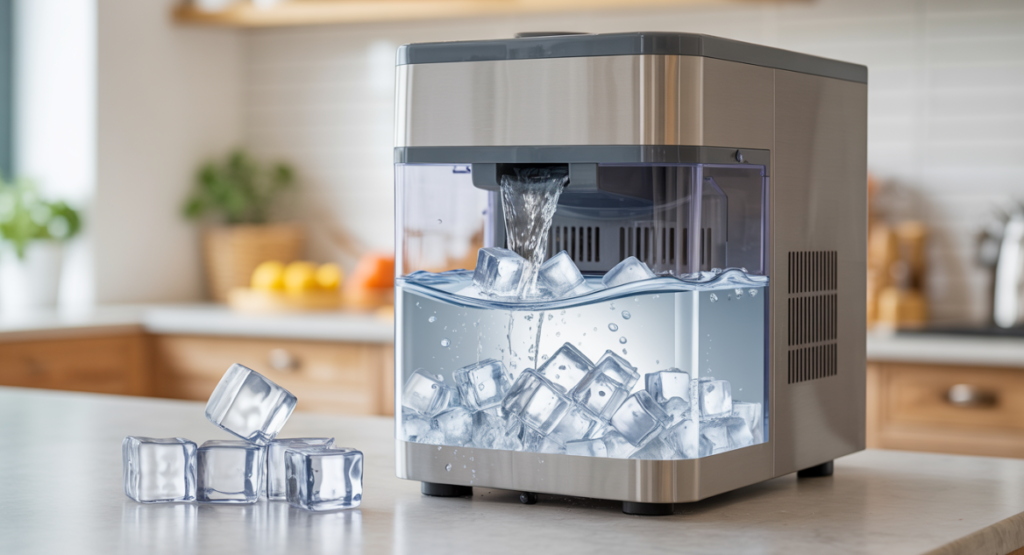
A countertop ice maker works completely differently. It uses a direct refrigeration system where metal prongs or a cooled evaporator plate are lowered directly into the water. The water freezes around the cold metal surface from the outside in — layer by layer — creating ice in a fraction of the time.
Here is the full cycle of how a countertop ice maker works:
- Water fills the internal reservoir from the tank.
- Metal prongs or cooling plates are lowered into the water.
- The refrigeration compressor activates and rapidly cools the prongs to below freezing.
- Ice forms around the prongs or on the cooling plate — layer by layer.
- A heating element briefly warms the prongs to release the ice.
- Ice drops into the storage basket below.
- The cycle repeats automatically until the basket is full or the water runs out.
The entire process — from water to ice in the basket — takes as little as 6 minutes for bullet ice, and up to 18 minutes for larger clear cube ice.
How Long Does It Take by Ice Type?
Not all ice is created equal — and not all ice is made equally fast. Here is a detailed breakdown:
Bullet Ice (Most Common Countertop Ice Type)
Cycle Time: 6 – 9 minutes
Bullet ice is the small, hollow, cylindrical ice produced by the majority of affordable countertop ice makers. Because each piece is small and hollow in the center, it has a large surface area relative to its volume — which means it freezes extremely fast.
A standard bullet ice maker produces 9 cubes per cycle and can make up to 26 lbs of ice per day.
Best for: Everyday drinks, water, sodas, parties Melts: Faster than full cube — great for rapid chilling, not ideal for slow sipping
Nugget / Sonic / Pellet Ice
Cycle Time: 20 – 30 minutes for first solid batch
Nugget ice (also called Sonic ice or pellet ice) works differently from bullet ice makers. Instead of freezing around prongs, nugget ice makers compress flaked ice into soft, chewable nugget shapes. This process takes a bit longer to get started — about 20 to 30 minutes before the first solid nuggets are ready. Once the machine is running at full temperature, it produces ice continuously and can make 25 to 40 lbs per day.
Best for: Sodas, cocktails, chewable everyday ice, coffee drinks Melts: Slowly and softly — absorbs drink flavors beautifully
Clear Full Cube Ice
Cycle Time: 12 – 18 minutes
Clear cube countertop ice makers use a directional freezing process that pushes impurities and air bubbles out of the ice as it forms — creating perfectly transparent, dense, slow-melting cubes. Because the cubes are larger and denser than bullet ice, each cycle takes longer.
Best for: Whiskey, bourbon, premium cocktails, home bars Melts: Very slowly — the gold standard for serious drinks
Crescent Ice
Cycle Time: 10 – 15 minutes
Crescent-shaped ice is the classic half-moon shape you find in hotel ice machines. It fits perfectly in glasses and melts at a moderate rate. Cycle times fall in the middle range — faster than clear cube, slower than bullet ice.
Best for: All-purpose home use, mixed drinks, water Melts: Moderate rate — good balance of chilling power and longevity
How Long Does a Portable Ice Maker Take to Make Ice?
A portable ice maker — a countertop model that uses a manual water tank rather than a plumbed water line — operates on the exact same cycle times as described above. The terms “portable ice maker” and “countertop ice maker” are often used interchangeably, and their ice-making speeds are identical:
- Bullet portable ice maker: 6 – 9 minutes per batch
- Nugget portable ice maker: 20 – 30 minutes for first batch
- Clear cube portable ice maker: 12 – 18 minutes per batch
The key difference with a portable ice maker is that you must manually refill the water tank when it runs empty. If you walk away and let the tank run dry, ice production stops until you add more water. Built-in plumbed undercounter ice makers never have this issue since they connect directly to your water supply.
How Long Does It Take for a New Refrigerator Ice Maker to Make Ice?
This is one of the most common questions we receive — and the answer surprises most people.
A brand-new refrigerator ice maker takes 24 hours to produce its very first batch of ice. Sometimes it can take up to 48 hours before you see ice at all.
Why so long? Unlike countertop ice makers that start making ice almost immediately, a refrigerator ice maker is part of an integrated system. The entire freezer must reach the correct operating temperature (0°F / -18°C) before the ice maker begins its first cycle. In a brand-new refrigerator, this temperature stabilization alone takes 12–24 hours.
What to expect with a new refrigerator ice maker:
| Timeframe | What Happens |
|---|---|
| 0 – 12 hours | Freezer cooling down — no ice production yet |
| 12 – 24 hours | Freezer reaches target temp — first ice cycle begins |
| 24 hours | First small batch of ice produced |
| 24 – 48 hours | Ice production ramps up to normal rate |
| 48 – 72 hours | Full ice bin achieved for the first time |
Pro Tip: Discard the first 1–2 batches of ice from a new refrigerator. New water lines and ice molds may contain manufacturing residue, dust, or carbon from a new water filter. Running those first batches through and discarding them ensures your ice tastes clean and fresh.
How Long Does It Take for an Ice Maker to Make Ice After a Reset?
If you have reset your refrigerator ice maker — either after a malfunction, after replacing the water filter, or after moving the fridge — here is what to expect:
After a reset, your ice maker typically takes 1.5 to 2 hours to produce the first batch of ice.
This is much faster than the initial 24-hour startup time because the freezer is already at the correct operating temperature. The reset simply restarts the ice-making cycle from the beginning.
Step-by-step timeline after a reset:
- 0 – 30 minutes: Ice maker initializes and water fills the mold
- 30 – 90 minutes: Water in the mold freezes fully
- 90 – 120 minutes: First batch of ice drops into the bin
- Every 90–120 minutes: New batch produced (refrigerator ice makers)
Important: After replacing a water filter, always discard the first 2–3 batches of ice. Air trapped in the new filter and water line can cause hollow, small, or oddly-shaped cubes in the first few cycles.
How Long Does It Take to Make Ice in the Freezer? (Without an Ice Maker)
If you are using standard ice trays in your home freezer (without any ice maker), here is how long it takes:
| Freezer Temperature | Time to Freeze Ice Trays |
|---|---|
| 0°F (-18°C) — ideal | 3 – 4 hours |
| 10°F (-12°C) — slightly warm | 4 – 6 hours |
| 20°F (-6°C) — too warm | 6+ hours (poor quality ice) |
Standard ice cubes (full-size tray) take 3–4 hours at the correct freezer temperature of 0°F. Smaller ice cube trays (mini cube trays) take 1.5–2.5 hours. Large luxury ice cube molds (2-inch cubes, sphere molds) take 6–8 hours for perfectly clear results.
This is why countertop ice makers are so popular — they produce ice 30x faster than a standard freezer tray.
How Long Does It Take for a Samsung Ice Maker to Make Ice?
Samsung refrigerator ice makers are among the most popular in the world — and one of the most commonly searched. Here is the specific timeline for Samsung ice makers:
First use (brand new Samsung fridge): 24 hours before first ice batch Normal operation cycle time: Every 90 minutes to 2 hours per batch Full ice bin from empty: 12 – 24 hours After a reset: 1.5 – 2 hours for first batch After filter replacement: Discard first 2–3 batches
Samsung-Specific Tips:
- Samsung refrigerators have a “Power Freeze“ function that speeds up the freezer’s cooling and can reduce ice production time.
- Samsung’s Twin Cooling Plus models keep freezer and refrigerator humidity separate — this actually helps ice quality and production speed.
- If your Samsung ice maker is making small or hollow ice, the most likely cause is a clogged water filter that needs replacement.
- Samsung recommends replacing the water filter every 6 months for optimal ice production.
8 Tips to Make Your Countertop Ice Maker Produce Ice Faster
Now that you know how fast a countertop ice maker makes ice under normal conditions, here are the best ways to speed it up even further:
Tip 1: Use Cold Water Instead of Room Temperature Water
This is the single easiest speed improvement. Cold water (straight from the fridge, around 40°F / 4°C) requires far less energy to freeze than room temperature water (70°F / 21°C). Using cold water can reduce cycle time by 1–3 minutes per batch — that adds up significantly over a full day of ice production.
Tip 2: Keep Your Ice Maker Away From Heat Sources
If your ice maker sits next to your oven, toaster, or in direct sunlight, the compressor works much harder to maintain freezing temperatures. Move the machine to a cooler spot on your counter and you will see noticeably faster ice production. Heat sources can slow cycle times by 30% or more.
Tip 3: Make Sure the Machine Has Proper Ventilation
Countertop ice makers need airflow around them to release heat from the compressor. Always leave at least 5–6 inches of space on all sides and above the machine. A poorly ventilated ice maker works harder, runs hotter, and produces ice slower.
Tip 4: Keep the Water Tank Full
Running the water tank low slows down production because the machine must wait for water to flow into the reservoir. Refill the tank before it empties completely for non-stop ice production.
Tip 5: Choose the Smaller Ice Size Setting
Most countertop ice makers offer two ice size options — small and large. Small ice cubes freeze significantly faster because each piece has less water to freeze. If speed is more important to you than cube size, always choose the small setting.
Tip 6: Clean Your Ice Maker Regularly
Mineral buildup from hard water coats the metal prongs and cooling surfaces inside your ice maker over time. This insulating layer of scale makes the machine work harder and freeze slower. Clean your ice maker every 3–6 months with a food-safe cleaning solution to maintain peak speed and performance.
Tip 7: Let the Machine Warm Up for the First Cycle
When you first turn on your countertop ice maker, the first cycle is always the slowest as the refrigeration system reaches operating temperature. Do not judge your machine’s speed based on the very first batch. By the second or third cycle, the machine is running at full speed.
Tip 8: Keep the Ambient Room Temperature Below 90°F (32°C)
Most countertop ice makers are rated for use in environments up to 90°F. Above this temperature, the machine struggles to maintain the temperature differential needed for fast freezing. In very hot rooms, ice production slows dramatically. If you are using your ice maker in a garage or outdoor setting in summer, this may be a factor.
Best Portable Ice Maker: Top Picks for Speed and Performance
Now that you know how fast a countertop ice maker makes ice, here are the top-performing models for speed:
Fastest Overall — Chefman Iceman Dual-Size Countertop Ice Maker
Cycle Time: 6 minutes | Daily Production: 26 lbs The fastest countertop ice maker tested by independent reviewers in 2025. Produces the first batch of bullet ice in just 6 minutes from a cold start. Two ice sizes, self-cleaning, and a built-in handle for portability.
Best Nugget Ice Speed — Costway Nugget Countertop Ice Maker
First Batch: 20 – 25 minutes | Daily Production: 34 lbs The fastest nugget ice maker in its price range. Outperforms even the popular GE Profile Opal in total daily ice output, at roughly half the price.
Best Budget Speed — AGLUCKY Countertop Ice Maker
Cycle Time: 6 – 8 minutes | Daily Production: 26 lbs Under $80 and performs comparably to machines costing three times as much. A great choice if you want fast bullet ice without a high price tag.
Best for Home Bar — NewAir 80 Lb. Clear Ice Maker (Undercounter)
Cycle Time: 12 – 18 minutes | Daily Production: 80 lbs Not the fastest per cycle, but the highest total daily production of any home-use model. If you entertain frequently and want clear, premium ice, this is the machine to get.
Ice Maker Speed Comparison: Countertop vs. Freezer vs. Refrigerator
| Method | First Ice Ready | Daily Output | Ice Quality |
|---|---|---|---|
| Countertop ice maker (bullet) | 6 – 9 minutes | 26 – 40 lbs | Good |
| Countertop ice maker (nugget) | 20 – 30 minutes | 25 – 40 lbs | Excellent |
| Countertop ice maker (clear cube) | 12 – 18 minutes | 20 – 30 lbs | Premium |
| Refrigerator ice maker | 24 hours (first use) | 3 – 8 lbs | Good |
| Standard freezer ice tray | 3 – 4 hours | 2 – 4 lbs | Basic |
| Large luxury ice mold (freezer) | 6 – 8 hours | 1 – 2 lbs | Premium |
FAQs
Q: How fast does a countertop ice maker make ice on the first use?
A: Most countertop ice makers produce their first batch of bullet ice in 6 to 9 minutes from a cold start. Nugget ice makers take 20 to 30 minutes for the first solid batch. The very first cycle is always the slowest — speed improves from the second cycle onward as the machine reaches full operating temperature.
Q: How long does a portable ice maker take to make ice?
A: After resetting a refrigerator ice maker, expect the first new batch of ice in approximately 1.5 to 2 hours. The freezer is already cold, so the wait is much shorter than during first-time startup.
Q: How long does it take for a new refrigerator ice maker to make ice?
A brand-new refrigerator ice maker takes 24 hours before producing its first batch of ice. The freezer needs to fully reach 0°F first. Some models may take up to 48 hours. Always discard the first 1–2 batches from a new fridge.
Q: How long does it take for an ice maker to make ice after a reset?
A: After resetting a refrigerator ice maker, expect the first new batch of ice in approximately 1.5 to 2 hours. The freezer is already cold, so the wait is much shorter than during first-time startup.
Q: How long does a Samsung ice maker take to make ice?
A: A Samsung refrigerator ice maker takes about 24 hours on first use. During normal operation, it produces a new batch every 90 minutes to 2 hours. After a reset or filter replacement, the first batch takes about 1.5 to 2 hours.
Final Thoughts
So — how fast does a countertop ice maker make ice? The short answer: incredibly fast. Most countertop models deliver your first batch of fresh bullet ice in just 6 to 9 minutes, making them the fastest way to get ice at home by a wide margin.
Compared to waiting 3 to 4 hours for freezer ice trays, or 24 hours for a new refrigerator ice maker to start production, a countertop ice maker is in a completely different league when it comes to speed and convenience.
To get the fastest possible performance from your machine, remember these key tips: use cold water, keep the machine well-ventilated, position it away from heat sources, choose the small cube setting, and clean it every 3 to 6 months.
Have questions about your specific ice maker model or speed? Drop a comment below — we read every one and are happy to help!
Published by IceMakerReviews.com — your trusted source for ice maker reviews, buying guides, and expert troubleshooting.