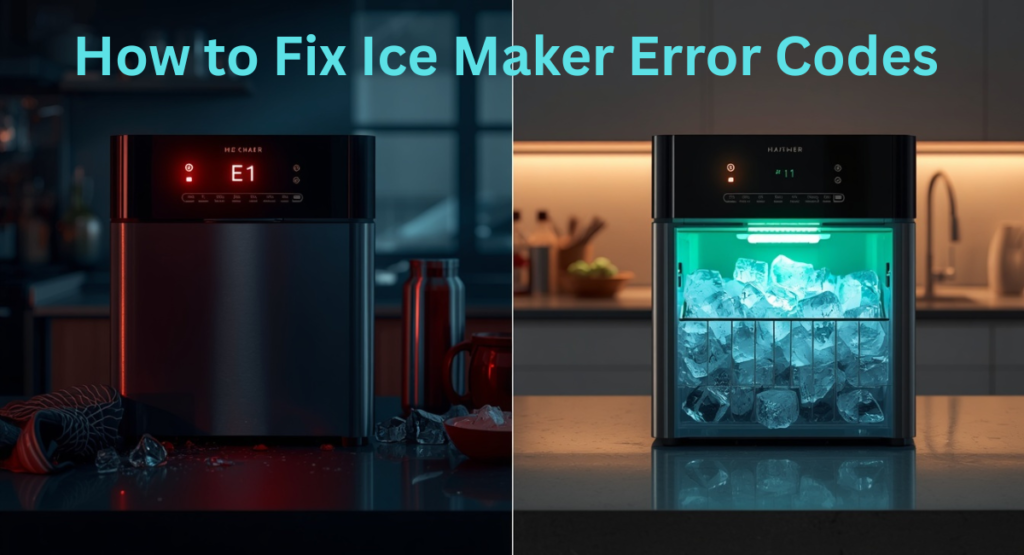
Your ice maker stops working and instead of just going quiet, it throws a code at you — E1, CI, dE, PF — and now you’re stuck googling letters and numbers instead of getting your ice back. The frustrating part is that every brand uses a different system, so the advice you find for one machine often doesn’t apply to yours at all.
Learning how to fix ice maker error codes doesn’t have to mean calling a technician for every blinking light. I pulled together the error codes across the most common ice maker brands and machine types — countertop nugget makers, and built-in refrigerator ice makers from GE, Frigidaire, Whirlpool, and Samsung — so you can find your exact code, understand what it actually means, and know whether it’s a two-minute fix or a call-a-technician situation.
Quick answer: Most ice maker error codes fall into four categories — water supply issues (E1, F3), full-bin or sensor faults (E2, CI), temperature/cooling problems (E4, CC, dE), and communication faults between the control board and display (E6, PF). Identify your brand and exact code below, then follow the matching fix.
Table of Contents
1. Countertop and Portable Nugget Ice Makers (E1–E4 System)
Most budget and mid-range countertop nugget ice makers — including popular models like Euhomy, Vevor, and similar machines — use a simple four-code system. If you’re troubleshooting a nugget ice maker rather than a built-in refrigerator unit, this is very likely your code system.
| Code | Meaning | Fix |
|---|---|---|
| E1 | Water shortage — the reservoir doesn’t have enough water to start or continue a cycle | Refill the reservoir fully and check the water level float isn’t stuck |
| E2 | Ice basket full — the infrared sensor thinks the bin is at capacity | Empty the bin and wipe the sensor area clean; mineral film often triggers false readings |
| E3 | Water circulation failure — water isn’t reaching the evaporator prongs properly | Clean the water pump and inlet area; this is the single most common code and it’s usually mineral scale, not a broken part |
| E4 | Ambient temperature too high — the unit senses room temperature above roughly 90°F (32°C) | Move the machine to a cooler spot with better airflow, away from direct sunlight or heat sources |
The E3 code deserves extra attention, since one detailed troubleshooting breakdown from an experienced appliance technician covering Euhomy models notes that E3 alone accounts for roughly a third of all service calls on these machines, and mineral scale buildup on the water sensor is almost always the root cause — not a failed part. If you’re seeing E3 repeatedly, our full descaling guide is the right first step before assuming anything is broken.
This same E1–E4 pattern shows up across several other budget brands too — a separate breakdown of Vevor ice machine error codes confirms nearly identical meanings, which suggests many manufacturers are using the same underlying control board hardware from the same suppliers.
2. GE Refrigerator Ice Maker Error Codes
GE refrigerators display letter-based codes rather than numbers, and the one you’ll see most often for ice problems is CI.
| Code | Meaning | Fix |
|---|---|---|
| CI | Check Ice Maker — ice is jammed, the mold isn’t cycling, or the water valve is clogged/off | Clear any jammed cubes, confirm the water supply valve is open, check for a kinked line |
| CC | Refrigerator compartment too warm | Check door seals, clean condenser coils, verify vents aren’t blocked |
| PF | Power Failure — power was recently interrupted | Not a hardware fault; press System Check to clear it |
| dE / DF | Defrost system hasn’t completed a cycle in 24–48 hours | Check for a heavy ice block on the evaporator coil behind the freezer panel |
A detailed GE-specific repair resource confirms that the CI code specifically flags an ice maker fault where the arm is active but no cubes are dropping, which lines up with jammed ice or a blocked water valve as the two most likely causes. GE’s own appliance support documentation also outlines the correct water pressure range needed for proper ice maker fill cycles, which is worth checking through GE’s official refrigerator water pressure specifications if water-related codes keep returning. If you own a GE Profile-series machine specifically, our GE Profile XPIO13BCBT manual breakdown covers model-specific reset sequences in more depth.
3. Frigidaire Ice Maker Error Codes
Frigidaire uses different code sets for built-in refrigerators versus standalone nugget ice makers, so it’s worth confirming which type of machine you have before troubleshooting.
| Code | Meaning | Fix |
|---|---|---|
| DI SP / DISP | Ice jammed in the dispenser chute (refrigerator models) | Remove the ice bin, thaw and empty it fully, then reset |
| E1 | Water supply problem (nugget ice makers) | Check the water line connection and confirm adequate pressure |
| E3 | Sensor failure (nugget ice makers) | Inspect and clean or replace the affected sensor |
| SY EF | Evaporator fan malfunction (refrigerator models) | Check the fan for obstructions; often a full reset resolves it |
Frigidaire’s own official support documentation confirms the DI SP code specifically indicates ice jammed in the dispenser chute, often caused by ice that’s melted and refrozen around the auger during infrequent use or power fluctuations. If your Frigidaire doesn’t have a dedicated clean button and you’re troubleshooting alongside a maintenance issue, our guide on cleaning a Frigidaire ice maker without a clean button covers the manual process step by step.
4. Whirlpool Ice Maker Error Codes
Whirlpool’s ice maker codes vary significantly between US and UK/EU models, and many US units rely more on internal diagnostic test sequences than a simple display code.
| Code | Meaning | Fix |
|---|---|---|
| E0 / EE | Ice maker fault or circuit fault | Check the water line and sensor connections; run a diagnostic test cycle |
| E1 | Refrigerator sensor fault | Inspect and replace the thermistor if damaged |
| E6 | Communication failure between control board and display | Full power cycle — unplug for 5 minutes, then reconnect |
Whirlpool’s official troubleshooting documentation, referenced through iFixit’s Whirlpool refrigerator error code guide, notes that most US Whirlpool units display very few standalone error codes compared to European models, relying instead on a built-in diagnostic test mode accessible through specific button combinations on the control panel.
5. Samsung Ice Maker Error Codes
Samsung refrigerators commonly display two-digit-plus-letter codes (like 26E or 33E) rather than single letters, and these are almost always tied to the ice maker’s internal sensors rather than the compressor itself.
| Code | Meaning | Fix |
|---|---|---|
| 26E | Ice maker sensor or communication fault | Power cycle the unit; check the wiring harness connector for corrosion |
| 27E | Related sensor communication issue | Same as above — often resolves together with 26E after a reset |
| 33E / 39E | Ice maker component-level faults | May require inspecting the ice maker module directly; persistent codes often need a replacement module |
These exact codes were confirmed directly in Samsung’s own official support community, where a verified contributor explained that codes in the 20s and 30s range specifically point to the ice maker system’s sensors and components rather than general refrigerator cooling faults.
6. Universal First Steps Before Troubleshooting Any Code
Regardless of brand, three checks solve a surprising number of error codes before you need to touch anything internal:
- Power cycle the unit. Unplug for a full 5 minutes (not just a few seconds) to fully reset the control board and clear transient faults.
- Check the water supply line. A kinked, frozen, or low-pressure line triggers water-related codes across nearly every brand and model.
- Inspect for ice jams and mineral buildup. Physical blockages and scale account for a large share of sensor-related codes, especially E2, E3, and CI-type faults.
If your machine has been sitting unused for a while before the code appeared, leftover water in the lines is a common trigger — our guide on properly emptying an ice maker before storage explains how to avoid this exact issue going forward.
7. How Ice Type Affects Which Codes You’ll See
It’s worth noting that the error code system your machine uses often depends on the ice style it produces, not just the brand. Nugget-style machines (also called Sonic ice or pebble ice makers) rely heavily on a water circulation pump and evaporator prongs, which is exactly why E3 circulation faults are so common on these units specifically — there’s simply more moving water involved than in a basic cube-ice refrigerator unit. If you’re comparing ice styles before buying a replacement machine, our crushed ice maker comparison breaks down how different mechanisms affect long-term reliability.
8. Repair Cost vs. Replacement — When Error Codes Mean It’s Time for a New Machine
Not every error code is worth repairing. If you’re facing a compressor-related fault (like Whirlpool’s E6 communication failure after multiple resets, or a persistent GE dE/DF defrost code) on a countertop machine that’s several years old, replacement parts plus labor can approach the cost of a new budget unit entirely.
As a rough guide:
- Worth repairing: Water supply codes (E1, F3), sensor cleaning issues (E2, E3, CI), and communication resets (PF, most single-instance codes)
- Worth evaluating carefully: Recurring E6 communication faults, persistent dE/DF defrost errors, or any code that returns immediately after a full reset and thorough cleaning
- Usually worth replacing: Compressor faults on machines already showing their age, or any unit where a genuine part replacement costs more than half of a comparable new model
If you do end up replacing rather than repairing, checking whether the new unit keeps ice properly frozen between uses matters just as much as the ice-making mechanism itself — our guide on countertop ice makers that actually keep ice frozen covers what separates a well-insulated bin from one that lets ice melt within hours.
Persistent temperature codes (CC, dE, DF), repeated communication faults after multiple resets, or any code tied to the compressor or sealed refrigerant system are signs to stop DIY troubleshooting. Consumer Reports maintains an independently tested countertop ice maker ratings and reliability hub that’s a useful reference if you’re deciding whether a persistent fault means it’s time to replace the unit entirely rather than keep repairing it.
FAQs About How to Fix Ice Maker Error Code
What does E1 mean on an ice maker?
On most countertop nugget ice makers, E1 indicates a water supply issue — the reservoir doesn’t have enough water. On some refrigerator models (like older Whirlpool units), E1 instead refers to a temperature sensor fault, so check your specific brand’s code list.
Why does my ice maker keep showing an error code after I reset it?
A code that returns immediately after a reset usually points to a persistent physical issue — mineral buildup on a sensor, a genuinely blocked water line, or a failing component — rather than a temporary glitch that a reset alone can clear.
Can hard water cause ice maker error codes?
Yes. Mineral buildup from hard water is one of the most common causes of sensor-related codes like E2 and E3. The National Sanitation Foundation’s guidance on water filtration standards is useful background if you’re considering adding a filter to reduce this long-term.
Is it safe to keep using an ice maker that’s showing an error code?
For water or sensor codes, yes, once you’ve addressed the root cause. For temperature or compressor-related codes, continuing to run the unit can risk further damage — it’s better to resolve the code first.
Does low water pressure cause ice maker error codes?
It can. Insufficient incoming water pressure often triggers water-supply codes like E1 or F3 on ice makers connected directly to a home’s water line. The EPA’s guidance on typical residential water pressure ranges is a good reference if you want to check your home’s numbers directly.
How do I find the exact error code list for my specific model?
Brand-wide code lists like the ones above cover most common faults, but always cross-reference your exact model number with the manufacturer’s manual, since some model years and configurations use slightly different code numbering.
Final Thoughts
Learning how to fix ice maker error codes comes down to identifying your brand’s specific code system first, then working through water supply, sensor cleanliness, and power cycling before assuming a part has actually failed. Most codes — especially E1, E2, E3 on countertop units, and CI on GE machines — are cleanup and maintenance issues, not expensive repairs.
If you’re shopping for a more reliable machine after dealing with repeated error codes, our Typhur nugget ice maker review and GoveeLife Pro review cover two models with more thorough self-cleaning systems that reduce sensor-related faults long term. For more troubleshooting and buying guides, browse the full IceMakerReviews.com library.