If you’ve searched for how can you make dry ice at home, you’ve probably run into a lot of confusing advice online — some sites even claim you can make it with water, salt, or baking soda. Unfortunately, that’s not true, and this guide is going to set the record straight.
Dry ice isn’t frozen water. It’s solid carbon dioxide (CO2), and making it requires a very specific process involving pressure and rapid cooling. In this guide, you’ll learn exactly how can you make dry ice at home the real way, why the water/salt/baking soda methods don’t work, what equipment you actually need, safety precautions, and better alternatives if a DIY approach isn’t practical for you.
Let’s clear up the myths first, then walk through the real method step by step.
Table of Contents
What Is Dry Ice, Exactly?
Before we get into how can you make dry ice at home, it helps to understand what dry ice actually is.
Dry ice is simply carbon dioxide gas that has been compressed and cooled until it turns into a solid. Unlike regular ice, it doesn’t melt into a liquid. Instead, it “sublimates,” meaning it turns directly from a solid into a gas. That’s why dry ice never leaves a puddle behind.
A few quick facts:
- Dry ice has a surface temperature of about -109.3°F (-78.5°C)
- It’s roughly twice as dense as regular water ice
- It can cause instant frostbite if it touches bare skin
- It releases carbon dioxide gas as it sublimates, which can be dangerous in unventilated spaces
Because of these properties, dry ice can’t form the same way regular ice does. This is exactly why so many “easy” methods you’ll find online, including using water, salt, or baking soda, simply don’t work.
Can You Make Dry Ice With Water, Salt, or Baking Soda?
This is one of the most searched questions related to dry ice, so let’s answer it directly: no, you cannot make real dry ice with water, salt, or baking soda at home.
Here’s why each of these popular methods fails:
Water: Freezing water, no matter how cold your freezer gets, only produces regular water ice. Water doesn’t contain carbon dioxide, so there’s no way to convert it into CO2 ice through freezing alone.
Salt: Mixing salt with ice (an “ice and salt” mixture) lowers the freezing point of water, which is a classic trick used in ice cream makers and science experiments. It creates a colder brine, but it still doesn’t produce carbon dioxide. You’ll get very cold saltwater slush, not dry ice.
Baking soda: Baking soda reacts with acids like vinegar to release carbon dioxide gas, but that reaction happens at room temperature and produces only a small amount of gas that immediately escapes into the air. There’s no pressure or cooling mechanism involved, so the CO2 never solidifies.
If you’ve seen a “hot ice experiment” mentioned alongside dry ice searches, it’s worth knowing that hot ice is a completely different thing. It’s made from sodium acetate, and while it’s a fun, crystallizing science experiment, it has nothing to do with carbon dioxide or dry ice.
So if none of these kitchen methods work, what does? Let’s get into the real process.
How Can You Make Dry Ice At Home: The Real Method
The only practical way to answer how can you make dry ice at home without industrial equipment is by using a CO2 fire extinguisher. Commercially, dry ice is produced by compressing and liquefying carbon dioxide gas, then rapidly releasing the pressure so it cools and solidifies. A CO2 fire extinguisher works on the same basic principle, since it already holds liquid carbon dioxide under high pressure.
What You’ll Need
- A carbon dioxide (CO2) fire extinguisher (not a dry chemical or ABC extinguisher)
- A thick cloth bag, pillowcase, or an old sock
- Insulated or heavy-duty gloves
- Safety goggles
- A well-ventilated outdoor space
You can usually identify a CO2 extinguisher by its unusually large, black discharge horn and the absence of a pressure gauge. These are commonly found in restaurant kitchens, server rooms, and workshops. If you don’t already own one, some fire safety companies will let you rent or refill one for a reasonable fee.
Step-by-Step: How To Make Dry Ice At Home
- Put on your safety gear first. Gloves and goggles are non-negotiable here, since the CO2 discharge is extremely cold and can cause instant frostbite.
- Take the extinguisher outside or into a large, open, well-ventilated area. Never do this in a small, enclosed room.
- Wrap the cloth bag around the discharge horn and secure it tightly with a rubber band, zip tie, or tape, leaving no gaps for the gas to escape.
- Hold the bag firmly with both hands. There will be strong pressure pushing against it once you discharge the extinguisher.
- Pull the pin and squeeze the handle for a steady 4 to 6 second burst.
- Check the bag. You should find a soft, snow-like buildup of solid carbon dioxide inside. This is your dry ice.
- Compress the snow into blocks with gloved hands if you want it in a more usable shape, or use it loose for effects like fog and cooling.
That’s genuinely the entire process. It’s simple in theory, but it does require the right equipment, so it’s not something you can improvise using items already in your kitchen.
Why It’s Hard To Make Dry Ice Without a Fire Extinguisher
Many people search for how to make dry ice at home no fire extinguisher, hoping there’s a simpler workaround. Realistically, there isn’t a safe or reliable one for home use.
The reason comes down to pressure. Carbon dioxide only becomes a solid when it’s under very specific pressure and temperature conditions. Industrial dry ice manufacturers use compressors and expansion chambers to achieve this. A CO2 fire extinguisher is the only common household-accessible item that already stores CO2 at the necessary pressure, which is why it’s the standard DIY method.
Some people ask about making dry ice without CO2 altogether, but this is a bit of a contradiction, since dry ice is, by definition, solid carbon dioxide. Without a carbon dioxide source, you cannot produce dry ice, no matter what other ingredients you combine.
Dry Ice Methods Compared
Here’s a quick side-by-side look at every method people search for, so you can see at a glance what actually works.
| Method | Does It Make Real Dry Ice? | Why |
|---|---|---|
| CO2 fire extinguisher | Yes | Releases pressurized liquid CO2, which cools and solidifies instantly |
| Water (freezing) | No | Water contains no carbon dioxide, so it can only form regular ice |
| Salt + ice | No | Lowers freezing point of water; produces cold brine, not CO2 |
| Baking soda + vinegar | No | Releases a small amount of CO2 gas at room temperature, but with no pressure, it can’t solidify |
| Dry ice maker/machine | Yes | Purpose-built equipment that compresses and expands CO2 safely and consistently |
| Buying pre-made dry ice | Yes | Already manufactured industrially; no equipment needed on your end |
| Hot ice (sodium acetate) | No | A different substance entirely; not carbon dioxide, just a look-alike science experiment |
As the table shows, only three approaches actually work: a CO2 fire extinguisher, a dedicated dry ice maker, or simply buying it ready-made.
Is Making Dry Ice At Home Safe?
Safety matters more here than with almost any other home science project. According to CDC guidance on dry ice handling, it should always be handled with insulated gloves, used only in well-ventilated spaces, and never stored in an airtight container, since built-up gas pressure can cause it to rupture or even explode.
Keep these precautions in mind:
- Never touch dry ice with bare skin. Direct contact causes frostbite within seconds.
- Work outdoors or in a large, ventilated room. Carbon dioxide can displace oxygen in small spaces, creating a suffocation risk, as outlined in NIOSH’s guidance on CO2 exposure.
- Never store it in a sealed container, including jars, bottles, or coolers with tight lids, per OSHA’s workplace safety standards.
- Keep it away from children and pets.
- Never ingest dry ice. It can cause severe internal injuries.
- Discharge the fire extinguisher outdoors, away from your face, since the initial blast is forceful and extremely cold.
If you’re not confident handling pressurized equipment safely, it’s completely reasonable to skip the DIY approach and buy dry ice or a machine instead, which we’ll cover next.
Easier Alternatives to Making Dry Ice at Home
If the fire extinguisher method feels like more effort or risk than you want to take on, you have a couple of solid alternatives.
Buy Ready-Made Dry Ice
Most grocery stores, party supply shops, and welding gas suppliers sell dry ice by the pound. This is by far the easiest and safest option if you just need it for a Halloween fog effect, keeping food cold, or a science demonstration.
Use a Dry Ice Maker or Machine
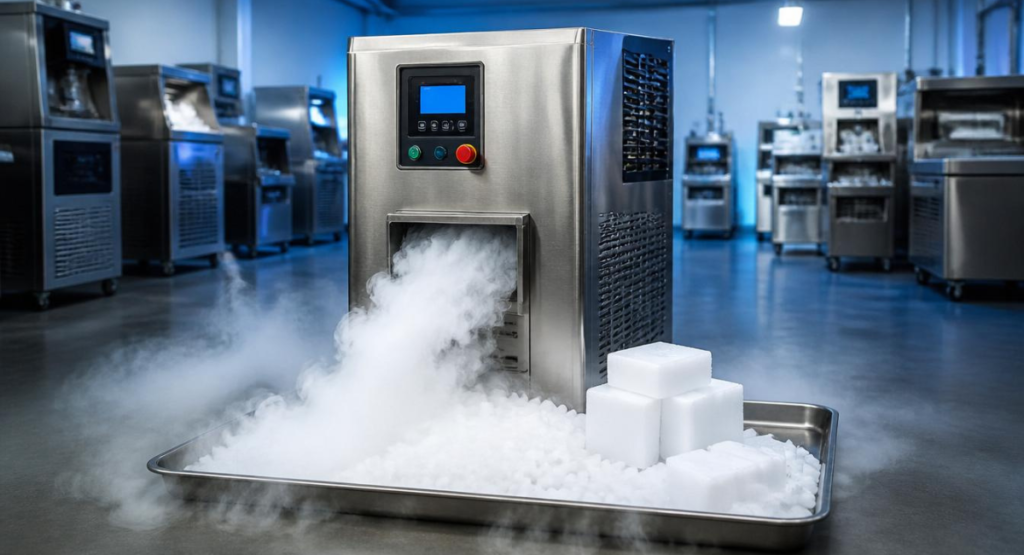
If you need dry ice regularly, whether for events, food preservation, or a small business, investing in a dedicated dry ice maker can make far more sense than repeatedly discharging fire extinguishers. These machines are built specifically to convert liquid CO2 into usable dry ice blocks or pellets safely and consistently.
If you’re also curious about home ice equipment in general, our ice maker reviews and buying guides cover everything from countertop units to commercial-grade machines.
There’s a wide range of options depending on your needs:
- Small dry ice makers for occasional personal or hobby use
- Commercial dry ice machines designed for frequent, higher-volume production
- Dry ice block makers that produce solid, easy-to-transport blocks rather than loose snow
If you’re comparing dry ice machine manufacturers or trying to decide between a personal dry ice maker and a commercial dry ice machine, it’s worth checking a detailed dry ice machine buying guide before purchasing, since price, output capacity, and safety features vary a lot between models.
Common Mistakes to Avoid
Even people who know the correct method sometimes run into trouble. Here are a few mistakes worth avoiding:
- Using the wrong extinguisher type. Only CO2 extinguishers work. Dry chemical extinguishers, which are far more common, will not produce dry ice.
- Skipping gloves “just for a second.” Frostbite from dry ice happens almost instantly, so there’s no safe amount of bare-skin contact.
- Sealing dry ice in a container to store it. This is one of the most common and most dangerous mistakes, since pressure buildup can cause containers to burst.
- Attempting this indoors. Even a moderate amount of released CO2 can lower oxygen levels in a small room.
Frequently Asked Questions
How do you make dry ice at home?
The most reliable home method is discharging a CO2 fire extinguisher into a cloth bag, which causes the pressurized carbon dioxide to solidify into dry ice snow.
Can I make dry ice with just water?
No. Water freezes into regular ice, not carbon dioxide ice. There’s no process that converts H2O into CO2.
Can I make dry ice with salt or baking soda?
No. Salt only lowers water’s freezing point, and baking soda’s CO2 reaction with vinegar is too weak and unpressurized to form solid dry ice.
Is it dangerous to make dry ice at home?
It can be if proper precautions aren’t followed. Always wear insulated gloves and safety goggles, work outdoors or in a ventilated space, and never store dry ice in a sealed container.
Is buying a dry ice maker worth it?
If you need dry ice regularly, a dry ice maker or commercial dry ice machine is usually more cost-effective and far safer than repeated DIY attempts with a fire extinguisher.
Final Thoughts
So, how can you make dry ice at home? The honest answer is that it’s possible, but only with a CO2 fire extinguisher, not water, salt, or baking soda, despite what some articles suggest. The process is straightforward once you understand it, but it does demand real safety precautions, since you’re working with extreme cold and pressurized gas.
If a DIY approach feels like too much risk or hassle, buying pre-made dry ice or investing in a dedicated dry ice maker is a safer, more convenient path, especially if you’ll need it more than once. Either way, now you know exactly what actually works and what’s just an online myth.