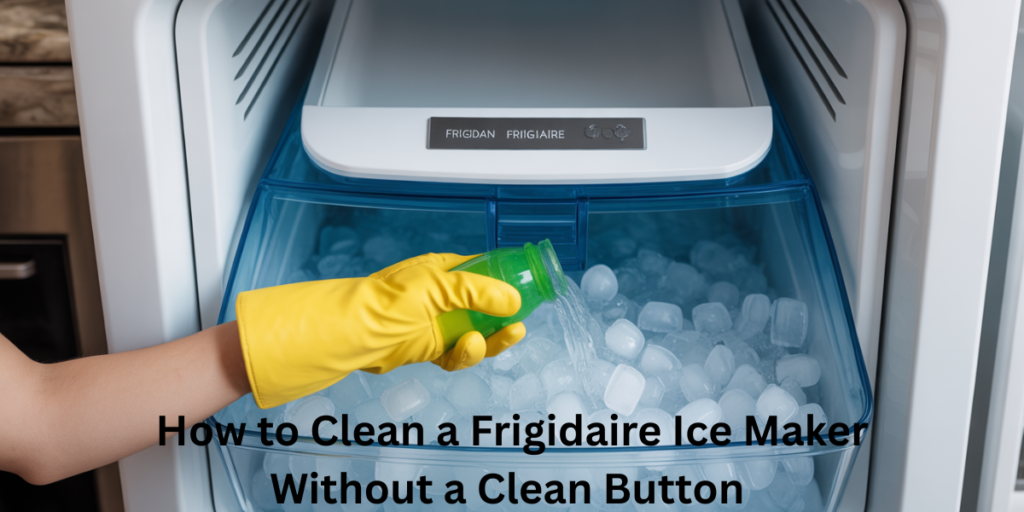
Introduction
White vinegar is one of the most effective, safest, and most affordable ways for anyone wondering how to clean Frigidaire ice maker with vinegar. It breaks down the mineral deposits that slow your machine down, removes the invisible biofilm that causes bad-tasting ice, and leaves zero harmful chemical residue behind — as long as you rinse properly.
This guide covers everything: the exact vinegar-to-water ratio to use, the full step-by-step cleaning process, how to deep clean a Frigidaire ice maker, how to drain it first, model-specific tips for the EFIC452-SS-CU, countertop units, portable models, and the Gallery series, plus the answers to every question people ask about vinegar cleaning. Whether your Frigidaire has a clean button or not, this guide has you covered.
Table of Contents
Why Vinegar Works So Well on Frigidaire Ice Makers
Before you start cleaning, it helps to understand why vinegar works. That way, you know exactly what you are cleaning and why the steps matter.
The main enemy inside any ice maker — including every Frigidaire model — is mineral scale. Every time water freezes and melts inside your machine, the minerals dissolved in that water (primarily calcium and magnesium) get left behind. Over time, this invisible buildup:
- Coats the evaporator rods and reduces freezing efficiency
- Clogs the pump inlet screen and slows water flow
- Builds up inside the water lines and reservoir
- Creates a rough surface where bacteria and mold attach
White distilled vinegar contains acetic acid — typically at 5% concentration. Acetic acid reacts chemically with calcium carbonate (the main component of mineral scale) and dissolves it. That is why vinegar fizzes slightly when it contacts heavy scale buildup. It is not hurting your machine — it is doing exactly what it is supposed to do.
Vinegar is also a mild antimicrobial agent. While it is not a registered disinfectant (meaning it does not kill 100% of pathogens), it significantly reduces the bacteria and mold population on the surfaces it contacts, including the pink slime (Serratia marcescens) that commonly grows inside ice makers.
✅ Science fact: Studies show that a 5% acetic acid solution (standard white vinegar) reduces Listeria monocytogenes and E. coli populations by over 99% on food-contact surfaces when applied for sufficient contact time. This is why vinegar has been used as a food-safe cleaner for decades.
The Right Vinegar-to-Water Ratio (by Cleaning Type)
One of the most common mistakes people make is using the wrong concentration. Too weak, and the vinegar cannot dissolve the scale. Too strong and you risk corroding seals and leaving a stubborn taste in your ice. Here are the correct ratios for each scenario:
Regular Maintenance Clean
1: 10
1 part vinegar, 10 parts water
Best for monthly or quarterly cleaning with light buildup
Standard Deep Clean
1: 1
Equal parts vinegar and water
Best for machines not cleaned in 3+ months or with visible scale
Heavy Scale Removal
2: 1
2 parts vinegar, 1 part water
For severe buildup, pink slime, or machines unused for 6+ months
⚠️ Important: Never use apple cider vinegar, balsamic vinegar, or any flavored vinegar. Only use plain white distilled vinegar (5% acidity). Any other type will leave sugar residue and discolor your machine’s interior.
What You Need Before You Start
Everything on this list is affordable and likely already in your home:
- White distilled vinegar (standard 5% acidity — a 32oz bottle is plenty)
- Fresh, clean water (filtered water is ideal)
- Soft microfiber cloth or clean sponge
- Small cleaning brush or old toothbrush
- Mild dish soap (for the ice bin and removable parts)
- Dry towel for final drying
- Large bowl or sink for washing removable parts
What NOT to use:
- Bleach — corrodes internal metal components and is unsafe on food-contact surfaces at high concentrations
- Abrasive scrubbers or steel wool — scratches the plastic interior, creating grooves where bacteria live
- Dish soap inside the water cycle — creates foam that damages the pump
- Apple cider vinegar or any flavored vinegar — leaves residue and discolors plastic
- Boiling water — warps plastic components and can crack the reservoir
Step-by-Step: How to Clean a Frigidaire Ice Maker With Vinegar
This is the complete cleaning process. It works for all Frigidaire portable and countertop models. Total time: approximately 60 to 90 minutes, including cycle time.
1. Power Off and Unplug the Machine
Press the power button to stop the ice-making cycle. Then unplug the machine from the wall outlet completely. Never clean any part of your ice maker while it is still plugged in — this is both a safety risk and can cause sensor errors.
If your model has a built-in refrigerator ice maker (like the Gallery series), turn it off at the control panel and shut off the water supply line to the fridge.
2. Remove All Ice and Discard It
Open the lid, remove the ice storage bin, and throw away every piece of ice inside. Even if the ice looks clean, it was made inside a machine that needs cleaning — do not consume it.
Set the ice bin aside. You will wash it separately in the next step.
3. Drain the Water Reservoir Completely
This step is critical and often skipped. Locate the drain plug on the bottom or back of your machine. On most Frigidaire portable models it is a rubber plug at the base. Remove it and let all the water drain out into a sink or bowl.
If you skip draining, your vinegar solution gets diluted by leftover water, making it much less effective. Once drained, replace the plug securely before adding your cleaning solution.
✅ Model tip: On the EFIC117-SS and EFIC123-SS, the drain plug is on the bottom rear of the unit. On the EFIC452-SS-CU, it is on the lower left side. Check your model’s manual if you cannot locate it.
4. Wash the Ice Bin and Removable Parts
While the machine drains, take your ice bin, ice scoop, and any other removable parts to the sink. Wash them with warm water and a small amount of mild dish soap. Rinse thoroughly — you do not want any soap residue on parts that contact your ice. Set them on a clean towel to air dry.
If there is visible slime or mineral crust on the bin, soak it for 5 minutes in a bowl of 1:1 vinegar and water solution before scrubbing.
5. Wipe Down the Interior Surfaces
Before running the vinegar cycle, do a quick manual wipe-down of everything you can reach inside the machine. Dampen your microfiber cloth with plain warm water and wipe:
- The inside walls of the reservoir compartment
- The underside of the lid
- The ice chute and drop area
- The ice tray surface
- The area around the water inlet
Use your toothbrush to scrub any visible pink, orange, or black slime from corners and grooves. These areas are the most common starting points for mold growth.
6. Mix and Add the Vinegar Solution
Based on the condition of your machine, choose the right ratio from the chart above. For most standard cleans, a 1:1 mix of white vinegar and water is the most effective starting point.
Pour the vinegar solution into the water reservoir up to the MAX fill line. Do not fill above the max line — overfilling can cause leaks during the cycle.
How much do you need? Most Frigidaire portable models hold 2 to 2.5 liters. A standard 32oz (about 1-liter) bottle of vinegar mixed with 1 liter of water fills most machines to the right level.
7. Run the Vinegar Cleaning Cycle
Plug the machine back in and power it on. Let it run a complete ice-making cycle — this circulates the vinegar solution through the pump, water lines, evaporator, and all internal water-contact surfaces. One cycle takes approximately 10 to 15 minutes on most Frigidaire models.
Discard all ice produced during this cycle. Every piece of ice from the vinegar cycle contains cleaning solution residue and must not be consumed. This includes any ice that forms and drops automatically.
If your machine has a CLEAN button, see Section 5 below for the self-clean method instead.
8. Drain the Vinegar Solution
After the cycle completes, power off and unplug the machine again. Remove the drain plug and drain every drop of the vinegar solution. Tilt the machine slightly forward to help ensure all liquid drains out. Replace the drain plug securely.
9Run 2 to 3 Fresh Water Rinse Cycles
This is the most important step for preventing vinegar-tasting ice. Fill the reservoir to the MAX line with fresh, clean water. Plug in and run a complete ice-making cycle. Drain the machine, then repeat this process two to three times.
Discard all ice from every rinse cycle. Do not consume it. Each rinse cycle flushes more vinegar residue out of the pump, lines, and internal components.
✅ How to know when you’re done rinsing: Fill the reservoir with fresh water and smell it after the cycle runs. If it smells completely neutral with no vinegar trace, your rinse cycles are complete. If there is any vinegar scent, run one more rinse cycle.
10Dry and Reassemble
Once rinsing is complete, drain the machine one final time and leave the lid open for 15 to 30 minutes to allow everything to air dry. Wipe any remaining moisture from the interior with a clean, dry cloth. Reattach the ice bin and ice scoop once they are fully dry. Your Frigidaire ice maker is now clean and ready to make fresh ice.
How to Clean a Frigidaire Ice Maker With a Clean Button
Some Frigidaire models — particularly newer countertop units — include a self-clean or wash button. Using it with a vinegar solution is even more thorough than a manual cycle because the built-in clean function typically runs longer and at a higher internal temperature.
- Power off the machine and drain it completely (Steps 1 to 4 above).
- Fill the reservoir with your vinegar solution (1:1 ratio for most models).
- Plug the machine in. Do not press the power button yet.
- Press and hold the CLEAN or WASH button for 3 to 5 seconds until the clean cycle light illuminates or the display shows “CL” or “CLEAN.”
- Let the self-clean cycle run to completion — this typically takes 20 to 30 minutes on Frigidaire models.
- Drain the vinegar solution when the cycle ends.
- Run 2 to 3 fresh water rinse cycles as described in Step 9 above.
- Discard all ice from rinse cycles. Taste-test the final batch before consuming.
⚠️ Note: If your Frigidaire does NOT have a clean button, this is completely fine. The manual vinegar cycle method (Steps 1 through 10 above) is equally effective and is the method recommended in most Frigidaire owner manuals.
How to Clean a Frigidaire Ice Maker Without a Clean Button
Most Frigidaire portable ice makers — including the EFIC117-SS, EFIC123-SS, EFIC206, and the model sold at Costco — do not have a clean button. This does not make cleaning harder. Follow the full 10-step process in Section 4 above. The manual vinegar cycle works by circulating the acidic solution through the same internal water path that a self-clean cycle would use.
The only difference from using a clean button is that the cycle runs at normal ice-making speed rather than a dedicated slow-clean speed. To compensate, run the vinegar cycle twice before rinsing if your machine has not been cleaned in more than 3 months.
➡️ For a more detailed guide specifically for models without a clean button, see our full article: How to Clean Frigidaire Ice Maker Without Clean Button
How to Deep Clean a Frigidaire Ice Maker With Vinegar
A standard clean handles regular maintenance. A deep clean is what you need when:
- The machine has not been cleaned in 6 or more months
- You can see heavy white mineral crust inside the reservoir or on the internal parts
- Ice production has noticeably slowed down
- There is pink, orange, or black slime visible inside
- Ice tastes bad even after a standard cleaning
For a deep clean, follow the same 10-step process but with these important additions:
- Use a stronger solution — mix 2 parts vinegar to 1 part water instead of the standard 1:1 ratio.
- Soak before cycling — after adding the vinegar solution to the reservoir, let the machine sit unplugged for 20 to 30 minutes before running any cycles. This gives the acetic acid time to penetrate and dissolve heavy scale deposits that a quick cycle alone cannot break down.
- Scrub the evaporator fingers — after soaking, use your toothbrush to gently scrub the metal freezing rods (evaporator fingers) if you can reach them. Mineral scale on these rods is the number one cause of slow ice production.
- Clean the pump inlet screen — remove the water reservoir and look for the small mesh screen at the bottom of the reservoir compartment. Use your toothbrush and undiluted vinegar to scrub it. This tiny screen clogs silently and reduces water flow to the pump.
- Run the vinegar cycle twice — for heavy buildup, run two back-to-back vinegar cycles before draining and rinsing.
- Run 3 to 4 rinse cycles — with a stronger vinegar solution, you need more rinse cycles to fully clear the taste. Do not rush this step.
6 months
Maximum time between deep cleans — even if the ice looks and tastes fine
How to Drain a Frigidaire Ice Maker Before Cleaning
Draining your machine before adding the vinegar solution is not optional — it is the step that makes the difference between a real clean and a diluted, ineffective one. Here is exactly how to do it on each type of Frigidaire machine:
Portable and Countertop Models (EFIC117, EFIC123, EFIC206, EFIC452, etc.)
- Unplug the machine.
- Open the lid and empty all the ice from the bin.
- Locate the drain plug — a rubber plug usually found on the underside of the rear of the machine.
- Place the machine near a sink or put a bowl underneath.
- Remove the drain plug and tilt the front of the machine upward slightly to encourage complete drainage.
- Wait until all water stops dripping — usually 2 to 3 minutes.
- Replace the drain plug firmly before adding the vinegar solution.
Built-In Refrigerator Models (Gallery Series)
Built-in refrigerator ice makers do not have a separate drain that you can access. Instead, turn off the ice maker, remove the ice bin, and drain any loose water from the bin area by hand using a towel or small cup. The ice-making mechanism itself drains automatically. Simply wipe accessible surfaces with the vinegar solution on a cloth — do not pour liquid directly into the mechanism.
Model-Specific Cleaning Tips
Frigidaire EFIC452-SS-CU
The EFIC452 is a compact stainless steel model with a higher daily ice output than most portable units. The drain plug is located on the lower left side of the machine rather than the bottom rear — check there first. This model has a relatively large water reservoir, so you will need approximately 1.5 liters of vinegar solution for a 1:1 clean. The pump on the EFIC452 is more powerful than older models, which means the vinegar circulates faster and more thoroughly — one cycle is usually sufficient for regular maintenance cleans. Always clean the water tube screen (the small mesh screen in the reservoir) when cleaning this model, as it is prone to collecting fine mineral particles.
Frigidaire Countertop Ice Makers (How to Clean a Countertop Frigidaire)
All Frigidaire countertop ice makers follow the same 10-step vinegar cleaning process. The key difference between countertop models is the reservoir size — smaller models like the EFIC206 need less solution, while the larger EFIC452 needs more. Always fill to the MAX line regardless of model. If your countertop model has a CLEAN button, use the self-clean method described in Section 5. For countertop models used daily in hard water areas, the 1:1 vinegar ratio once per month is recommended to prevent scale accumulation.
Frigidaire Portable Ice Makers (How to Clean a Frigidaire Portable Ice Maker)
Frigidaire portable ice makers are the most popular models for home use, and understanding how to clean Frigidaire ice maker with vinegar is especially important for keeping these machines running efficiently. The EFIC117-SS — the most widely sold portable Frigidaire — does not have a clean button, so following the full 10-step manual vinegar cleaning process is essential.
How to Clean Out a Frigidaire Ice Maker (Gallery / Built-In)
The Gallery series and other built-in refrigerator ice makers require a different approach because the mechanism is not removable. Turn off the ice maker using the freezer control panel. Remove the ice bin and wash it by hand with warm, soapy water. Using a cloth dampened with your vinegar solution (1:1 ratio), wipe all surfaces you can reach inside the freezer compartment where the ice maker sits, including the ice chute and the housing around the mechanism. Do not spray or pour vinegar directly into the mechanism. Replace the ice bin, turn the ice maker back on, and discard the first 3 batches of ice produced. There is no drain to access on these models — the machine manages drainage automatically.
Frigidaire Nugget Ice Maker Cleaning With Vinegar
Frigidaire nugget ice makers require more frequent cleaning than bullet ice models because the auger mechanism (the spiral that chews ice into nuggets) is a prime breeding ground for slime and mold. Use the 1:1 vinegar solution and clean every 30 days. During the wipe-down step, use your toothbrush to scrub the auger itself as thoroughly as possible. Run the vinegar cycle twice for nugget models during a deep clean. After rinsing, run 3 fresh water cycles — nugget machines tend to retain more cleaning solution residue than bullet ice models due to the auger mechanism.
How Often Should You Clean Your Frigidaire Ice Maker With Vinegar?
| Usage Pattern | Cleaning Frequency | Method |
|---|---|---|
| Light use, filtered water | Every 90 days | Standard 1:10 vinegar cycle |
| Daily use, average tap water | Every 60 days | Standard 1:1 vinegar cycle |
| Heavy use, hard water area | Every 30 days | Standard 1:1 vinegar cycle |
| Nugget ice makers (all) | Every 30 days | 1:1 vinegar, double cycle |
| Machine unused for 3+ months | Immediately before use | Deep clean — 2:1 vinegar |
| Visible slime, scale, or bad taste | Immediately | Deep clean — 2:1 vinegar |
✅ Hard water tip: If you live in a hard water area (most of the US Midwest and Southwest), you will see white mineral deposits form faster. Using filtered or bottled water in your reservoir reduces cleaning frequency by up to 50% and extends the life of your pump and evaporator.
What to Do After the Vinegar Clean
After completing all rinse cycles, here is what to do before putting your machine back into regular use:
- Do the taste test: Run the machine with fresh water, let it make one full batch of ice, and taste a cube. It should taste completely clean and neutral with zero vinegar flavor. If you detect any vinegar, run one more rinse cycle.
- Leave the lid open for 20 minutes: This allows the interior to air dry completely. A dry interior is a mold-resistant interior.
- Reinstall all parts dry: Only put the ice bin and scoop back after they are completely dry. Wet parts trap moisture and encourage the mold growth you just cleaned away.
- Use filtered water for the first few batches: This keeps the clean interior clean for longer and gives you the best-tasting first batches of fresh ice.
- Set a cleaning reminder: Add a reminder to your phone for the appropriate cleaning interval based on your usage pattern above. Consistent cleaning prevents the heavy scale and mold buildup that requires aggressive deep cleaning.
5 Cleaning Mistakes That Can Damage Your Frigidaire Ice Maker
Mistake 1 — Not Draining Before Adding Vinegar
Pouring vinegar solution into a reservoir that still has old water in it dilutes the solution to the point of ineffectiveness. Always drain fully first. A 1:1 solution diluted by a half-full reservoir of water becomes a 1:3 or weaker solution — not strong enough to break down mineral scale.
Mistake 2 — Skipping Rinse Cycles
This is the most common cause of vinegar-tasting ice after cleaning. One rinse cycle is never enough. Always run a minimum of 2 to 3 rinse cycles, and taste test the final batch before consuming. For deep cleans with a 2:1 ratio, run 4 rinse cycles minimum.
Mistake 3 — Running the Machine While Still Plugged In During Wipe-Down
Always unplug the machine before reaching inside to wipe surfaces or scrub the evaporator. Not only is this a safety issue — splashed water on control components can cause sensor errors and permanent damage to the control board.
Mistake 4 — Using Dish Soap in the Reservoir
Dish soap is great for washing the ice bin and scoop by hand. It should never be added to the water reservoir and run through the machine. Soap creates foam that the pump cannot handle, and soap residue is extremely difficult to rinse out of the water lines completely.
Mistake 5 — Using the Wrong Vinegar Type
Only white distilled vinegar (5% acidity) is suitable for cleaning ice makers. Apple cider vinegar, wine vinegar, balsamic vinegar, and cleaning vinegar (10%+ acidity) all cause problems. Cleaning vinegar is too strong and can degrade rubber seals. Flavored vinegars leave sugar residue. Use only standard white distilled vinegar from the grocery store.
FAQs
How do I clean a portable Frigidaire ice maker?
Portable Frigidaire models use the same cleaning process as countertop units. The key steps specific to portable models are: locating and fully removing the drain plug before cleaning, removing and cleaning the water tube screen (if your model has one), and using the manual vinegar cycle method since most portable models do not have a clean button. The EFIC117-SS, EFIC123-SS, EFIC206, and the Costco Frigidaire model all use this same process.
How do I clean a Frigidaire countertop ice maker?
Unplug the machine, drain it completely, wash the ice bin and scoop separately, wipe the interior with a damp cloth, fill the reservoir with a 1:1 vinegar solution, plug in and run one ice-making cycle, discard the ice, drain, then run 2 to 3 fresh water rinse cycles. This process takes about 60 to 90 minutes total and should be done every 30 to 90 days, depending on usage and water hardness.
How much vinegar do I use to clean a Frigidaire ice maker?
For a standard clean, use a 1:1 ratio — one part white vinegar mixed with one part water. Most Frigidaire portable models have a 2 to 2.5 liter reservoir, so approximately 1 liter of vinegar mixed with 1 liter of water fills it to the MAX line. For light maintenance cleaning, you can use a more diluted 1:10 ratio. For heavy scale or a deep clean, use 2 parts vinegar to 1 part water.
Why does my ice still taste like vinegar after cleaning?
This almost always means you did not run enough rinse cycles. Run 2 to 3 more complete cycles with fresh water and discard all ice. Make sure you drain the machine fully between each rinse cycle — residual vinegar solution sitting in the bottom of the reservoir will contaminate every rinse. If the taste persists after 4 or 5 rinse cycles, check that the drain plug is fully sealed so old solution is not leaking back in from a gap.
Can I use vinegar to clean a Frigidaire ice maker with a clean button?
Yes, and it actually works better with the clean button. Fill the reservoir with the 1:1 vinegar solution, then press and hold the CLEAN button instead of running a normal ice cycle. The clean cycle runs longer and more thoroughly than a standard ice-making cycle, giving the vinegar more time to work on scale and biofilm. Follow with the same 2 to 3 rinse cycles afterward.
Quick Reference: Frigidaire Ice Maker Vinegar Cleaning Cheat Sheet
| Drain fully via the drain plug | Action | Key Detail |
|---|---|---|
| 1 | Power off and unplug | Never clean while plugged in |
| 2 | Remove and discard all ice | Do not consume ice from a dirty machine |
| 3 | Drain fully via drain plug | Tilt machine to drain completely |
| 4 | Hand-wash ice bin and scoop | Tilt the machine to drain completely |
| 5 | Wipe interior surfaces | Toothbrush for corners and grooves |
| 6 | Add vinegar solution to MAX line | 1:1 ratio for standard, 2:1 for deep clean |
| 7 | Run one full ice cycle | Discard ALL ice — do not eat it |
| 8 | Drain vinegar solution | Drain completely before rinsing |
| 9 | Run 2–3 fresh water rinse cycles | Discard all ice from rinse cycles |
| 10 | Dry, reassemble, taste-test | Ice should taste clean and neutral |
Final Thoughts
Cleaning your Frigidaire ice maker with vinegar is one of the most effective, safest, and most affordable maintenance habits you can build. By learning how to clean Frigidaire ice maker with vinegar properly, you can remove mineral scale, reduce bacteria and mold, and keep your machine producing clean, clear, great-tasting ice without harsh chemicals.
The process takes about 60 to 90 minutes from start to finish, with most of that time being hands-off while the machine runs its cleaning and rinse cycles. Knowing how to clean Frigidaire ice maker with vinegar every 30 to 90 days based on usage and water hardness can help your appliance perform like new for years.
You now know everything there is to know about how to clean a Frigidaire ice maker with vinegar. Go make great ice.