Introduction
Every time you press a button and watch fresh ice tumble into your glass within minutes, you’re enjoying the result of 180 years of innovation. The countertop ice maker that fits comfortably on your kitchen counter today is the descendant of massive, expensive machines that took decades to perfect.
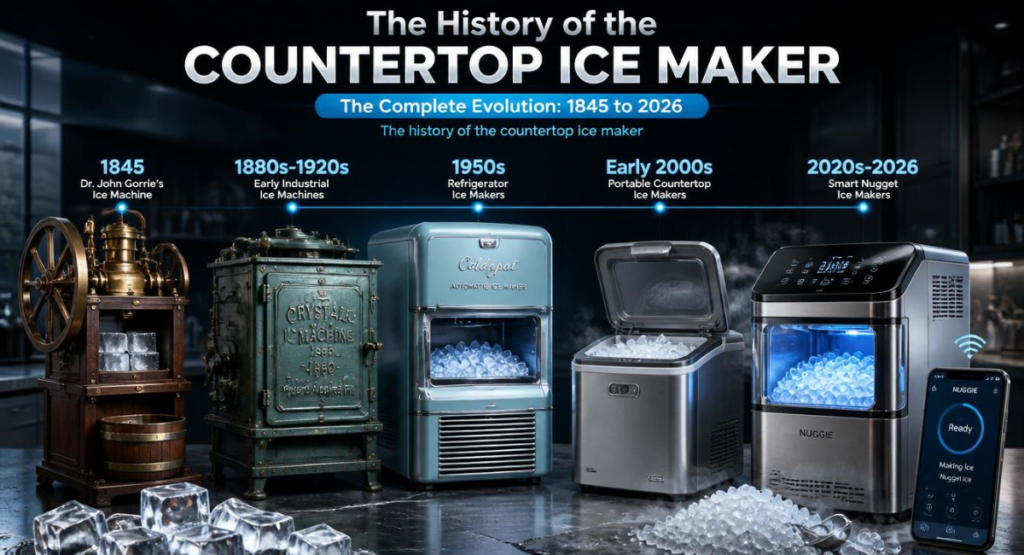
This is the complete history of the countertop ice maker — from John Gorrie’s groundbreaking 1845 invention that earned him the title “Father of Refrigeration,” through hand-cranked household machines, mid-20th-century built-ins, and finally to the smart WiFi-enabled nugget ice makers that dominate today’s market.
Whether you own a GoveeLife Smart Nugget Ice Maker Pro, a Typhur Fast Nugget Ice Maker, or any modern countertop unit, understanding this history helps you appreciate just how revolutionary today’s technology really is. Let’s dive in.
⚡ Quick Answer
The countertop ice maker traces back to Dr. John Gorrie in 1845, who invented the first mechanical ice maker. Commercial ice machines emerged in 1866 (Thaddeus Lowe), built-in residential models appeared in the 1950s, and the modern portable countertop ice maker as we know it became widely available in the early 2000s. Smart nugget ice makers exploded in popularity after GE Profile Opal launched in 2015.
Table of Contents
Before Machines: The Ice Trade Era (1800–1845)
Before any machine could make ice, ice itself was a luxury commodity. Wealthy households in the early 1800s relied on the “natural ice trade” — workers harvested huge blocks from frozen lakes and rivers, especially in New England, and shipped them by horse and railroad to warmer cities and even tropical countries.
The biggest name in this era was Frederic Tudor, known as the “Ice King” of Boston. Starting in 1806, Tudor built an empire shipping ice from Massachusetts lakes to the Caribbean, India, and the American South. He insulated his cargo with sawdust to prevent melting and made a fortune.
But this system had two huge problems:
- It was expensive — only the wealthy could afford regular ice
- It was unreliable — warm winters meant less ice harvest
This created the perfect conditions for someone to invent artificial ice. That someone was Dr. John Gorrie.
1845: Dr. John Gorrie’s Revolutionary Invention
The story of the countertop ice maker truly begins with Dr. John Gorrie, a physician working in Apalachicola, Florida, in the 1840s. Gorrie was treating malaria and yellow fever patients in the hot, humid climate, and he believed that cooling sickrooms with ice would aid recovery.
At the time, ice had to be shipped from the North — a slow, expensive, and unreliable process. Gorrie reasoned: if he could make ice locally, he could save lives.
Gorrie’s Mechanical Refrigeration Process
In 1845, Gorrie built his first working mechanical ice maker. The principle was elegant:
- Compress air using a steam-powered piston
- Cool the compressed air
- Release the compressed air, which expanded and dropped dramatically in temperature
- Use this cold air to freeze water into ice blocks
This is the fundamental principle that every refrigerator and ice maker — from the giant industrial units to your countertop GoveeLife Pro — still uses today.
The 1851 Patent and Tragic Story
Gorrie received U.S. Patent 8080 on May 6, 1851 for his “Improved Process for the Artificial Production of Ice.” It was the first ice machine patent in U.S. history.
But Gorrie’s success was sabotaged. Frederic Tudor, the Ice King, saw artificial ice as a threat to his natural ice empire. Tudor launched a smear campaign against Gorrie’s invention, calling it “ungodly” and unsafe. Combined with the death of Gorrie’s financial backer, this destroyed Gorrie’s plans for commercial production.
Dr. John Gorrie died in 1855, humiliated and financially ruined — but his invention lived on. Today, his original ice machine is preserved at the Smithsonian Institution, and Florida honors him with a statue in the U.S. Capitol’s National Statuary Hall.
1866–1900: The Birth of Commercial Ice Machines
While Gorrie’s invention failed commercially, other inventors picked up where he left off:
1853: Alexander Twining’s Patent
Alexander Twining received the second major ice machine patent. His machine was the first to scale up for commercial use, leading to the first commercial refrigeration system in the U.S. in 1856.
1866: Thaddeus Lowe’s First Commercial Success
Thaddeus Lowe — a Civil War aeronaut who had built observation balloons for the Union Army — invented the first successful commercial ice machine. Lowe’s machine actually made ice profitably, ending decades of failed attempts.
1870s–1890s: The Industrial Era
By the 1870s, industrial ice plants were springing up across America and Europe. These massive machines could produce hundreds of pounds of ice daily, supplying:
- Breweries (for keeping beer cold)
- Meat packing houses
- Hotels and restaurants
- Railroad refrigerator cars
- Shipping vessels for fish and produce
The natural ice trade collapsed by 1900 as artificial ice became cheaper and more reliable.
1880s–1920s: Hand-Cranked Household Ice Makers
The first attempt at residential ice making came in the 1880s with hand-cranked machines. These weren’t quite “countertop ice makers” in the modern sense — they required serious physical labor.
How Hand-Cranked Ice Makers Worked
A typical hand-cranked ice maker consisted of:
- An outer wooden bucket filled with a freezing solution (ice + salt water)
- An inner metal canister holding water
- A hand crank with paddles to stir the water
You’d turn the crank for 20-30 minutes until the water froze into ice. These machines were popular in:
- Farmhouses without electricity
- Small shops and ice cream parlors
- Households that could afford the labor
This era produced what would become a uniquely American institution: the summer ice cream social, where families would gather and take turns cranking ice cream makers.
1920s–1950s: The Electric Revolution
The widespread adoption of electricity in American homes during the 1920s transformed ice making completely. Two major developments stand out:
1920s: The Mechanical Refrigerator Boom
General Electric introduced the “Monitor Top” refrigerator in 1927 — the first widely successful electric refrigerator with a built-in freezer compartment. Families could now make their own ice using metal trays.
But the process was slow and clunky: fill trays with water, place in freezer, wait 4-6 hours, twist trays to release ice cubes. There was nothing “automatic” about it.
1929: The First Tube Ice Machine
Industrial ice production leaped with the invention of the tube ice machine — a commercial system that produced cylindrical ice tubes much faster than block ice. This technology would later inspire the bullet ice makers we see today.
1940s–1950s: Automatic Ice Makers Emerge
The first truly automatic refrigerator ice makers were introduced in the late 1940s, and by 1953, Servel released the first commercially successful automatic ice maker for home freezers. No more twisting metal trays — the freezer made ice on its own.
1950s–1970s: Built-In Refrigerator Ice Makers
By the 1960s, automatic ice makers became standard in higher-end refrigerators. These produced the classic crescent-shaped or half-moon ice cubes you might remember from your parents’ or grandparents’ kitchen.
The Crescent Ice Era
The crescent shape was the result of curved metal molds that fed water through and ejected ice into a bin. It dominated home ice making for nearly 50 years.
Through-the-Door Ice Dispensers
In 1965, General Motors’ Frigidaire division introduced the first through-the-door ice dispenser — a major luxury feature that became standard in premium refrigerators by the 1980s.
The Problem With Built-In Ice Makers
Built-in systems had a fatal flaw: they could only make ice as fast as your freezer could freeze it. Hosting a party meant waiting hours or buying bagged ice. This limitation set the stage for the next innovation.
1970s–1990s: The Commercial Ice Machine Boom
While home ice making improved slowly, commercial ice machines exploded with innovation in the 1970s and 80s.
1981: Scotsman’s Nugget Ice Patent
Scotsman Industries patented their “Brilliance” nugget ice technology in the 1980s — using an auger to compress flake ice into soft, chewable pellets. This is the same fundamental design used in today’s residential nugget ice makers.
Restaurant chains like Sonic Drive-In and Chick-fil-A built reputations around their addictive nugget ice. Hospitals favored it because patients could chew it safely. By the 1990s, commercial nugget ice was a $200+ million market.
The 1990s: Hospitality Ice Variety
Commercial ice machines diversified into many shapes:
- Bullet ice — cylindrical, clear, melts slowly
- Crescent ice — traditional shape
- Cubed ice — square, clear, classic
- Flake ice — soft, used in seafood displays and medical applications
- Nugget ice — soft, chewable, perfect for cocktails
- Gourmet/sphere ice — large, slow-melting, premium
For more on these types, see our complete guide to what type of ice Sonic ice is.
2000s: The Portable Countertop Era Begins
The 2000s brought the most important shift in ice maker history: true portability. Engineers figured out how to shrink commercial-grade technology into compact countertop units that didn’t require water line plumbing.
2003–2005: First Consumer Countertop Ice Makers
The first widely available portable countertop ice makers were introduced by companies such as Magic Chef, NewAir, and Whynter. These produced bullet-style ice in 6-10 minutes from a built-in water reservoir.
Key Features That Made This Possible
- Compact compressor technology (borrowed from mini-fridges)
- Self-contained water reservoirs (no plumbing needed)
- Insulated ice baskets (kept ice from melting too fast)
- Affordable manufacturing (mass production in Asia)
The Market Explosion
By 2010, portable countertop ice makers were a mainstream product. RV owners, apartment dwellers, party hosts, and small business operators all embraced them. Brands like Igloo entered the space with their popular handled portable ice makers, making countertop ice accessible to mainstream buyers.
2015: The GE Opal Nugget Ice Revolution
The biggest moment in modern countertop ice maker history came in September 2015, when GE Appliances launched the Profile Opal Nugget Ice Maker on Indiegogo.
The Indiegogo Crowdfunding Phenomenon
GE’s crowdfunding campaign was meant to raise $150,000. It raised $2.7 million — making it Indiegogo’s most successful campaign at that time. The demand for residential nugget ice was massive.
Why It Was Revolutionary
The Opal brought commercial-grade Scotsman-style nugget ice into homes for the first time. Sonic and Chick-fil-A fans could finally have “the good ice” without driving to a restaurant.
Key Opal innovations:
- True nugget (chewable pebble) ice from a residential machine
- Wi-Fi connectivity and app control (added in Opal 2.0)
- Self-cleaning cycles
- UV light and scale-inhibiting filter
- Sleek, kitchen-friendly design
Competitors Flood the Market
The Opal’s success triggered a wave of competitor products. By 2020, brands like Frigidaire, Newair, Whynter, EUHOMY, and Igloo all had nugget ice makers. By 2024-2026, the market exploded with smart, premium models from brands like GoveeLife, Typhur, Silonn, Aeitto, and Kismile.
See our roundup of the 7 best self-cleaning countertop ice makers for the current market.
2020s: Smart, Connected, Self-Cleaning
The current era of countertop ice makers is defined by three major trends: smart connectivity, advanced self-cleaning, and ultra-quiet operation.
Trend 1: Smart Home Integration
Modern premium ice makers connect to your home Wi-Fi and integrate with Alexa, Google Assistant, and proprietary apps. Features include:
- Schedule ice production from your phone
- Voice commands (“Alexa, start the ice maker”)
- Status notifications (water low, basket full)
- Cleaning reminders based on usage
- Customizable LED lighting
The GoveeLife Smart Nugget Ice Maker Pro and Silonn Nugget Ice Maker are leading examples of this smart-first approach.
Trend 2: Advanced Self-Cleaning Systems
Self-cleaning has evolved far beyond basic water flushing. Modern systems include:
- Dual cleaning modes (quick + deep) — pioneered by GoveeLife Pro
- High-pressure pump cleaning — like the Typhur Fast Nugget Ice Maker
- UV sterilization — common in GE Opal models
- Scale-inhibiting filters
- Removable, dishwasher-safe water tanks
Trend 3: Ultra-Quiet Operation
Older nugget ice makers were notoriously loud (55-65 dB). Modern engineering has dramatically reduced noise. The GoveeLife Pro’s AI NoiseGuard system operates at just 40 dB — quieter than most refrigerators.
Trend 4: Speed Improvements
First-ice production times have dropped dramatically:
| Era | First Ice Time |
|---|---|
| 2005-2010 | 15-20 minutes |
| 2015 (GE Opal) | 10-12 minutes |
| 2020 | 8-10 minutes |
| 2024 (GoveeLife Pro) | 6 minutes |
| 2026 (Aeitto) | 5 minutes |
The Future of Ice Makers
Looking ahead to the next decade, several emerging trends promise to redefine countertop ice makers again:
AI and Predictive Maintenance
Future ice makers will use AI to predict when cleaning is needed, when components are wearing out, and even when you’ll need ice based on your habits. Some models in 2026 already include basic AI features like GoveeLife’s NoiseGuard.
Sustainable & Eco-Friendly Models
Energy Star certified ice makers are becoming standard. Future models will use:
- R-290 propane refrigerant (lower environmental impact)
- Solar-compatible power options
- Water recycling systems
- Recyclable construction materials
Specialty Ice On Demand
Imagine pressing a button for clear cocktail spheres, then another for crushed nugget ice — all from one machine. Multi-mode ice makers are already being prototyped.
Direct Water Line + Reservoir Hybrid
Hybrid systems that can run from either a built-in tank OR a plumbed water line are gaining popularity, especially for kitchen integrations.
Voice and Gesture Control
Beyond Alexa and Google, future ice makers may use gesture sensors — wave your hand over the machine to dispense a specific amount of ice.
Quick Reference: Major Milestones
| Year | Event | Inventor/Company |
|---|---|---|
| 1806 | Natural ice trade begins | Frederic Tudor (Boston) |
| 1845 | First mechanical ice maker built | Dr. John Gorrie |
| 1851 | First U.S. ice machine patent (8080) | Dr. John Gorrie |
| 1853 | Second major patent | Alexander Twining |
| 1866 | First successful commercial ice machine | Thaddeus Lowe |
| 1880s | Hand-cranked household ice makers | Various |
| 1927 | First successful electric refrigerator | General Electric |
| 1929 | First tube ice machine | Vogt Ice Co. |
| 1953 | First successful automatic home ice maker | Servel |
| 1965 | First through-door ice dispenser | Frigidaire |
| 1981 | Scotsman nugget ice technology | Scotsman Industries |
| 2003 | First consumer countertop ice makers | Magic Chef, Whynter |
| 2015 | GE Opal nugget revolution | GE Appliances |
| 2024 | AI NoiseGuard technology | GoveeLife |
| 2026 | 5-minute first-ice milestone | Aeitto |
FAQ — History of the Countertop Ice Maker
Who invented the first ice maker?
Dr. John Gorrie, an American physician from Florida, invented the first mechanical ice maker around 1845. He received U.S. Patent 8080 in 1851 for his refrigeration machine. Gorrie is widely considered the father of modern refrigeration, though his invention was too expensive to produce commercially during his lifetime.
When was the first countertop ice maker invented?
The first compact residential ice makers emerged in the 1950s as built-in refrigerator ice makers. Truly portable countertop ice makers as we know them today appeared in the early 2000s.
What was the first ice maker called?
Dr. John Gorrie’s original invention was patented as a “machine for the artificial production of ice” in 1851. It was an air-compression refrigeration device, not a countertop model. The first commercial ice machine came from Thaddeus Lowe in 1866.
When did nugget ice makers become popular?
Commercial nugget ice machines have existed since the 1980s, primarily made by Scotsman for restaurants like Sonic Drive-In and Chick-fil-A. Residential countertop nugget ice makers became popular after GE released the Profile Opal in 2015 through Indiegogo, which raised $2.7 million and sparked massive consumer demand for Sonic-style chewable ice at home.
Why was John Gorrie’s ice machine not successful?
Frederic Tudor, the wealthy “Ice King” of Boston who dominated the natural ice trade, saw Gorrie’s invention as a threat to his empire. Tudor launched a smear campaign calling artificial ice “ungodly” and unsafe. Combined with the death of Gorrie’s financial backer, this destroyed his commercial plans. Gorrie died in 1855, humiliated and bankrupt.
What is the difference between old and modern ice makers?
Old ice makers (1950s-2000s) were built into refrigerators and made crescent or cubed ice slowly. Modern countertop ice makers are portable, produce ice in 5-10 minutes, offer multiple ice types (nugget, bullet, pebble), and feature smart connectivity, self-cleaning, and ultra-quiet operation.
Who made the first portable countertop ice maker?
Multiple companies released early portable countertop ice makers in the early 2000s, including Magic Chef, NewAir, and Whynter. There’s no single “first” brand, but these manufacturers pioneered the consumer market between 2003 and 2008.
How did countertop ice makers change after the GE Opal?
The GE Opal launched in 2015 and proved there was massive consumer demand for nugget ice at home. After its success, brands like Frigidaire, Newair, Whynter, EUHOMY, Igloo, GoveeLife, Typhur, Silonn, Aeitto, and Kismile all entered the nugget ice market, leading to today’s competitive landscape with smart features, app control, and self-cleaning systems.
What’s the next big innovation in ice makers?
The next decade will likely bring AI-powered predictive maintenance, eco-friendly refrigerants, water recycling, multi-mode machines that produce different ice types on demand, and deeper smart-home integration with voice and gesture controls.
Final Thoughts
From Dr. John Gorrie’s wooden-frame steam contraption in 1845 to the AI-powered, app-controlled smart nugget ice makers of 2026, the countertop ice maker has undergone 180 years of remarkable evolution. What started as a desperate attempt to cool malaria patients in Florida has become a $5+ billion global industry that touches almost every modern household.
The next time you press the button on your GoveeLife Pro, Typhur, Silonn, or Aeitto countertop ice maker and watch fresh ice tumble out in 5-6 minutes, take a moment to appreciate the generations of inventors who made it possible.
Dr. Gorrie may have died bankrupt, but his vision changed the world. Every modern ice maker — whether commercial or countertop — is built on the principles he pioneered. That’s a legacy worth celebrating, one ice cube at a time.
More From IceMakerReviews.com
📖 Related Guides
- 7 Best Countertop Ice Makers With Self-Cleaning in 2026
- What Type of Ice Is Sonic Ice? Full Guide to Nugget Ice
- Best Commercial Ice Maker for Restaurants 2026
- How to Clean the Igloo Ice Maker — Step-by-Step
- Can You Leave a Portable Ice Maker On All the Time?
- How to Use the Insignia Ice Maker — Beginner’s Guide
📖 Product Reviews
- GoveeLife Smart Nugget Ice Maker Pro Review
- Typhur Fast Nugget Ice Maker Review
- Silonn Nugget Ice Maker Review
- Aeitto Nugget Ice Maker Review
Published by Waseem Khan on IceMakerReviews.com. Read our Affiliate Disclosure, Privacy Policy, and Terms and Conditions. This article was last updated on May 29, 2026.
Affiliate disclosure
As an Amazon Associate, IceMakerReviews.com earns from qualifying purchases at no extra cost to you. Read our full disclosure.