It seems like a simple question. You need an ice maker, you look at a few options online, and suddenly you are staring at numbers like “26 lbs/day” and “44 lbs/day” with no idea what any of that means for your actual kitchen, your actual family, and your actual drink habits. Then you buy something based on price alone, and two weeks later either you are constantly running out of ice or you have a machine that runs non-stop and makes way more than you can ever use.
Both situations are frustrating. And both are completely avoidable if you know how to match an ice maker’s capacity to your home before you buy.
This guide breaks it all down — in plain language, with real numbers, and without pushing you toward any specific product. By the time you finish reading, you will know exactly what size ice maker you need for your home, your family, and the way you actually live.
📋 In This Guide
- What “Size” Actually Means for an Ice Maker
- How Much Ice Does a Home Actually Use Per Day?
- Recommended Capacity by Family Size
- Recommended Capacity by Use Case
- Quick Reference Chart
- Countertop vs Undercounter vs Freestanding
- Physical Dimensions — Will It Actually Fit?
- Does the Type of Ice Change How Much You Need?
- 5 Sizing Mistakes People Make
- Frequently Asked Questions
- Final Verdict
What “Size” Actually Means for an Ice Maker
When most people think about the size of an ice maker, they picture how much counter space it takes up. That matters — but it is actually the second thing you should think about. The first and most important measure of “size” for an ice maker is its daily ice production capacity, measured in pounds per day (lbs/day).
These are two completely separate things, and confusing them leads to bad buying decisions.
1. Daily Ice Production (the number that actually matters)
Every ice maker has a rated capacity — something like “26 lbs per day” or “40 lbs per day.” This tells you how much ice the machine can produce in a full 24-hour period under ideal conditions (a cool room, cold water, continuous cycling). It does not tell you how much ice it stores at any one time. It just tells you the machine’s maximum output over an entire day.
Think of it like a coffee machine’s flow rate. A higher number means faster production over time — not a bigger tank.
2. Storage Capacity (often overlooked)
Separate from production capacity, some ice makers also have a built-in storage bin — a reservoir inside the machine that holds finished ice. Countertop models typically hold only 1 to 2 lbs at a time in a small basket. Undercounter units often have bins holding 20 to 30 lbs. The storage capacity tells you how much ready ice is available right now, without cycling.
3. Physical Dimensions (fits the space)
Finally, there are the actual physical measurements — width, depth, and height. This determines whether the machine can sit on your counter, fit under a cabinet, or slide into a built-in niche. We cover this in detail in the physical dimensions section below.
How Much Ice Does a Home Actually Use Per Day?
Here is something most buying guides skip entirely: a real baseline for how much ice an average American household actually uses.
Research published by Lawrence Berkeley National Laboratory found that the average US household uses roughly 1.8 lbs of ice per day across all purposes — drinks, cooling, food prep, and everything else. That number climbs significantly during summer months, during parties, and in households where iced coffee, smoothies, or cocktails are a daily routine.
Meanwhile, the average built-in refrigerator ice maker produces only about 3.5 lbs of ice per day. That is just barely enough for a couple of people with moderate drink habits — and nowhere near enough the moment you have guests over or the summer heat kicks in.
This is exactly why standalone ice makers exist. Even a basic countertop model producing 26 lbs per day gives you seven times what your refrigerator can manage. For most homes, that is a genuine quality-of-life upgrade.
To estimate your personal daily ice need, think about these factors:
- Drinks per person: Each glass of iced water, iced coffee, or soda uses roughly a quarter to half a pound of ice
- How often you entertain: A casual gathering of 10 people can go through 15–20 lbs of ice easily
- Seasonal habits: Ice use typically doubles in summer compared to winter in most American homes
- Kids at home: Families with children tend to go through significantly more ice — sports bottles, after-school drinks, water bottles
Recommended Ice Maker Capacity by Family Size
The simplest way to narrow down your size decision is to start with how many people live in your home. Here is a practical breakdown based on typical daily usage patterns in American households:
One practical rule that helps: choose an ice maker that produces 1.5 to 2 times your estimated daily need. This buffer prevents shortages during peak hours, accounts for days when the machine runs in a warm room (which slows output), and means the machine does not have to work at 100% capacity all day — which helps it last longer.
Recommended Capacity by Use Case
Family size is a great starting point, but how you actually use ice matters just as much. Here are the most common home use cases and what each one calls for:
Everyday Drinks and Iced Coffee
If your main need is cold drinks throughout the day — water, iced tea, iced coffee, juice — a machine producing 20 to 26 lbs per day is more than sufficient for one or two people. This covers the standard countertop ice maker category perfectly. You get ice in about 6–8 minutes per batch and never have to think about it during a normal day.
Family Kitchen Use
For a busy household kitchen where several people grab ice throughout the day — for water bottles, after-school drinks, cooking, and evening beverages — you want something in the 26 to 34 lbs per day range. A machine in this range stays ahead of demand without taking up significant counter space.
Home Bar
A dedicated home bar is where ice demand can catch people off guard. Cocktails, mixed drinks, and ice buckets for bottles — these add up fast. For a home bar that sees regular use, experts generally recommend at least 50 lbs per day, and for a well-used garage bar or entertainment space, a 100 lbs/day undercounter unit is the more reliable long-term choice. For occasional home bar use, a strong countertop model at 26–40 lbs per day can work with some advance planning.
Outdoor Entertaining and BBQs
Summer parties change everything. If you are regularly hosting backyard BBQs, pool parties, or holiday cookouts, plan on roughly 1 to 1.5 lbs of ice per person per event for drinks alone — more if you are filling coolers or using ice buckets for bottles. A party of 20 needs 20–30 lbs minimum just for beverages. For active entertainers, a high-output countertop machine (40+ lbs/day) or a compact undercounter unit makes far more sense than relying on a basic 26 lb model.
Dorm Room or Small Apartment
Tight space, one or two people, mostly drinks. A compact countertop ice maker in the 20–26 lbs/day range is the right call. It sits on a desk or counter, needs no plumbing, and produces plenty of ice for one person’s daily needs. Physical size is more important here than capacity — look for units under 9 inches wide.
Quick Reference Chart — Ice Maker Size by Home Need
📊 Ice Maker Size Guide at a Glance
| Home Situation | Daily Ice Need | Recommended Capacity | Machine Type |
|---|---|---|---|
| 1–2 people, casual use | 3–5 lbs/day | 20–26 lbs/day | Countertop |
| Family of 3–4, daily drinks | 8–12 lbs/day | 26–34 lbs/day | Countertop or undercounter |
| Large family, 5+ people | 15–20 lbs/day | 34–50 lbs/day | Countertop (high-output) or undercounter |
| Dorm room / apartment | 2–4 lbs/day | 20–26 lbs/day | Compact countertop |
| Home bar (occasional) | 10–20 lbs/event | 40–60 lbs/day | Countertop (high-output) |
| Home bar (regular use) | 20–40 lbs/day | 75–100 lbs/day | Undercounter |
| Parties / entertaining (20+ guests) | 30–50 lbs/event | 50–100 lbs/day | Undercounter or freestanding |
| RV / camping | 3–6 lbs/day | 20–26 lbs/day | Portable countertop |
Countertop vs Undercounter vs Freestanding — Which Size Type Is Right for You?
Once you know the capacity range you need, the next decision is the type of machine. These three categories represent very different approaches to ice making at home — and they are not interchangeable.
Countertop Ice Makers
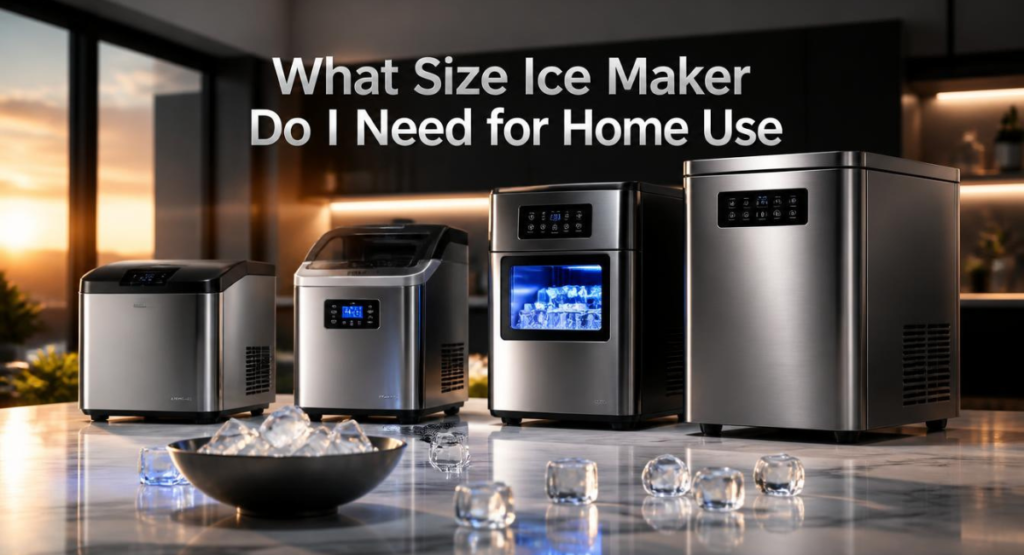
Countertop ice makers are the most popular choice for home use because they are portable, require no plumbing, and fit in almost any space. You fill the water tank manually, the machine cycles ice in 6–10 minutes, and you scoop it out as needed. Most countertop models produce between 20 and 40 lbs of ice per day. They are perfect for single users, couples, small families, dorm rooms, RVs, and home offices.
The trade-off: the ice basket holds only 1–2 lbs at a time, and ice melts back into the reservoir if not used promptly. There is no active storage refrigeration in a standard countertop model.
Undercounter Ice Makers
Undercounter ice makers are installed permanently under a countertop, much like a dishwasher. They connect to a water line, so you never fill a tank manually. Most include a real storage bin that actively keeps ice frozen — often holding 20–30 lbs. Daily production typically ranges from 50 to 100+ lbs per day. These are the right choice for home bars, kitchen islands, and any household that needs ice ready on demand throughout the day without thinking about it.
The trade-off: installation is required, they are not portable, and the upfront cost is significantly higher than a countertop model.
Freestanding Ice Makers
Freestanding units are larger, floor-standing machines typically used in commercial or semi-commercial settings. For most home users, a freestanding machine is more than you need — and it takes up significant floor space. However, for serious entertainers with a dedicated bar area or large outdoor kitchen, a freestanding unit with 100+ lbs/day capacity is a legitimate home investment.
Physical Dimensions — Will It Actually Fit?
Capacity is the most important number, but dimensions are what determine whether your chosen machine can actually live in your space. Before purchasing, measure your intended spot and check three things:
| Machine Type | Typical Width | Typical Depth | Typical Height | Clearance Needed |
|---|---|---|---|---|
| Compact countertop (20–26 lbs) | 8–10 inches | 10–12 inches | 11–13 inches | 6 inches on all sides |
| Standard countertop (26–40 lbs) | 10–14 inches | 12–14 inches | 13–15 inches | 6 inches on all sides |
| Undercounter (50–100 lbs) | 15–18 inches | 22–24 inches | 32–34 inches | Front-vented or side-vented |
| Freestanding commercial | 22–30 inches | 24–28 inches | 36–42 inches | 6+ inches on all sides |
Two things most people forget when measuring:
- Ventilation clearance: Every ice maker needs breathing room — typically 6 inches on all sides, including the back. Pushing it flush against a wall blocks airflow, causes overheating, and reduces ice output significantly. This is one of the most common reasons countertop ice makers underperform.
- Cabinet height overhead: If your ice maker sits under cabinets, make sure the lid can open fully. Most countertop models open from the top, and you need at least a few inches of clearance above the machine to scoop ice comfortably.
Does the Type of Ice Change How Much You Need?
Yes — and this is something most buying guides do not explain clearly. Different ice types melt at different rates, which directly affects how much ice you go through per day.
Bullet Ice
Bullet ice is the hollow, cylindrical ice produced by most standard countertop ice makers. It is fast to produce (6–8 minutes per batch) and works well for casual drinks, water, and general use. Because it is hollow, it has a larger surface area and melts a bit faster than solid cube ice. If your household uses mostly bullet ice, expect to go through it a bit faster — meaning your ice maker needs to cycle more frequently.
Nugget Ice (Pebble or Sonic Ice)
Nugget ice — the soft, chewable, pebble-like ice popularized by Sonic Drive-In — is beloved for iced coffee, smoothies, and cold drinks. It is softer and more porous than bullet ice, which means it melts faster and absorbs drink flavor more readily. Nugget ice machines produce ice at a slower rate than bullet ice makers, so if nugget ice is your preference, account for slightly lower daily output at a given capacity rating. For more on nugget ice machines specifically, check our Silonn ice maker reviews which cover several nugget-style options.
Clear Cube Ice
Clear ice is dense, slow-melting, and visually striking in cocktails. It melts much more slowly than both bullet and nugget ice — meaning you get more time from each cube and go through ice more slowly overall. If your priority is a home bar with premium cocktails, a clear ice maker often means you need less daily production capacity than you might think, because each batch lasts significantly longer in the glass.
| Ice Type | Melt Speed | Best For | Daily Need Adjustment |
|---|---|---|---|
| Bullet ice | Fast | Water, casual drinks, general use | Standard estimate |
| Nugget ice | Fastest | Iced coffee, smoothies, chewing | Add 20–30% to estimate |
| Clear cube ice | Slowest | Cocktails, whiskey, premium drinks | Subtract 20% from estimate |
| Crushed ice | Very fast | Blended drinks, coolers, injuries | Add 30–40% to estimate |
5 Sizing Mistakes People Make When Buying a Home Ice Maker
After looking at dozens of home ice maker buying experiences, the same sizing mistakes come up over and over again. Here they are, so you can avoid them:
Mistake 1: Buying Based on Price Alone
The cheapest option is often a small countertop machine producing 20–26 lbs per day. For a single person, that is fine. For a family of four, it becomes a machine that runs constantly and still cannot keep up. The cost of getting the wrong size — frustration, wasted energy, early replacement — is almost always higher than the cost of stepping up one tier from the start.
Mistake 2: Forgetting About Summer
Ice use in American homes roughly doubles in summer. A machine that is “just enough” in January will leave you short in July. When sizing your machine, think about your peak summer demand — not your average year-round usage. That is the real stress test for your ice maker.
Mistake 3: Confusing Production Capacity with Storage
A machine that makes 26 lbs per day does not have 26 lbs of ice sitting ready to grab. Most countertop models hold only 1–2 lbs in the basket at one time. If you need 10 lbs of ice ready immediately for a party, you need to either plan ahead, use a machine with a proper storage bin, or have a secondary freezer to stockpile ice in advance.
Mistake 4: Ignoring Ventilation Space
Tucking an ice maker into a tight cabinet nook or pushing it flush against a wall cuts its actual output dramatically — sometimes by 30–40% — because the machine cannot dissipate heat efficiently. If your space does not allow for proper clearance, reconsider the placement or choose a machine designed for tight-space installation.
Mistake 5: Not Accounting for Guest Days
Your daily household ice use is one number. Your ice use on the day you host Thanksgiving, a birthday party, or a summer BBQ is a completely different number. If you entertain even occasionally, size your machine for those peak moments — not the quiet Tuesday evening.
Frequently Asked Questions
A family of four with typical drink habits — water, iced tea, the occasional soda — uses roughly 8 to 12 lbs of ice on a regular day. To account for summer peaks and the occasional gathering, a machine producing 26 to 34 lbs per day is the right target. This gives you a comfortable buffer without oversizing.
For one or two people with everyday drink habits, yes — a 26 lbs per day machine is more than enough. For a family of three or four, it works but leaves less margin on busy days. For regular entertaining or a family of five or more, you will want something higher. The 26 lbs/day category is the most popular for home use because it covers the widest range of basic needs at an accessible price point.
Plan on roughly 1 to 1.5 lbs of ice per person for drinks alone. For 20 guests, that is 20–30 lbs minimum — and more if you are filling coolers, chilling bottles, or serving food that needs ice. If you do not own a machine that produces enough in one day, you can always run your machine continuously for a day or two before the event and store the ice in your freezer to build up a reserve.
For most households, yes — and often it produces significantly more ice than the built-in refrigerator ice maker, which typically manages only 3.5 lbs per day. Even a basic countertop model at 26 lbs per day is a major upgrade in production. The difference is convenience: a countertop model requires manual water filling and ice scooping, while a built-in refrigerator ice maker is fully automatic once plumbed in.
According to research from Lawrence Berkeley National Laboratory, the average US household uses about 1.8 lbs of ice per day in total. Per person, that is roughly 0.5 to 1 lb on a normal day for casual beverage use. Active households, hot climates, and heavy iced-drink habits can push that to 2–3 lbs per person per day easily.
In most cases, yes — size up rather than down. Ice makers that are slightly oversized for your daily needs cycle less frequently, experience less wear, and last longer. A machine running at 60–70% capacity all day will outlast one running at 100% by a significant margin. The cost difference between one capacity tier is usually small enough that sizing up is almost always the smarter long-term decision.
For a small apartment or studio, a compact countertop ice maker in the 20–26 lbs/day range is ideal. Look for a footprint under 10 inches wide and a height under 13 inches so it fits comfortably on a counter or small table without dominating the space. The mini ice maker guide on Ice Maker Reviews covers the best compact options currently available.
Final Verdict — What Size Ice Maker Do You Actually Need?
The right ice maker size is the one that matches your real daily habits — not the biggest machine on the shelf, and not the cheapest option either. Here is a simple final summary:
- 1–2 people, casual use: 20–26 lbs/day countertop model
- Family of 3–4: 26–34 lbs/day countertop model
- Large family or frequent entertaining: 40–60 lbs/day high-output countertop or entry-level undercounter
- Serious home bar or regular hosting: 75–100 lbs/day undercounter unit
- Dorm room, RV, or small apartment: 20–26 lbs/day compact countertop
The most important thing to remember is that ice maker capacity ratings are measured under ideal conditions — a cool room, cold water, continuous cycling. In a warm summer kitchen, actual output can be 10–20% lower than the rated capacity. That is another reason to size up when in doubt.
Take the time to measure your intended space, think honestly about your peak ice days — not just your average Tuesday — and choose a machine that gives you headroom rather than running at its limit every day. Your ice maker will last longer, perform better, and make your life genuinely easier.
For hands-on reviews of specific models, explore the Ice Maker Reviews blog, where every machine is evaluated on real-world performance — not just spec sheets.
External References
- Lawrence Berkeley National Laboratory — Ice-Making in the U.S.: Household Ice Use Survey
- U.S. Department of Energy — Energy Efficiency in Home Refrigeration Appliances
- Consumer Reports — Ice Maker Ratings and Lab Tests
- EPA Energy Star — Refrigerator and Ice Maker Efficiency Requirements (PDF)
- NRDC — How to Save Energy in Your Kitchen (Appliance Guide)