Introduction
You glance over at your ice maker, and there it is — a red light blinking away like a tiny alarm siren. No ice. No explanation. Just that unsettling red glow.
Good news: in most cases, a flashing red light on your ice maker is not a sign of total failure. It is your machine’s way of telling you something specific is wrong, and once you understand what it means, you can fix it yourself in a matter of minutes.”
In this complete guide, we will cover every reason your ice maker red light is flashing — across all major brands, including GE, Whirlpool, LG, Samsung, Frigidaire, KitchenAid, Kenmore, and portable countertop models. We will also walk you through exact step-by-step fixes, tell you when to call a technician, and help you prevent the problem from coming back.
💡 Pro Tip: Bookmark this page before you start troubleshooting. You will likely need to refer back to specific sections as you work through each fix.
Table of Contents
1. What Does a Flashing Red Light on an Ice Maker Actually Mean?
Ice makers use indicator lights to communicate status and errors — similar to the check engine light in your car. A red light that is flashing (as opposed to solid) almost always indicates a fault condition or a preventive alert. The machine has detected something outside of normal operating parameters and has paused or stopped ice production to avoid damage.
The critical thing to understand is this: the meaning of the red light depends entirely on the brand, model, and the blinking pattern. A slow single blink means something very different from a fast double-blink on the same machine.
Portable vs. Built-In Ice Makers: Key Differences
Before diving into causes and fixes, it helps to know which type of ice maker you have, because the red light signals work differently:
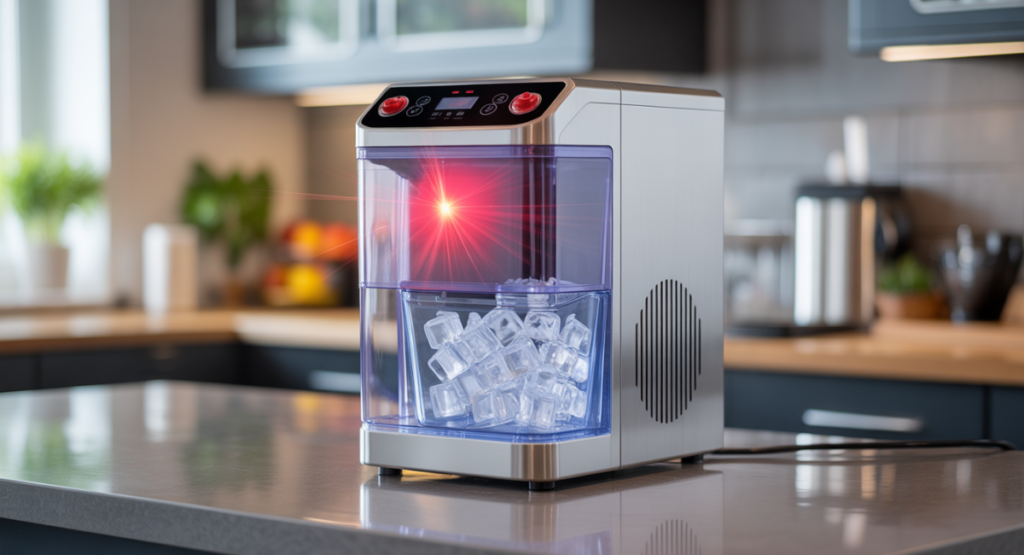
⦁ Portable / countertop ice makers (like Frigidaire EFIC117, IKICH, Ecozy, Oraimo): These typically have dedicated indicator lights labeled ‘Add Water,’ ‘Ice Full,’ or ‘Clean.’ The red light usually points to a water reservoir issue or an ice-basket-full alert.
⦁ Built-in refrigerator ice makers (GE, Whirlpool, LG, Samsung, KitchenAid, Kenmore): These are wired into the refrigerator’s control system. The red light is often located next to the On/Off switch and communicates via blink patterns that correspond to specific error codes.
⦁ Commercial ice machines (Ice-O-Matic, Manitowoc, Hoshizaki): These use a more advanced LED diagnostic system with multiple lights operating together to identify faults.
2. Ice Maker Red Light Flashing: Quick Reference Chart by Blink Pattern
Use this table first. Match your blink pattern to find the likely cause instantly:
| Blink Pattern | Brand | Likely Cause | Quick Fix |
|---|---|---|---|
| Slow flashing (1 blink) | Most brands | Low water / water supply error | Check water line & filter |
| 2 blinks, pause, repeat | Whirlpool / KitchenAid / Kenmore | Sensor or ice jam detected | Clear ice jam, check optical sensor |
| Rapid blinking (fast) | GE / Frigidaire | Fill or drain failure / fault mode | Reset power; call tech if persists |
| Solid red (no blink) | LG / Samsung | Thermostat or ice maker module failure | Replace module or call service |
| Red + Yellow flashing together | Ice-O-Matic commercial | Fill or drain failure | Call commercial tech |
| Red light on ‘Low Water’ indicator | Frigidaire countertop | Clogged filter or bad water sensor | Replace the module or call the service |
3. Top 9 Reasons Your Ice Maker Red Light Is Flashing (With Fixes)
1. Low Water Supply or Water Line Issue
This is the single most common reason for a red blinking light — across every brand. Your ice maker needs a steady, pressurized water supply to operate. If the water inlet valve is not getting enough pressure (the minimum is typically 20 PSI), the machine detects a fill failure and triggers the red light.
How to check and fix it:
- Go behind your refrigerator and locate the water supply line. Make sure the shutoff valve is fully open — it should be turned completely counterclockwise.
- Check the line itself for kinks or pinches. Even a slight bend can restrict flow enough to trigger the sensor.
- Look for any visible cracks or splits in the water line tubing.
- Turn on your water dispenser (if your fridge has one). If water flows normally, your main supply line is fine — the issue is likely in the ice maker’s inlet valve specifically.
- Test your home water pressure with a gauge. Anything below 20 PSI will cause fill failures.
💡 Pro Tip: If the water dispenser works perfectly but the ice maker still shows a red light, the problem is almost certainly the ice maker water inlet valve — not the main supply.
2. Clogged or Expired Water Filter
A dirty water filter is one of the most overlooked causes of ice maker red light flashing — and one of the easiest to fix. Most manufacturers recommend replacing the water filter every 6 months. When the filter gets clogged, water flow to the ice maker drops below the threshold needed to fill the ice mold, triggering an error.
For some models (especially Kenmore and Whirlpool), the control panel will actually display a ‘Replace Filter’ message accompanied by a red light. Other models just show the flashing red without any text explanation.
How to fix it:
- Locate your water filter housing — usually in the upper right corner inside the fridge, in the base grille, or inside the door.
- Remove the old filter (twist counterclockwise or push and release, depending on the model).
- Install a new OEM or certified compatible replacement filter.
- Run 2–3 gallons of water through the dispenser to flush air from the new filter.
- Press the ‘Filter Reset’ button (usually held for 3 seconds) to clear the indicator light.
- Allow 24 hours for the ice maker to resume normal production.
⚠️ Note: Using a non-certified third-party filter can sometimes cause false low-pressure readings. If your red light returns after a new filter install, try a genuine OEM filter.
3. Ice Jam or Blocked Ejector Arm
Ice jams are extremely common — especially in households where the ice maker runs constantly during warm months. When a cube gets stuck in the ejector mechanism or builds up in the ice mold, the motor stalls. The control board detects this stall and flashes the red light to prevent motor damage.
On many models, particularly Whirlpool, KitchenAid, and GE side-by-sides, you will notice the red light blinks twice repeatedly when an ice jam is the cause. This is the machine’s coded way of saying: ‘I tried to harvest and got stuck.’
How to fix it:
- Turn the ice maker OFF using the switch next to the red light.
- Remove the ice bin completely. Look inside the ice maker mechanism for any cubes stuck in the rake/ejector tines.
- Do NOT use a sharp object to remove ice. Use a plastic utensil or your fingers.
- Check that the wire shutoff arm (if your model has one) is in the down position. If it is stuck in the up position, the machine thinks the bin is full and will not make ice.
- Replace the ice bin, switch the ice maker back ON, and wait 15–20 minutes for the first cycle.
💡 Pro Tip: If ice jams are a recurring problem, check that your freezer temperature is set to 0°F (-18°C). Freezers set too warm (above 5°F) produce soft, irregular cubes that are more likely to jam.
4. Frozen Water Fill Tube
The fill tube is the small plastic tube that channels water from the inlet valve into the ice mold. This tube runs through a cold section of the freezer and can ice over completely, especially if the refrigerator door has been left open frequently or the defrost cycle is not working properly.
When the fill tube is frozen, no water reaches the mold. The machine attempts to fill, detects nothing, and triggers the red light. This is a very common cause in older refrigerators or after the ice maker has sat unused for extended periods.
How to fix it:
- Unplug the refrigerator or turn the ice maker off.
- Locate the fill tube — it is usually a small white or clear tube at the back of the freezer ceiling, directly above the ice maker tray.
- Apply gentle heat using a hair dryer on its LOWEST setting. Hold it 6–8 inches from the tube and move it back and forth.
- Alternatively, place a warm (not hot), damp cloth over the tube area and let it sit for 15 minutes.
- Once the ice has melted, dry the area and turn the ice maker back on.
⚠️ Important: Never use boiling water or a heat gun on the fill tube. Excessive heat can warp the plastic and damage the valve behind it.
5. Faulty Water Inlet Valve
The water inlet valve is the solenoid-controlled valve that opens to let water into the ice maker when the control board signals it. Over time, the valve’s solenoid can weaken, the valve screen can clog with mineral deposits, or the valve can fail to open or close fully.
A faulty inlet valve is often misdiagnosed because the water dispenser continues to work fine (since it uses a different section of the same valve in many refrigerators). You will have a red light flashing, no ice production, and perfectly working water from the door.
How to diagnose it:
- Unplug the fridge. Pull it away from the wall.
- Locate the water inlet valve at the back lower section of the refrigerator.
- Inspect the mesh screen on the valve inlet for mineral buildup. If it looks clogged, clean it gently with a toothbrush.
- Use a multimeter set to ohms (Ω). Place the probes on the solenoid terminals of the ice maker section of the valve. A reading of 200–500 ohms is normal. A reading of OL (open loop) means the solenoid is dead and the valve needs replacement.
Replacement valves for most major brands cost between $20 and $60 and can be installed with basic tools in about 30 minutes.
6. Optical Sensor or Infrared Emitter/Receiver Failure
Many refrigerator ice makers — especially Whirlpool, KitchenAid, and Kenmore models — use an infrared optical sensor system to detect whether the ice bin is full. There is an emitter (transmitter board) and a receiver on opposite sides of the ice maker. When the ice level blocks the beam, ice production stops.
When either the emitter or receiver fails, the circuit is never completed. The control board may interpret this as either a perpetually full bin (stopping production entirely) or an error condition (triggering the red light blink). A common symptom: the red light blinks twice repeatedly even after you have removed all ice from the bin.
How to test it:
- Open the freezer and manually press the small white flapper or paddle on the left side of the ice maker (this simulates pressing the flapper that would normally be pressed by ice in a full bin).
- While holding the flapper in, observe the red light. It should switch from flashing to solid red.
- If the light continues to blink even while the flapper is held in, the optical sensor boards (emitter and/or receiver) are likely faulty and need to be replaced.
💡 Pro Tip: This is a commonly misdiagnosed issue. Many people replace the entire ice maker module when all they need is the $15–25 sensor boards. Always test the sensor first.
8. Failed Ice Maker Module, Thermostat, or Control Board
If you have worked through all the above causes and the red light is still flashing, the problem may be internal to the ice maker unit itself. The ice maker module (also called the motor module or harvest control) contains the thermostat, the timing circuit, and the motor driver. When any of these components fail, the red light typically goes solid (not flashing) or flashes continuously with no response to any manual inputs.
Signs that point to module failure:
⦁ The red light blinks, but the ice maker never attempts a harvest cycle, even after a full reset.
⦁ The ice mold fills with water but never freezes or releases ice.
⦁ The ice maker motor runs, but the rake does not complete a full revolution.
⦁ Solid red light that does not respond to pressing the sensor flapper.
In this case, the entire ice maker module typically needs to be replaced. For most built-in refrigerator models, the module costs $50–$150 and is a DIY-friendly repair. For LG and Samsung models, the module is more complex and often requires professional service.
9. Portable Ice Maker Specific Causes
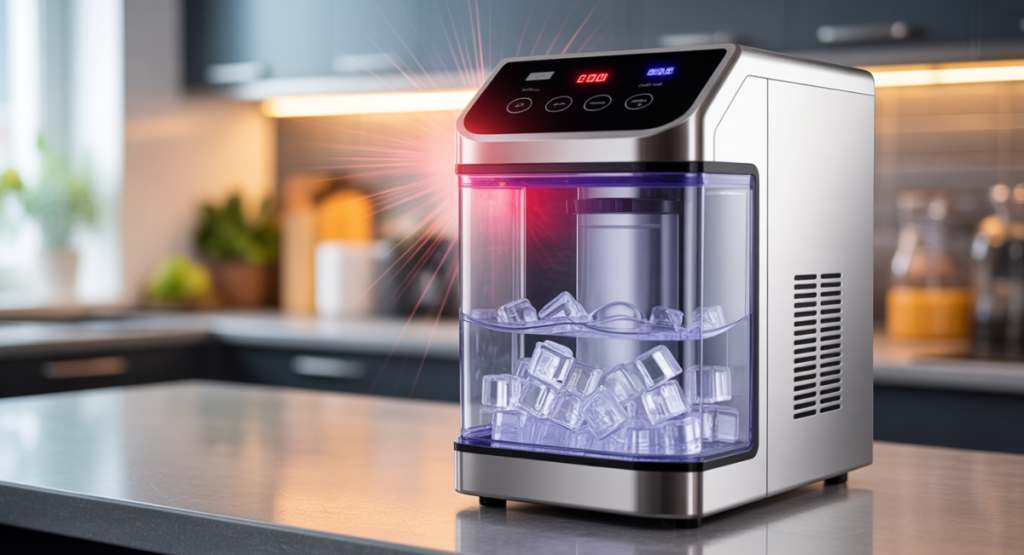
If you have a countertop or portable ice maker, the red light works differently. Most portable models have dedicated indicator lights rather than a blinking code system. Here are the specific meanings:
⦁ ‘Add Water’ light flashing red: The water reservoir is empty, or the water sensor is dirty. Refill the tank and wipe the float sensor inside the reservoir with a damp cloth.
⦁ ‘Ice Full’ light flashing red: The ice basket is full, or the infrared sensor detecting ice level is blocked or dirty. Empty the basket and wipe the sensor window inside the machine.
⦁ Both ‘Add Water’ and ‘Ice Full’ lights are flashing simultaneously: This usually indicates a general system error. Unplug the unit for 5 minutes to reset.
⦁ Red light flashing despite a full water tank: The water filter (if present) may be clogged, or the water pump inside the unit may be failing.
⦁ Ecozy IM-NS280C specific: A red light can indicate that the ambient room temperature is too high (above 95°F / 35°C) for operation.
⦁ GE Opal nugget ice maker: The LED ring flashing red indicates a water flow issue or the need for a cleaning cycle.
💡 Pro Tip: For portable ice makers, running a cleaning cycle with a 1:10 white vinegar and water mixture every 6–8 weeks dramatically reduces sensor errors and pump failures.
4. Ice Maker Red Light Flashing by Brand: Specific Fixes
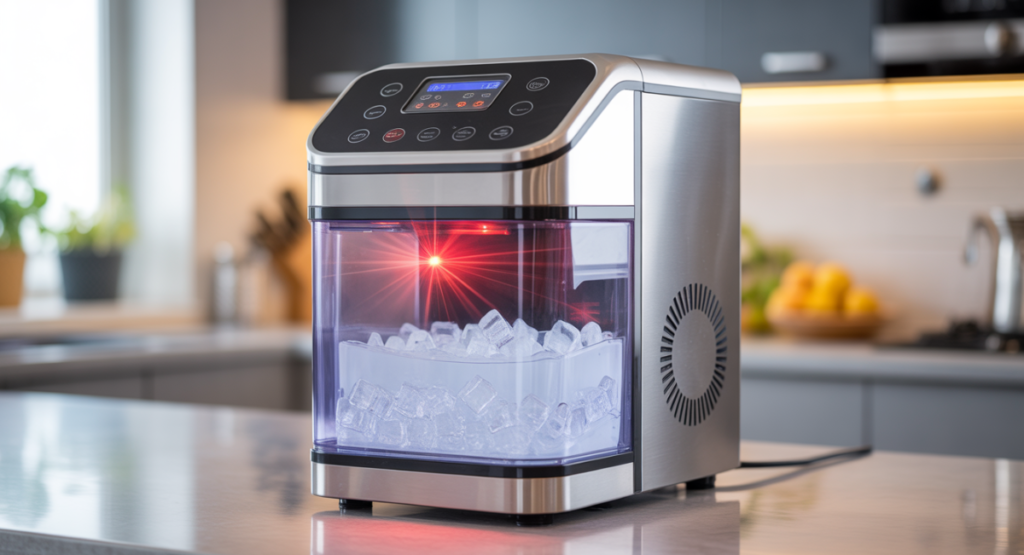
GE Refrigerator Ice Maker Red Light Flashing
GE refrigerators typically have a green indicator light on the ice maker body, not red — but the models with red lights near the On/Off switch will flash to indicate a water supply or sensor issue. If the green light on a GE ice maker is flashing, it indicates a stuck rake from a jammed cube. The diagnostic process: Turn the ice maker off for 15 seconds, then back on. Press the sensor paddle 3 times within 15 seconds. Within 3 minutes, the ice maker should enter harvest mode. If it does not, a fault state is confirmed.
Whirlpool / KitchenAid Ice Maker Red Light Flashing Twice
The classic 2-blink pattern on Whirlpool and KitchenAid side-by-side refrigerators is almost always the optical sensor. The transmitter and receiver boards are located on either side of the ice maker. Test by pressing the white flapper paddle — if the light turns solid while held, the sensor is operational. If it keeps blinking, replace the sensor boards. Model-specific note: On the KSCS25F, blinking during normal operation (when the flapper is not pressed) is actually normal operating behavior.
Kenmore Elite Ice Maker Red Light Blinking
Kenmore ice makers share their platform with Whirlpool and use the same 2-blink optical sensor diagnostic. Additionally, Kenmore Elite models have a manual shutoff switch on the upper right side of the ice maker interior. If this switch is in the ‘off’ position, the ice maker will not produce ice even if the panel indicator is set to ‘on.’ Always verify this secondary switch first before any other troubleshooting on Kenmore models.
LG Ice Maker Red Light Flashing
LG ice makers — particularly in French Door and Side-by-Side models — are known to develop frozen fill tube issues due to the ice maker’s position in the refrigerator door. A solid red light on an LG often indicates the thermostat inside the ice maker module is defective. LG also has a Service Test Mode: press and hold the Test button on the ice maker for 3 seconds to run a full harvest cycle test. If the cycle does not complete, the module needs replacement.
Samsung Ice Maker Red Light Flashing
Samsung French Door refrigerators have a history of ice maker issues related to freezing. The icemaker compartment in Samsung models can develop frost buildup that blocks the fan and prevents the ice maker tray from cooling properly. A forced defrost cycle (holding the Energy Saver and Power Freeze buttons simultaneously for 8 seconds on most models) will clear frost buildup and often resolve the red light issue without any parts replacement.
Frigidaire Countertop Ice Maker Red Light Flashing
The Frigidaire EFIC117, EFIC123, EFIC206, and Gallery series all use dedicated ‘Add Water’ and ‘Ice Full’ red indicator lights rather than a blinking error code system. A flashing ‘Add Water’ light despite a full tank almost always means either a clogged water filter or a dirty float sensor. The float sensor sits inside the reservoir and can be gently cleaned with a cotton swab dipped in white vinegar.
5. How to Reset an Ice Maker With a Red Blinking Light
Before performing any deeper troubleshooting, always attempt a full power reset. A reset clears any transient errors from the control board and gives the ice maker a clean start. Here is the universal reset process that works for most brands:
- Locate the ice maker On/Off switch (usually next to the red light) and turn it to OFF.
- Unplug the refrigerator from the wall outlet completely. Do not just flip the ice maker switch.
- Wait a full 5 minutes. (Some sources say 30 seconds — but 5 minutes ensures the control board capacitors fully discharge.)
- Plug the refrigerator back in.
- Turn the ice maker switch back to ON.
- Close the freezer and do not open it for at least 30 minutes.
- Wait up to 24 hours for the ice maker to complete its first full cycle and begin producing ice.
Brand-specific reset shortcuts:
⦁ Samsung: Hold Energy Saver + Power Freeze for 8 seconds to enter forced defrost mode.
⦁ LG: Press and hold the Test button on the ice maker module for 3 seconds to run the diagnostic cycle.
⦁ Ice-O-Matic: Remove front panel (two screws), hold Power and Clean buttons simultaneously for 3 seconds until lights flash blue and yellow.
⦁ GE: Turn off, press sensor paddle 3 times within 15 seconds of turning back on.
⦁ Portable units: Unplug for 5 minutes, then refill water tank before plugging back in.
6. When Should You Call a Professional?
DIY troubleshooting resolves the vast majority of ice maker red light flashing problems. However, there are specific situations where professional service is the right call:
⦁ The red light flashes continuously with no response to any reset attempt after trying all troubleshooting steps.
⚠️ Cost Warning: Professional appliance technicians typically charge $80–$150 for a service call plus parts. Get a written estimate before authorizing any work.⦁ You have tested the water inlet valve with a multimeter and confirmed it has no continuity, and you are not comfortable replacing it yourself.
⦁ The freezer is not maintaining proper temperature (0°F), pointing to a compressor or refrigerant issue.
⦁ Your LG or Samsung ice maker has persistent freezing issues that come back within weeks after a defrost cycle — these often require a sealed-system repair or ice maker repositioning.
⦁ The ice maker module shows signs of burning, melting, or electrical damage.
⦁ Your unit is under warranty — attempting DIY repairs can void the warranty.
As a general rule of thumb, if the repair cost exceeds 50% of the price of a new comparable ice maker unit, replacement is more economical than repair, especially if the unit is more than 8–10 years old.
⚠️ Cost Warning: Professional appliance technicians typically charge $80–$150 for a service call plus parts. Get a written estimate before authorizing any work.
7. How to Prevent Your Ice Maker Red Light From Flashing Again
Once you have fixed the issue, a little regular maintenance goes a long way toward keeping your ice maker running smoothly and that red light from coming back.
⦁ Replace your water filter every 6 months. Set a calendar reminder — this single habit prevents the majority of water-flow-related red light alerts.
⦁ Keep your freezer temperature at exactly 0°F (-18°C). Check it with a dedicated freezer thermometer twice a year.
⦁ Clean the ice maker tray and interior every 3–6 months. Use a solution of 1 tablespoon of white vinegar per quart of warm water. Rinse thoroughly.
⦁ Inspect the water supply line annually for kinks, cracks, or mineral buildup.
⦁ Do not store food directly in front of freezer vents — restricted airflow makes the compressor work harder and can raise freezer temps enough to affect ice production.
⦁ If you go on vacation for more than 2 weeks, turn the ice maker off to prevent ice from melting, refreezing, and jamming the mechanism.
⦁ For portable ice makers: empty and dry the water reservoir completely if storing the unit for more than a few days to prevent mold and mineral deposits.
FAQs
Why is my ice maker red light flashing but it is still making ice?
This can happen when the sensor detects a minor fault but the ice maker continues to operate through it. The most common cause is a dirty optical sensor or a slightly restricted water flow that has not yet dropped below the minimum fill threshold. The ice maker is working, but it is running inefficiently. Address the root cause (clean the sensor, replace the filter) to prevent it from escalating into a full stoppage.
Can I just ignore the flashing red light on my ice maker?
You can, in the short term — but it is not recommended. The red light means something is operating outside normal parameters. Ignoring it typically leads to complete ice production failure within days to weeks, and in some cases can lead to a frozen fill tube, water damage, or a burned-out motor. The fix is usually simple and inexpensive when caught early.
My ice maker red light flashes twice and then stops. What does that mean?
A specific 2-blink pattern followed by a pause is the classic Whirlpool / KitchenAid / Kenmore optical sensor error code. The machine is telling you it cannot detect the beam between the emitter and receiver. Check for ice blocking the sensor path first, then test the sensor boards using the flapper test described in this guide.
How long should I wait after fixing the issue before the ice maker produces ice?
After a full power reset and fix, most ice makers take between 6 and 24 hours to produce the first new batch of ice. Built-in refrigerator ice makers typically take longer than portable countertop units. If no ice appears after 24 hours, the root cause has likely not been fully resolved.
Is a flashing red light different from a solid red light?
Yes — significantly. A solid (non-flashing) red light on most models indicates a more serious failure state, often involving the thermostat, ice maker module, or control board. A flashing red light usually points to a recoverable error like low water, a jam, or a dirty sensor. If your light is solid and not flashing, the unit may need a module replacement rather than a simple fix.
Final Thoughts: Ice Maker Red Light Flashing Is Usually a Simple Fix
A red blinking light on your ice maker can feel alarming — but in the vast majority of cases, it is a straightforward problem with a clear solution. Most people fix their ice maker red light issue in under an hour without spending a single dollar on parts.
Start with the basics: check your water supply, replace an overdue filter, look for ice jams, and do a full power reset. If those do not solve it, work through the brand-specific diagnostics in this guide. You now have a complete troubleshooting roadmap that covers every scenario.
If you found this guide helpful, take a look at our other ice maker troubleshooting articles on IceMakerReviews.com — we cover everything from ice maker cleaning to choosing the best portable units for your home.