
Last updated: October 2026. This post contains affiliate links. As an Amazon Associate, we earn from qualifying purchases at no extra cost to you. Read our affiliate disclosure.
It’s 4:45 p.m., a reagent needs to stay cold, and the ice bucket is full of slush. Anyone who has worked at a bench knows the feeling. Fresh, clean ice on demand is one of those small things that quietly keeps a lab running.
Choosing the right ice maker for laboratory use is not as simple as picking the fastest machine on Amazon, though. Labs have different needs from kitchens. Some want soft flakes that wrap around tubes. Others just need a steady supply of cubes for ice baths. And the price gap is huge: lab-grade machines cost thousands, while commercial and countertop machines cost a fraction of that.
This guide explains the difference in plain language. You will see five Amazon picks, what each one does well, what lab-grade machines really cost, and how to decide whether a budget machine is enough for your setup.
Table of Contents
Quick Answer: Which Ice Maker Is Best for a Laboratory?
- Best compact pick for a small bench or teaching lab: the SenCre nugget ice maker (#3). It’s small, makes ice in about 5 minutes and has a self-cleaning function.
- Closest to flake ice on a budget: the VEVOR snowflake ice machine (#1). It makes fine, snow-like ice, though it is designed for desserts and drinks.
- Best all-rounder for a shared lab: the EUHOMY under-counter machine (#4), with 100 lbs a day and a 33 lb bin.
- Best for busy labs and core facilities: the GSEICE (#5) at 300 lbs a day with a 70 lb bin, or the ICYGLEE (#2) at 400 lbs a day with a 220 lb bin.
Please read this first: the five machines below are food-grade commercial and household ice makers sold on Amazon. None of them is sold as a certified laboratory instrument. They suit routine jobs such as ice baths, keeping reagents cool, student labs, teaching labs, home labs and research support areas. If you work under GLP, GMP or clinical rules, or if your ice could touch sterile material, you need a purpose-built lab ice maker and your institution’s own procedures. We explain the difference below.
Can You Use a Regular Ice Maker in a Laboratory?
Often, yes. Plenty of labs use ordinary commercial machines for general-purpose ice. One lab equipment supplier describes a standard ice maker as suitable for routine tasks such as ice baths or temporary reagent storage, while flake ice is recommended where tissue samples, enzymes or vaccines need quick, even chilling.
Here is a simple way to think about it:
| Your situation | Is a budget machine OK? |
|---|---|
| Ice baths and cooling reagents in sealed tubes | Usually fine |
| Teaching lab, school lab, home lab, workshop | Usually fine |
| Cooling equipment or keeping drinks and lunches cold in a research building | Fine |
| Ice that may touch open or sterile samples | Use lab-grade equipment and follow your SOPs |
| Clinical, blood bank, pharmaceutical or other regulated work | Use lab-grade equipment and your facility’s rules |
Whatever you choose, ask your lab manager or safety officer if you are unsure. Facility rules always come first.
Flake, Nugget, Cube and Crushed: Which Ice Type Is Best for Lab Work?
This is where most buying guides stay vague. The shape of the ice changes how fast it cools and how well it surrounds a tube.
Flake ice
Flake ice is soft, small and irregular. It has a lot of surface area, so it chills quickly and wraps around tubes and containers. A lab supplier notes that dry flake ice is the type most commonly used in laboratories because it contains less moisture. If you search for a flake ice machine for laboratory use, a flake ice maker or a commercial flake ice maker, this is the ice you are looking for.
Nugget ice (also called pellet or pebble ice)
Nugget ice, sold as a pellet ice maker, pebble ice maker or pebble ice machine, is soft, chewable and made of small compressed pieces. It packs well around items and melts a little slower than very thin flakes. A small nugget ice maker or nugget ice maker countertop model is often the easiest budget stand-in for flake ice at a bench.
Cube ice
Cube ice is the standard shape from under-counter commercial machines. It lasts longer in a bucket, but the cubes leave air gaps around tubes, so it cools small items less evenly than flakes.
Crushed or chipped ice
Many people search for a crushed ice machine, crushed ice maker countertop or chipped ice maker. In practice, most countertop “crushed ice” products are nugget makers. If you only want to crush cubes, you can crush the output of any cube machine in a clean, sealed bag.
| Ice type | Cooling contact | Best use | Our picks |
|---|---|---|---|
| Flake / snow | Excellent | Tubes, samples, quick chilling | #1 (snowflake style) |
| Nugget / pellet | Very good | Bench ice baths, small labs | #3 |
| Cube | Good | Large buckets, shared supply, cooling equipment | #2, #4, #5 |
| Crushed | Very good | General cooling | Crush the cubes from #2, #4 or #5 |
Note that a snowflake machine like #1 is built for desserts and drinks. It makes fine, fluffy ice, but it is not the same as a lab flake ice maker that produces dry, sub-cooled flakes.
Ice Maker for Laboratory Price: What Does Lab-Grade Equipment Really Cost?
If you are searching for an ice maker for laboratory price, here is the honest picture so you can budget properly.
- ConductScience lists benchtop flake ice makers and a cube ice machine at roughly $1,379 to $1,599, with larger split-type flake systems at several thousand dollars.
- Labcold flake ice makers at ESS Labshop range from about £4,225 to £7,995, depending on capacity.
- These lab machines also need a water supply, power and a drain placed below the level of the machine, which adds installation work.
Prices change, so always check the current listing. Compare that with the machines in this guide, which are much cheaper on Amazon. That is why many smaller labs, school labs and research support areas use commercial machines for routine cooling and keep lab-grade units for sensitive work.
People also search for terms like laboratory ice making machine, laboratory ice makers and flake ice machines for sale. If that is you, start with the lab suppliers above, then use this guide to see where a budget alternative could save money.
Our 5 Picks at a Glance
| # | Model | Ice type | Daily output | Best for |
|---|---|---|---|---|
| 1 | VEVOR Snowflake Ice Machine | Snowflake | 44 lbs | Fine, flake-style ice |
| 2 | ICYGLEE Commercial Ice Maker | Cube | 400 lbs | Core facilities, big shared labs |
| 3 | SenCre Nugget Ice Maker | Nugget | 40 lbs | Small bench, teaching lab |
| 4 | EUHOMY Commercial Ice Maker | Cube | 100 lbs | Mid-size shared labs |
| 5 | GSEICE Commercial Ice Maker | Cube | 300 lbs | Busy labs, quiet operation |
How to Choose the Best Ice Maker for Laboratory Use
1. Daily output and storage
Estimate how much ice your team uses at peak, then add a safety margin. As a rough guide, a single bench or small teaching group may need 10 to 40 lbs a day. A shared lab with several researchers may need 50 to 150 lbs. A core facility, a building-wide supply or a busy research hospital wing may need 300 lbs or more. Storage matters too: a machine that makes 300 lbs a day but only holds 33 lbs will still run out during a rush.
2. Ice type
Choose flake or nugget if quick, even cooling around tubes matters. Choose cube if you mainly fill buckets or cooling baths. See the table above.
3. Size and footprint
Benches are crowded. Check the width, depth and height, and leave breathing space around the machine so air can flow. Compact countertop machines suit a bench. Under-counter machines suit a workroom or corridor.
4. Plumbing and drainage
Countertop machines usually have a refillable tank. Under-counter machines need a water line and a drain hose, and the drain hose must stay below the machine’s drain outlet for smooth drainage. Plan this before you order.
5. Cleaning and hygiene
A self-cleaning function makes routine upkeep easier, but it does not replace your lab’s cleaning schedule. Look for machines with filters and easy-to-reach interiors.
6. Noise
Compressors can be loud in a small room. If your bench sits in an open lab or office, look for a quieter model. Our guide to the best quiet ice makers explains what to look for.
7. Certifications and warranty
Look for safety and energy listings such as ETL and DOE, and check the warranty. Certifications on a commercial machine are not the same as being a certified lab instrument, so match them to your facility’s requirements.
8. Speed
Fast first batches help during busy mornings. If speed matters most, see our roundup of the best fast ice makers under 10 minutes.
The 5 Best Ice Makers for Laboratory Use in 2026
These picks are based on manufacturer specifications and listing details. Prices on Amazon change often, so check the current price before you buy.
1. VEVOR Snowflake Ice Machine, 44LBS/24H Snowflake Ice Maker
Best for: labs and classrooms that want fine, snow-like ice on a small budget.
This is the machine on our list that comes closest to flake ice. It pre-cools in 60 seconds and then makes ice in about 3 seconds, with up to 44 lbs a day. Eight speed settings let you change the texture, from fluffy snowflake ice to thin strips or flakes. Fine ice like this surrounds tubes more closely than cubes do.
Be clear about what it is. VEVOR sells this as a snow cone and dessert machine for homes and small gatherings. It is a handy option for teaching demonstrations, student projects, and non-critical cooling, but it is not a lab-grade flake ice maker.

VEVOR Snowflake Ice Machine
- Up to 450 lbs of ice per 24 hours
- Up to 44 lbs of ice per day
- 60-second pre-cooling, ice in about 3 seconds after that
- 8 speed settings for different ice textures
- Touch panel with one-touch cleaning
- SUS304 food-grade cooling roller and SUS420 stainless blades
- Rust-resistant ABS body that is easy to clean
- 0.2 gallon water tank for small batches
2. ICYGLEE Commercial Ice Maker Machine, 400LBs Daily Industrial Ice Maker
Best for: core facilities, large shared labs and research buildings that need serious volume.
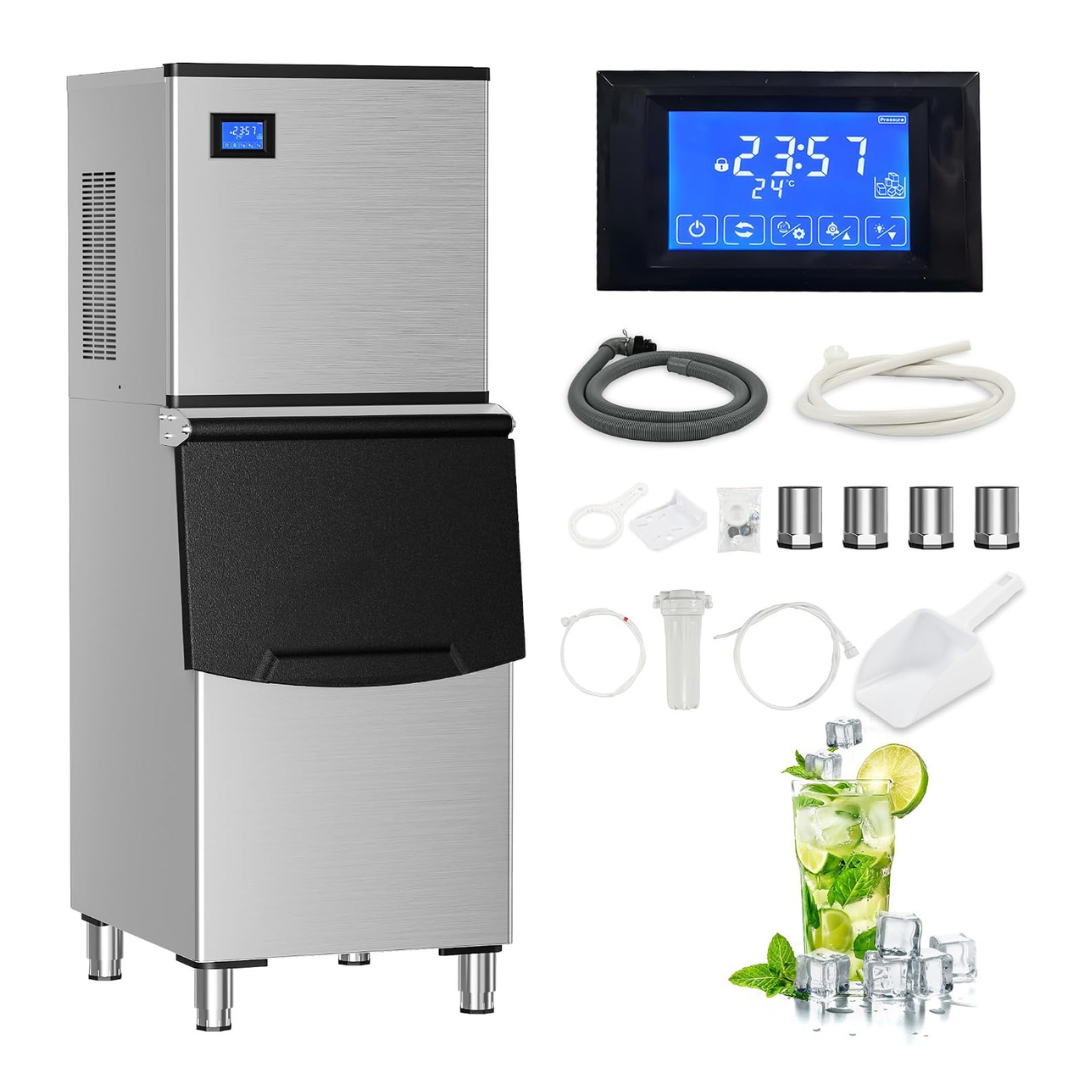
If many people draw ice all day, this is the volume machine. It produces up to 400 lbs a day, making 156 full cubes in 10 to 20 minutes, and the bin holds up to 220 lbs so peak demand is covered. The LCD panel lets you schedule production from 1 to 24 hours ahead and shows a countdown, temperature and alerts for full ice and low water. The listing says insulation keeps ice solid for 7 to 9 hours, even through a power cut.
Plan for installation. This is a two-box delivery, and the listing warns the boxes may arrive at different times. It includes a water filter, scoop, feet, connector, drain hose, inlet hose, toolkit, and filter tools.
ICYGLEE Commercial Ice Maker Machine
- Up to 400 lbs of ice per day
- 156 full cubes in 10 to 20 minutes
- 220 lb storage bin for peak demand
- 1 to 24 hour reservation timer with countdown display
- Full ice and low water reminders, plus temperature display
- Auto-cleaning and self-drainage functions
- ETL certified, with a one-year warranty promise
3. Nugget Ice Maker 40lbs/Day Countertop Ice Makers Chewable Pellet Ice
Best for: a small bench, a teaching lab or an office-style research space.
If you only need a modest, reliable supply, this SenCre countertop machine is easy to live with. It produces up to 40 lbs a day from a 1 L tank, and the first batch is ready in about 5 minutes. The ice is soft nugget ice, a good match for packing around tubes. At 7.28 x 13.0 x 12.68 inches, it fits on a bench or counter without taking over.
It comes with a 2-pound ice basket, scoop, drip tray and drain hose, so you can start quickly. Want to see more models from the brand? Browse our guide to the best SenCre ice makers.

Nugget Ice Maker 40lbs/Day Countertop Ice Makers
- Up to 40 lbs of nugget ice per day
- First batch in about 5 minutes
- Soft, chewable nugget ice
- Compact size: 7.28 x 13.0 x 12.68 inches
- Built-in self-cleaning function
- One-touch control
- Includes ice basket, scoop, drip tray and drain hose
4. EUHOMY Commercial Ice Maker Machine, 100lbs/24H Stainless Steel Under Counter Ice Machine
Best for: mid-size shared labs that want a dependable, space-saving under-counter machine.
This is the practical middle ground. It makes up to 100 lbs a day, producing 45 clear cubes in 10 to 20 minutes, and the 33 lb bin keeps a steady supply ready. At 17.5 x 15.9 x 31.1 inches it works built-in or freestanding. You can adjust ice thickness, and triple-layer insulation keeps ice cold for up to 8 hours.
Setup is straightforward: connect the water line, drain hose and power, and keep the drain below the outlet. The maker advises keeping it upright for 24 hours before first use, then running the self-cleaning cycle twice before the first batch. For more models, see our full roundup of EUHOMY ice makers.

EUHOMY Commercial Ice Maker Machine
- Up to 100 lbs of ice per day
- 45 crystal-clear cubes in 10 to 20 minutes
- 33 lb storage bin
- Adjustable ice thickness
- Triple-layer insulation for up to 8 hours of cold retention
- LCD panel with ice-full and low-water alerts and a 24-hour timer
- ETL certified, with drain hose, water line and scoop included
5. GSEICE Commercial Ice Maker Machine (300lbs/24H with 70lbs Ice Storage)
Best for: busy labs that want high output, a big bin and quiet running.
The GSEICE hits a nice balance of capacity and manners. It makes up to 300 lbs a day, producing 126 clear cubes in as little as 10 minutes, and the built-in bin holds up to 70 lbs. The compressor is rated at 50 dB or less, which matters in a shared workspace. A 0.79 inch thick, three-layer insulation helps keep ice cold for up to 8 hours.
The LED panel shows ambient temperature and lets you set the timer, start self-cleaning, adjust ice thickness and control the blue light. To start cleaning, press and hold “Timer/Clean” for more than 3 seconds. The listing also names ETL, DOE, CEC and NRCan certifications for safety and energy standards. As with other under-counter machines, keep it upright for 24 hours first, run the cleaning cycle twice, and keep the whole drain hose below the drain outlet.

GSEICE Commercial Ice Maker Machine
- Up to 300 lbs of ice per day
- 126 clear cubes in as little as 10 minutes
- 70 lb built-in storage bin
- Three-layer insulation for up to 8 hours of cold retention
- Quiet compressor at 50 dB or less
- LED panel with timer, thickness control, ambient temperature display and reminders
- ETL, DOE, CEC and NRCan certifications listed
Brands Labs and Buyers Search For
When people look for a commercial ice maker for laboratory use or a small ice maker for laboratory benches, a few names come up again and again.
- Fisher Scientific and Thermo Fisher: huge scientific suppliers that many labs already buy from. Searches for “Fisher Scientific” and “Thermo Fisher” are extremely popular, so it is worth checking their catalogs for lab-grade ice machines and current prices. We have not reviewed their models here.
- Labtron: people often search for a Labtron ice maker when comparing lab equipment brands. We haven’t reviewed Labtron models in this article, so check current specifications and prices with the seller.
- Hoshizaki: a major commercial ice machine brand. One lab supplier describes flake ice makers as a choice for laboratories and medical facilities, including a Hoshizaki flake range.
How to Keep Ice Clean in a Laboratory
Ice looks harmless, but a dirty machine can pass problems straight into your work. These habits help, whichever machine you choose:
- Follow the first-use steps. Several machines on our list advise keeping them upright for 24 hours and running the cleaning cycle twice before the first batch.
- Clean on a schedule. Use the self-cleaning function regularly, and wipe the bin and scoop. Write the dates on a log sheet.
- Use a clean scoop. Do not reach into the bin with gloved or bare hands, and do not store the scoop inside the bin.
- Keep ice away from open samples. Use sealed tubes, bags or secondary containers.
- Use filtered water where possible. It improves taste and clarity, and it helps protect the machine.
- Keep the drain clear. Slope the drain hose downward and check it for kinks.
- Do not eat or drink from the lab ice machine. Ice for samples and ice for drinks should be kept separate in many facilities.
Troubleshooting Common Ice Maker Problems
- Not making ice: check the water level or supply, the power, and whether the ice-full sensor is blocked. Make sure there is airflow around the machine.
- Small or cloudy ice: clean and descale the machine, change the filter if there is one, and check the water quality.
- Machine too loud: make sure it is level and not touching walls or cabinets. Vibration travels through hard surfaces.
- Ice melting fast: remember an insulated bin is not a freezer. Scoop extra ice into a clean insulated container if you will not use it soon.
- Water leaks: inspect the inlet and drain hoses, and confirm the drain hose sits below the drain outlet.
How Much Ice Does Your Lab Need?
| Your setup | Rough daily ice need | Suggested pick |
|---|---|---|
| Single bench, home lab, small teaching group | 10 to 40 lbs | #3 SenCre or #1 VEVOR |
| Shared lab with several researchers | 50 to 150 lbs | #4 EUHOMY |
| Busy shared lab or department | 150 to 300 lbs | #5 GSEICE |
| Core facility or building-wide supply | 300 lbs and up | #2 ICYGLEE |
These are estimates. Your real need depends on how often people draw ice and how long it stays in buckets. For a deeper look at planning quantities, see our guide on how much ice you need. If you also want to compare stainless steel bodies, our roundup of the best stainless steel ice makers is a useful next read.
FAQs
What is the best ice maker for laboratory use?
It depends on your work. For routine bench cooling, a compact nugget machine like the SenCre (#3) or a commercial cube machine like the EUHOMY (#4) is often enough. For sensitive or regulated work, choose a purpose-built lab flake ice maker and follow your facility’s procedures.
Is flake ice better than cube ice for a laboratory?
Flake ice has more surface area and wraps around tubes, so it generally cools small items faster and more evenly. Cube ice lasts longer in a bucket but leaves air gaps.
Can I use a nugget ice maker in a lab?
For general cooling and ice baths, many people do. Nugget ice is soft and packs well around containers. For sterile or regulated work, check your lab’s rules first.
How much does an ice maker for a laboratory cost?
Lab-grade flake ice makers commonly cost well over a thousand dollars, and some Labcold models are listed at several thousand pounds. Commercial and countertop machines like the ones in this guide cost much less. Check the live Amazon price for each model.
What is a small ice maker for laboratory benches?
A compact countertop nugget machine, such as #3, or a benchtop flake unit from a lab supplier. Measure your bench first and leave room for airflow.
Does a lab ice maker need a drain?
Under-counter commercial machines and lab flake makers usually need a water supply and a drain placed below the machine’s outlet. Countertop machines often use a refillable tank, though some include a drain hose.
Is a snowflake ice machine the same as a flake ice maker?
No. A snowflake machine like #1 is designed for desserts and drinks and makes fluffy, shaved-style ice. A lab flake ice maker produces dry flakes for sample cooling. They can look similar, but they are built for different jobs.
How often should I clean a laboratory ice machine?
Follow the manufacturer’s instructions and your facility’s schedule. Many labs clean on a regular, logged schedule. Use the self-cleaning cycle between deeper manual cleans.
Final Verdict: Which Ice Maker for Laboratory Should You Buy?
- Choose the SenCre nugget ice maker (#3) for a compact, quick bench supply.
- Choose the VEVOR snowflake machine (#1) if fine, snow-like ice suits your teaching or demo setup.
- Choose the EUHOMY (#4) for a dependable under-counter machine in a mid-size shared lab.
- Choose the GSEICE (#5) for high output, a large bin and quieter running.
- Choose the ICYGLEE (#2) when a whole department or core facility relies on one machine.
- If your work is sterile, clinical or regulated, step up to a purpose-built lab flake ice maker.
Measure your space, check the water and drain setup, and match the machine to your real daily need. That way you end up with ice when you need it and a machine that fits your budget. For more guides, browse our reviews of GoveeLife ice makers and Silonn ice makers.
Disclosure
Ice Maker Reviews is a participant in the Amazon Services LLC Associates Program. If you buy through our links we may earn a small commission at no extra cost to you. Specifications are taken from manufacturer listings and may change, so please confirm details on Amazon before purchasing. This article is general information, not professional laboratory or safety advice.