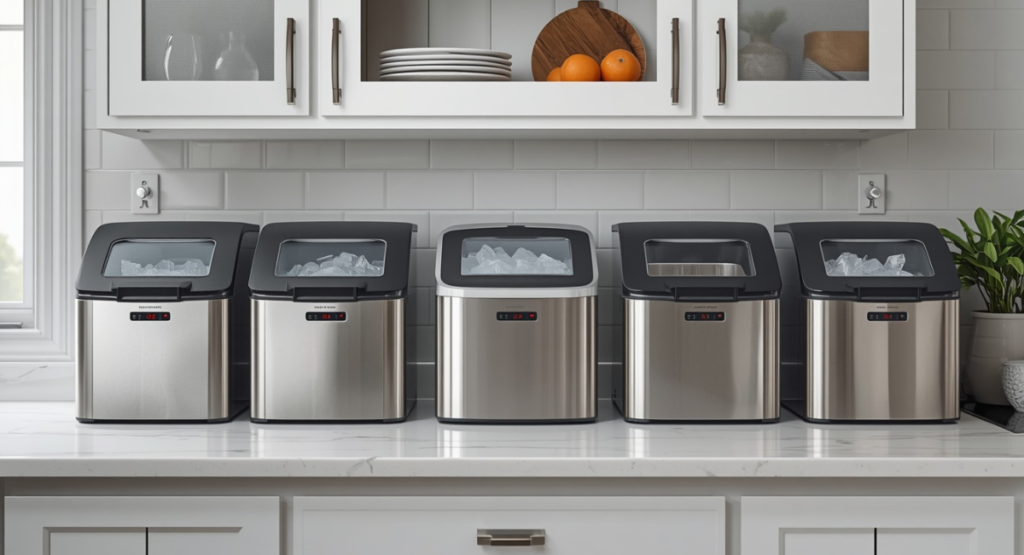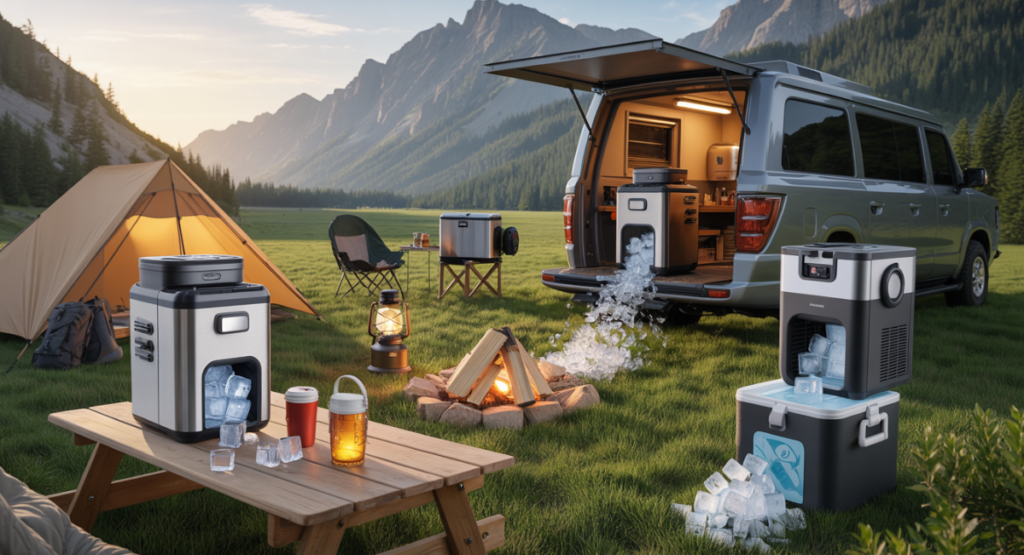

Quick answer: If you want a true ice maker for car use, only two of the five machines in this guide run directly from a 12V socket: the KYOFIS Portable 12V Ice Maker and the BODEGA 12V Ice Maker. The other three are powerful 120V countertop machines that make better ice faster, but they need mains power, a proper inverter, or a power station. I explain exactly which one fits which situation below, so you do not buy the wrong machine.
Disclosure: This article contains affiliate links. If you buy through them, we may earn a small commission at no extra cost to you. It never changes which products we include or what we say about them.
Table of Contents
Why People Want an Ice Maker for Car Trips
Anyone who has driven through a hot afternoon knows the problem. You stop for ice, it costs more than it should, and half of it is water by the time you reach your destination. A bag of ice in a cooler lasts a day or two at best. On a longer road trip you end up buying ice again and again, and the cooler fills with meltwater that soaks your food.
A small portable ice maker flips that around. Instead of carrying ice, you carry water and make ice on demand. That is why searches for terms like portable ice maker for car, 12 volt ice maker for car and travel ice maker for car keep growing. People who travel by car, caravan, camper van, RV or even boat want cold drinks without planning their whole day around a gas station freezer.
But here is the part that most product pages skip. A car is not a kitchen. Your electrical supply is limited, the temperature inside the vehicle can be extreme, and the machine has to cope with movement. A machine that is great on a kitchen counter can be a poor choice for a vehicle. That is the reason this guide spends as much time on power, battery protection and real-world use as it does on the products themselves.
How a Portable Ice Maker for Car Use Actually Works
Almost every compact ice maker works the same basic way. You fill a small water tank. A pump moves water over a cold surface, usually a set of metal prongs that are chilled by a cooling system. Ice forms on those prongs, then the machine warms them briefly so the ice drops into a basket. The cycle repeats until the basket is full or the water runs out.
There are two main cooling methods in this type of product:
- Semiconductor (thermoelectric) cooling. Very compact and light. Common in the cheapest mini ice maker for car models. Ice production is smaller, and the machine can struggle in a hot environment.
- Compressor cooling. The same technology as a refrigerator. Heavier, but faster and more consistent, which is why compressor machines produce many pounds of ice per day.
You will also see three ice styles, and it helps to know the difference because it changes how your drinks taste and how fast the ice melts:
- Bullet ice. Small, hollow, bullet-shaped cubes. Fast to make and the most common style in a portable ice maker.
- Nugget or pebble ice. Soft, chewable, and sometimes called “the good ice.” It absorbs the flavor of your drink and chills quickly because it has a lot of surface area.
- Cube ice. Larger, slower-melting cubes. Better for cocktails and for keeping a drink cold longer.
12 Volt vs 120V: The Mistake Most Buyers Make
This is the single most important section in this guide. When someone searches for an ice maker machine for car, many websites show them countertop machines that plug into a normal wall socket. These are great products, but a car does not have a wall socket.
Your car provides 12V DC power through the cigarette lighter or accessory socket. A home countertop ice maker needs 120V AC. To run it in a vehicle you would need a power inverter or a portable power station, and a compressor ice maker draws a lot of power, especially when it starts up.
Here is a simple way to understand the load. Power in watts equals volts multiplied by amps. A 120W machine on a 12V supply pulls about 10 amps (120 divided by 12). Many car sockets are fused at around 10 to 15 amps, so a 120W machine is already close to the limit of an ordinary socket. This is why you should always check your socket’s fuse rating in the vehicle manual before running any 12V ice maker for long periods.
So the honest summary is this:
- Products 1 and 2 in this guide are made to run on 12V DC (and also on AC at home), so they are the real ice maker for car options.
- Products 3, 4 and 5 are 120V countertop machines. They are excellent for a caravan with a hook-up, a holiday home, a campsite with power, or an RV with an inverter, but they are not designed to plug into a car socket.
If you want to compare more models across this category, our guide to the best portable ice maker covers the wider market, and our 12V ice maker guide goes deeper on vehicle power.
Buying Guide: What to Check Before You Buy an Ice Maker for Car or Caravan
1. Power source
Decide first where the machine will actually run. Car socket only? Look for 12V DC. Caravan with mains hook-up? A 120V or 230V machine is fine. Boat or RV with a battery bank? Look for 12V or 24V support and low-voltage protection. Everything else comes second.
2. Battery protection
A battery operated ice maker or any 12V machine can drain a battery overnight if it keeps running. The best ones include a low-voltage cut-off that shuts the machine down before your battery is flat. This feature matters more than a few extra ice cubes per hour.
3. Ice production speed and daily output
Brands advertise “cubes per cycle” and “pounds per day.” Remember that these numbers come from ideal lab conditions. A hot car, a warm water supply and a nearly full basket all reduce real output. Treat the numbers as the best case, not the typical case.
4. Size, weight and where it fits
Measure the space in your vehicle. A small ice maker that is 21 cm long fits on a car seat or in the footwell. A 40 lb-per-day compressor machine is closer to the size of a microwave and needs a fixed, level spot.
5. Noise level
If you sleep in a camper van or caravan, noise matters. Compressor machines are louder than semiconductor ones, though some listings quote levels as low as 40 to 45 dB.
6. Water tank size
A small tank means frequent refills. A bigger tank means more cycles per fill. On the road, fewer refills is a real convenience.
7. Cleaning features
Ice machines can grow mold or scale if they are not cleaned. Self-cleaning cycles, drain plugs and removable baskets make maintenance easier. We cover this in more detail in the cleaning section below, and you can also read our full guide on how to clean an ice maker.
8. Stability and movement
Never run an ice maker while the vehicle is moving over rough roads unless the manufacturer says it is safe. Water can slosh and spill. Most people make ice while parked, then store it in a cooler.
Quick Comparison Table
| # | Model | Power | Ice Type | Listed Speed | Listed Daily Output | Best For |
|---|---|---|---|---|---|---|
| 1 | KYOFIS Portable 12V | 12V DC / 100-230V AC | Hollow or solid cubes | 8 cubes in 10 min | Not stated (small cycle machine) | Car, road trips, solar setups |
| 2 | BODEGA 12V | 12V/24V DC or 100-240V AC | Bullet | 9 cubes in 8 min | Up to 24 lbs | RV, caravan, boat, camper |
| 3 | SenCre Nugget 40 lbs | 120V AC | Nugget | First batch in 5 min | Up to 40 lbs | Home, powered campsite |
| 4 | Newair Silver Countertop | 120V AC | Clear-style cubes | Under 15 min | Up to 40 lbs | Home bar, kitchen, office |
| 5 | Silonn Nugget | 120V AC | Nugget / pebble | Starts in 6 min | Up to 33-36 lbs (listing varies) | Large households, gatherings |
All figures come from the manufacturers’ own listings. Real results vary with temperature, water temperature and how full the basket is.
1. KYOFIS Portable 12V Ice Maker Machine for Car and Camping
Best for: Drivers who want a true portable ice maker for car use with the smallest footprint.
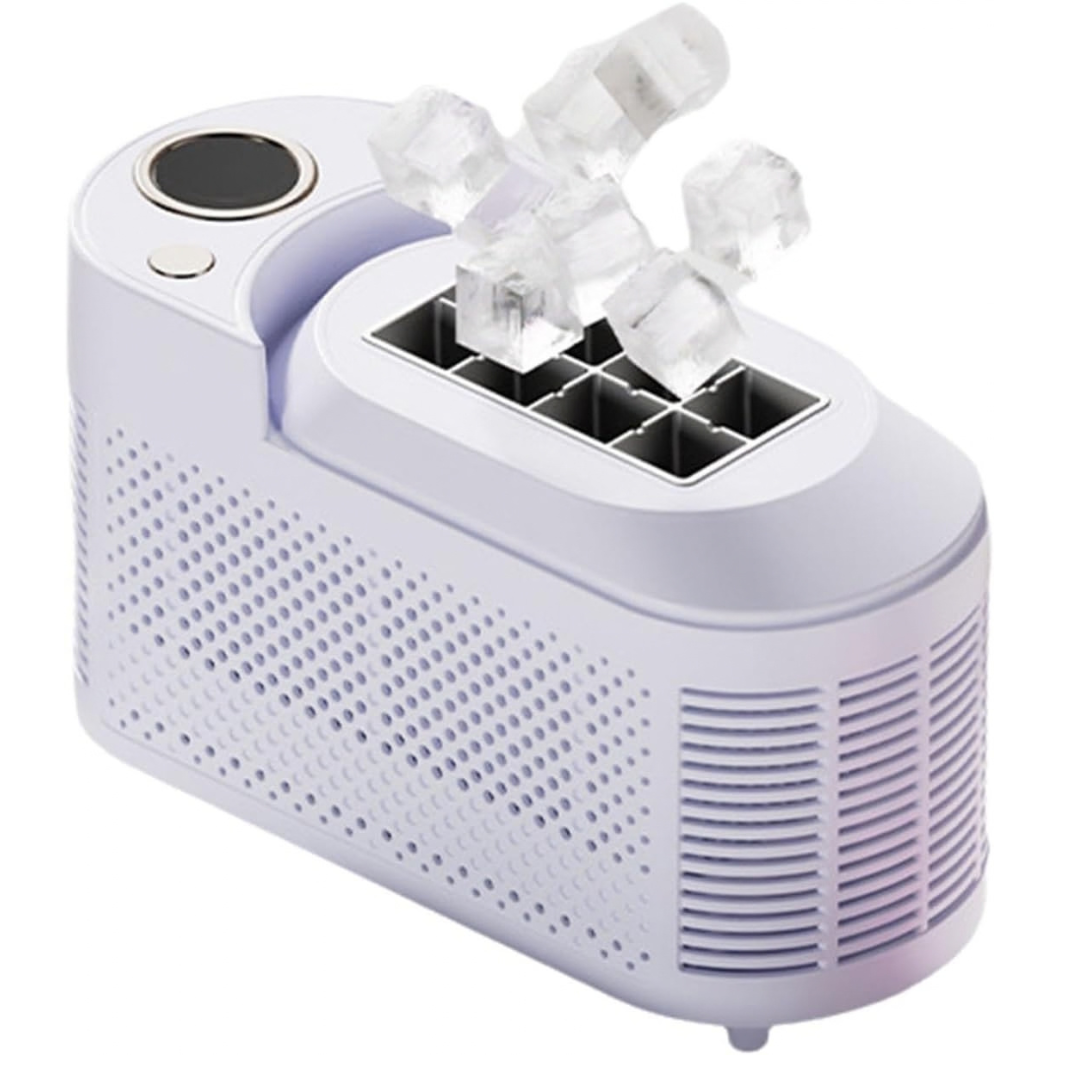
KYOFIS Portable 12V Ice Maker Machine
- Produces up to 26 lbs of bullet ice per day
- Produces 8 ice cubes in 10 minutes
- Hollow or solid ice modes
- 12V DC and 100-230V AC compatible
- 0.5L removable water tank
- 120W power consumption
- Self-cleaning cycle
- Noise level listed at 40 dB or less
- One-touch control
Overview
The KYOFIS is the most car-focused product on this list. It is built for people who want ice while traveling and who do not want a heavy appliance in the vehicle. The listing describes a compact machine that measures 21.6 x 9.3 x 12.8 cm, which is small enough to sit on a passenger seat, a console or a camping table.
What we like
The dual power design is the biggest advantage. You can use it in the car on the way to your destination, then plug it into a regular outlet at a hotel, a campsite or at home. That flexibility makes it a good travel ice maker for car owners who also want a small ice cube maker for the kitchen.
The hollow and solid ice modes are a nice touch. Hollow ice is quicker to make and is fine for a cold drink in a hurry. Solid ice takes longer but lasts longer in the glass. The removable tank also means you can add juice or fruit water to make flavored ice.
The low noise level is another plus. A listed 40 dB or less puts it in the range of a quiet room, so it will not annoy you if you run it in a camper van or a hotel room.
What to keep in mind
The tank is only 0.5L, so you will refill it often, and each cycle is only 8 cubes. This is a machine for a few drinks at a time, not for filling a big cooler. At 120W it also pulls about 10 amps on a 12V supply, so check your socket’s fuse rating, and run it with the engine on or with a battery that can handle the load.
Who should buy it
Choose this if you want an instant ice maker for car trips, you travel light, and you only need ice for a handful of drinks. It is also a sensible pick for a solo traveler or a couple on a weekend drive.
Pros and cons
- Pros: very compact, true 12V support, dual AC/DC power, quiet, self-cleaning, flavored ice option
- Cons: small tank, small batch size, not meant for large quantities of ice
See the latest price and reviews for the KYOFIS 12V Ice Maker
2. BODEGA 12V Ice Maker for RV, Portable AC/DC Ice Machine, 24 lbs/Day
Best for: RVs, caravans, camper vans and boats where you need more ice and proper battery protection.
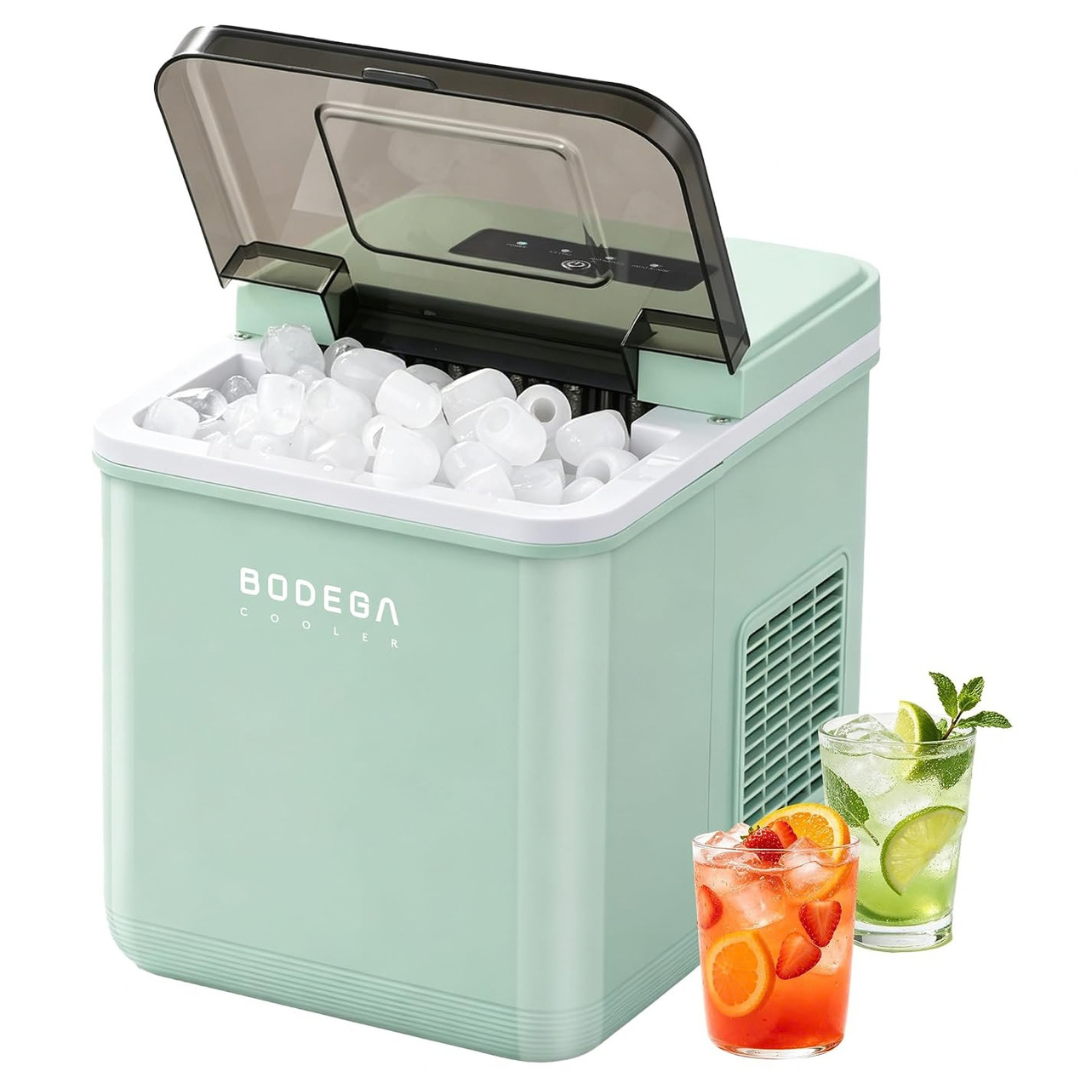
BODEGA 12V Ice Maker for RV
- Runs on 12V/24V DC or 100-240V AC, with no inverter required
- Built-in low-voltage battery protection
- 9 bullet ice cubes in 8 minutes
- Up to 24 lbs of ice per 24 hours
- Noise level of 45 dB or less
- 1.3L water tank
- Ice full and add water indicators
- Compressor restart protection
- BPA-free food-contact parts, bottom drain plug, removable basket and scoop
Overview
The BODEGA steps up from a small travel unit to a proper compressor-style machine. It is built for people who live on the road or spend long weekends camping. It is also the best match on this list for anyone searching for a 12 volt ice maker for caravan use or a 12 volt ice maker for boat use.
What we like
The battery protection is the standout feature, and it is the reason this machine suits anyone who sleeps in their vehicle. According to the listing, the machine shuts off automatically before it over-discharges your vehicle battery. For anyone who has woken up to a flat battery, that is a feature worth paying for.
The 12V/24V input also makes it flexible. Many boats, trucks and larger RVs run on 24V, and a machine that handles both avoids the need for converters. Combined with a 1.3L tank, you get more cycles per refill than a very small unit.
The practical touches help as well: an ice-full indicator, an add-water indicator, a drain plug and a removable basket and scoop. These small things make daily use much less annoying, especially when you are using the machine in a cramped space.
What to keep in mind
A compressor machine is bigger and heavier than the KYOFIS, so it needs a stable, level spot. It is not something you throw onto a car seat. The 24 lbs per day figure is a best-case number, and a hot vehicle will lower it. As with any 12V machine, run it with the engine on or with a healthy battery bank.
Who should buy it
If you own a caravan, an RV, a camper van or a boat, and you want a real 12 volt ice maker that protects your battery, this is the strongest option here. If you want something small for a car, the KYOFIS is easier to carry. For more RV-focused picks, see our guide to the best RV ice maker.
Pros and cons
- Pros: 12V/24V support, battery protection, larger daily output, quiet, drain plug, helpful indicators
- Cons: larger and heavier than a mini unit, needs a fixed spot, real output depends on heat
See the latest price and reviews for the BODEGA 12V Ice Maker
3. SenCre Nugget Ice Maker 40 lbs/Day Countertop Chewable Pellet Ice
Best for: Nugget ice lovers who have mains power at home, at a holiday property or at a powered campsite.
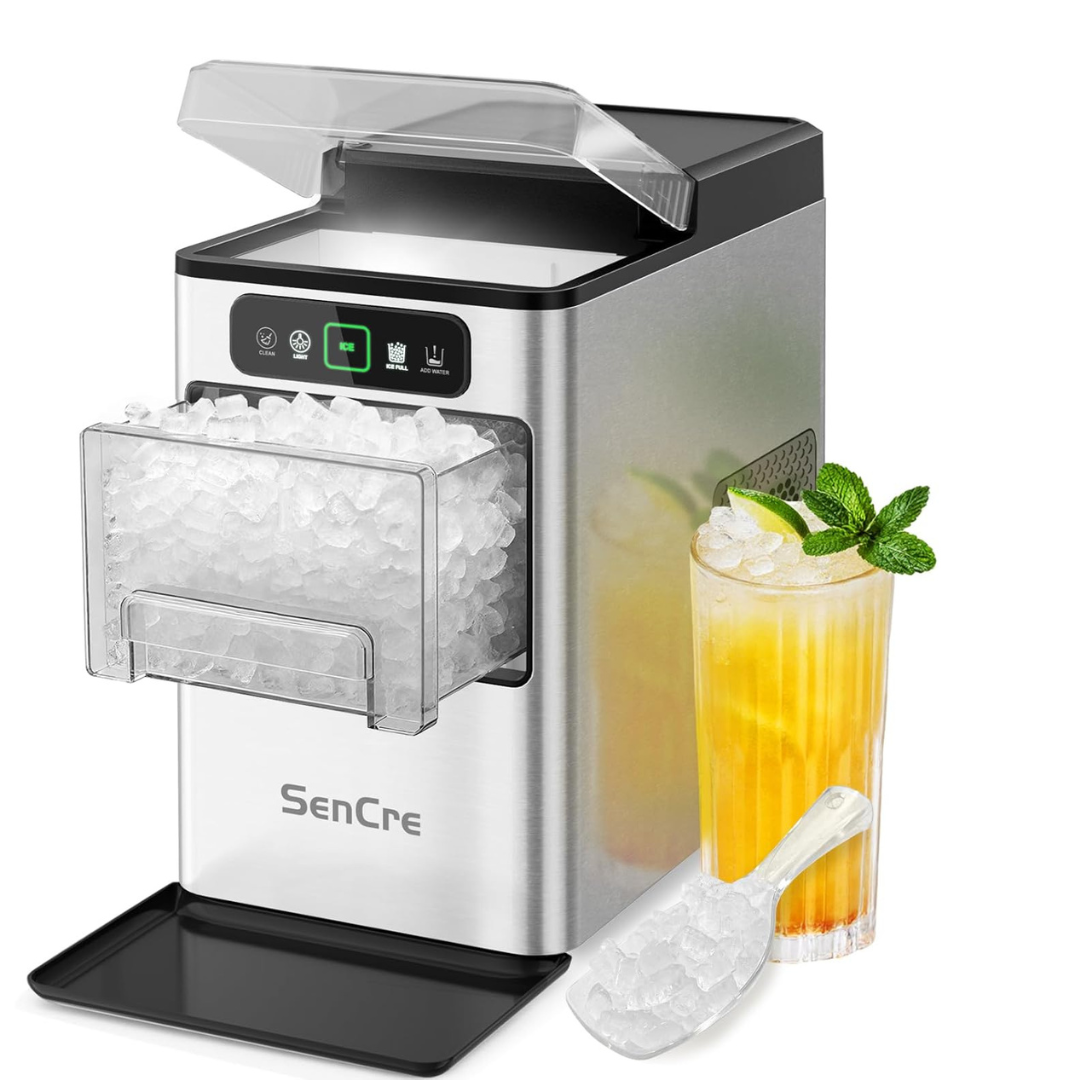
SenCre Nugget Ice Maker
- Up to 40 lbs of ice per day
- First batch ready in about 5 minutes
- 1L water tank with a compressor
- Soft, chewable nugget ice
- Self-cleaning function
- Dimensions of 7.28 x 13.0 x 12.68 inches
- 2-pound ice basket, scoop and drip tray
- Drain hose included
- One-touch control
Important note for car owners
This is a countertop machine for standard household power. It is not a 12V car ice maker. We include it because many readers who search for an ice maker for car or caravan trips also want a great machine for the destination, and because it shows what you gain if you move up from a mini unit to a full compressor nugget machine.
What we like
Nugget ice is the main reason to buy this machine. It is soft and easy to chew, and it soaks up the flavor of a drink instead of watering it down in the same way as hard cubes. If you drink a lot of iced coffee, soda or juice, the difference is noticeable.
The 40 lbs per day output is also generous. For a family, a holiday home or a small party, that is enough that you rarely run out. The self-cleaning button and the included drain hose make maintenance less of a chore.
What to keep in mind
It is much larger than a travel ice maker, and it needs 120V power, so it is not for use in a car without an inverter and a very capable power source. A nugget machine also draws more power than a small semiconductor unit, so a casual car socket will not run it.
Who should buy it
Choose this if you want chewable nugget ice at home or at a powered caravan site. If you want to compare other chewable ice machines, take a look at our guide to the best nugget ice maker.
Pros and cons
- Pros: soft chewable ice, high daily output, quick first batch, self-cleaning, drain hose included
- Cons: not a 12V car machine, larger footprint, needs mains power
See the latest price and reviews for the SenCre Nugget Ice Maker
4. Newair Silver Countertop Ice Maker Machine, Cubes Ready in Under 15 Minutes
Best for: Home bars, kitchens and offices where you want a simple machine with a two-button interface.
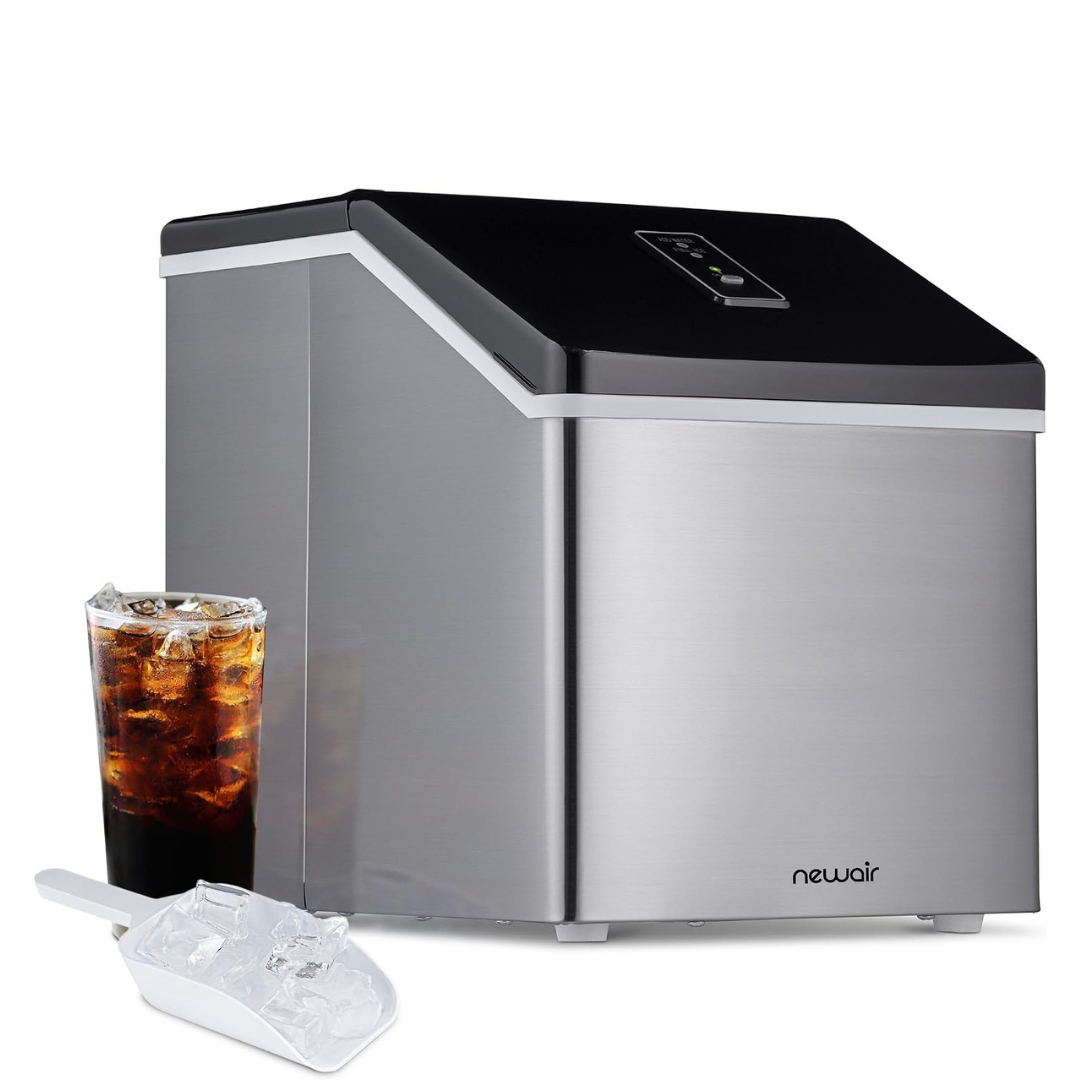
Newair Silver Countertop Ice Maker Machine
- First batch in under 15 minutes
- Up to 40 pounds every 24 hours
- 120V power
- Dimensions of 11.1 (D) x 14.25 (W) x 13.88 (H) inches
- Two-button operation with ice size selection
- Indicator lights for ice ready and add water
- Extra-thick insulated storage
- Melted ice water drains back into the machine and is reused
Important note for car owners
Like the SenCre, the Newair is a 120V machine. The listing states 120 volts, so it is a home or powered-site appliance, not a direct 12V portable ice maker for car use. It makes sense here as the home partner to a travel unit.
What we like
The simple interface is its biggest strength. There is no learning curve: switch it on, pick an ice size and let it run. The indicator lights tell you when ice is ready and when it needs water, so you never have to guess.
The thick insulation helps ice last longer in the basket, and the recycling of melted water reduces waste. The listing also describes the ice as clear-style, which many home drink fans like because it looks good and melts more slowly than cloudy ice.
What to keep in mind
The listing recommends that you check the dimensions and weight to make sure the machine fits your space, and that advice is fair. It is the largest unit on this list, so it is clearly not designed for a vehicle. Cubes also take longer for the first batch than the nugget machines.
Who should buy it
Choose the Newair if you want a straightforward, high-output machine for a kitchen or home bar. If you are still comparing options for the house, our best countertop ice maker guide covers more.
Pros and cons
- Pros: very simple controls, high daily output, good insulation, reuses melt water, clear indicators
- Cons: largest unit here, 120V only, slower first batch than nugget models
See the latest price and reviews for the Newair Countertop Ice Maker
5. Silonn Nugget Ice Maker Countertop, Pebble Ice, Self-Cleaning, Stainless Steel
Best for: Big households and gatherings where lots of soft nugget ice is needed.
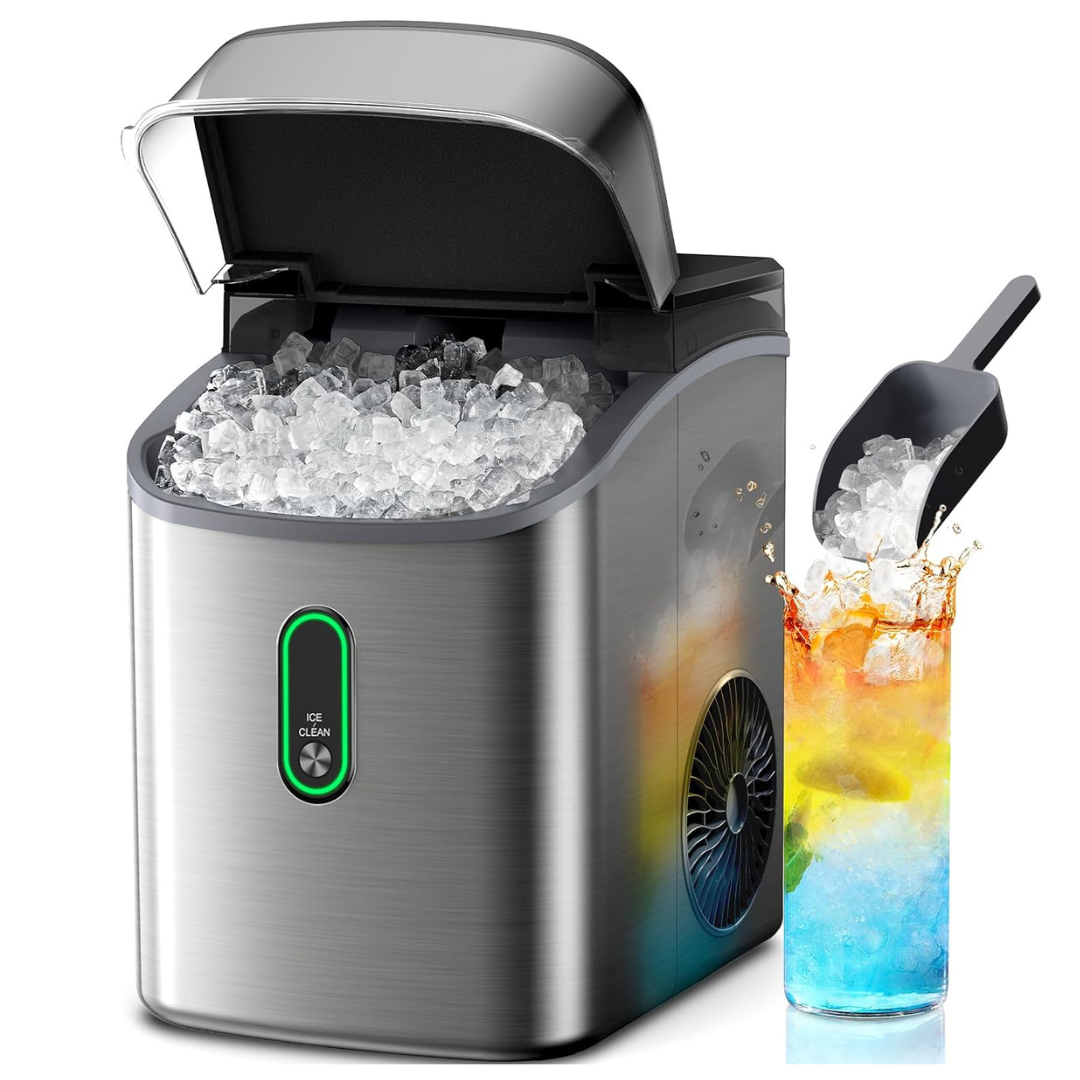
Silonn Nugget Ice Maker Countertop
- Up to 36 lbs of crushed ice per day (the product title says 33 lbs/24H, so the exact figure depends on the listing section)
- Equivalent to about 52 cups of 8.5 fl oz each
- Pebble ice production starts in about 6 minutes
- Soft, chewable nugget ice
- Self-cleaning feature
- Removable top for manual descaling and thorough cleaning
- Front-mounted controls and status indicators
- Stainless steel finish
Important note for car owners
This one is also a mains-powered countertop appliance. It is not a 12V car machine. It makes sense for readers who want a full-size nugget machine at home or at a destination with proper power.
What we like
The control panel is placed on the front, so you can see the machine’s status at a glance. The removable top is another good detail, because it lets you descale and clean the inside by hand, which is where most ice machines get dirty over time.
The stainless steel finish looks smart on a counter, and the daily output is high enough for large households. Nugget ice also chills a drink faster because of its large surface area, which is helpful for iced tea and coffee.
What to keep in mind
The manufacturer’s own numbers differ slightly between 33 and 36 lbs, so treat the output as roughly in that range. It is a full-size appliance and not something you take on the road. If you only need a few drinks’ worth of ice in a car, this is far more machine than you need.
Who should buy it
Choose the Silonn if you host often or live in a big household and want nugget ice in volume. For smaller spaces, you might prefer a small ice maker instead.
Pros and cons
- Pros: high output, soft nugget ice, self-cleaning, easy-to-access top for descaling, clear front controls
- Cons: not for vehicle use, mains power only, listing figures vary slightly
See the latest price and reviews for the Silonn Nugget Ice Maker
How to Use a 12 Volt Ice Maker Without Killing Your Battery
This is where most travelers get caught out. A 12V ice maker is fine, but a car battery is not designed to run a compressor for hours with the engine off. Follow these rules and you will avoid the common problems.
- Run it with the engine on whenever possible. The alternator supplies the power, so the battery is not being drained.
- Do not run it overnight on a starter battery. A starter battery is designed for short, high-current bursts, not long steady loads. A leisure battery or a power station is a better choice.
- Check your socket’s fuse rating. A 120W machine pulls about 10 amps at 12V. If your socket is rated at 10 amps, you have no margin.
- Use a machine with low-voltage cut-off. This is the main advantage of the BODEGA in this guide.
- Use a portable power station for longer stays. A rechargeable ice maker setup, meaning an ice maker plus a power station, is safer for camping.
- Make ice in batches while parked, then store it in a cooler. Insulated storage keeps ice for hours, so you do not need the machine running all day.
- Use cool water. Starting with cold water shortens each cycle and reduces the power used.
- Keep the machine level and secure. Spills and tilting cause errors, and water near vehicle electronics is a risk.
If you plan to run any ice machine from a power station or a solar setup, a battery capacity of 300Wh or more gives you a sensible margin for a few hours of use. The machines above each draw different amounts, so check the exact wattage printed on the unit you buy.
Ice Makers for Caravans, Campers, RVs and Boats
Searches like ice maker for caravan, portable ice maker for campers and rv portable ice maker show how many travelers want ice in places that do not have a normal kitchen. The needs are a little different from car use.
Caravan and RV
A caravan or RV usually has a small freezer, if it has one at all, so a countertop ice maker is a welcome addition. On a powered site you can run a 120V or 230V machine as normal. Off-grid, you need either a 12V machine, an inverter, or a power station. If you often camp without hook-up, the BODEGA is the best fit here. You can also browse our RV ice maker recommendations for more options.
Camper vans
Space and noise are the main concerns. A quiet, compact machine like the KYOFIS suits a camper van better than a big compressor unit, especially if you sleep nearby.
Boats and yachts
On a boat, you often have 12V or 24V house batteries, so a machine that takes DC power directly is ideal. A boat ice maker also needs to cope with movement, so run it while moored. If you are looking for a yacht ice maker or a boat ice maker, make sure the unit supports your boat’s voltage and always secure it. More on this topic is in our boat ice maker guide.
Camping and tailgating
For a campsite, a small ice maker plus a power station is a neat setup. You can make a batch while you set up the tent, keep the ice in a cooler, and refill when you need to.
Cleaning and Maintenance
An ice maker touches your drinks, so keep it clean. This is especially true in a hot vehicle, where bacteria and mold grow faster.
- Empty the water tank after each trip. Standing water goes stale quickly.
- Dry the basket and the inside. Leave the lid open so air can circulate.
- Run the self-cleaning cycle regularly. The KYOFIS, SenCre and Silonn all list this feature.
- Descale if you use hard water. Scale slows ice production and can damage the machine. The Silonn’s removable top makes this easier.
- Use clean, fresh water. Filtered or bottled water produces better-tasting ice.
- Use the drain plug where there is one. The BODEGA includes one, which makes emptying simple.
- Follow the manufacturer’s cleaning instructions. Different machines use different cleaning methods.
For a full walkthrough, see our guide on how to clean an ice maker.
Alternatives: Coolers and 12V Fridges
An ice maker is not the only way to keep drinks cold on the road. Think honestly about your trip before you buy.
- Insulated cooler plus bagged ice. Cheap and simple. Good for a day trip, but it needs refills and gets wet inside.
- 12V compressor fridge. Holds a set temperature without ice at all. A good choice for long trips, though it costs more and uses power continuously.
- Small ice maker plus a cooler. A good middle ground. You make ice when you need it and store it in a cooler.
If your main goal is keeping food cold, a fridge or a good cooler may serve you better. If your main goal is fresh ice for drinks, an ice maker is the right tool.
Which One Should You Buy?
- Best true ice maker for car use: KYOFIS Portable 12V Ice Maker. Smallest, quietest and easiest to carry.
- Best 12 volt ice maker for caravan, RV or boat: BODEGA 12V Ice Maker. Battery protection and a larger output.
- Best nugget ice at home: SenCre Nugget Ice Maker for a fast first batch and high output.
- Best simple home machine: Newair Countertop Ice Maker for easy two-button use.
- Best for big households: Silonn Nugget Ice Maker for volume and easy cleaning.
A lot of readers end up buying two machines: a small 12V unit for the road and a larger countertop unit for home. That is a perfectly sensible plan, and it is why we included both types in this guide.
Frequently Asked Questions
Can you use an ice maker in a car?
Yes, but only if it is designed for 12V DC power. A 12V model like the KYOFIS or the BODEGA can plug into your car’s power socket. A standard 120V countertop machine cannot be plugged straight into a car, and it needs an inverter or a power station.
Does a 12 volt ice maker drain a car battery?
It can. A 120W machine draws roughly 10 amps, so running it for a long time with the engine off can drain a battery. Run it with the engine on, use a leisure battery or power station, or choose a machine with low-voltage protection like the BODEGA.
How long does an ice maker for car use take to make ice?
The listings for the 12V machines in this guide state about 8 to 10 minutes for a small batch of cubes. In a hot vehicle, or with warm water, expect it to take longer.
What is the difference between hollow and solid ice?
For pure portability, the KYOFIS is the smallest on our list at 21.6 x 9.3 x 12.8 cm. For a bit more capacity and better battery protection, the BODEGA is the next step up.
Is nugget ice better than regular ice?
It depends on what you like. Nugget ice is soft and chewable and chills drinks quickly. Regular cubes melt more slowly, which many people prefer for cocktails. Both are fine, and the choice is a matter of taste.
Is it safe to run an ice maker while driving?
It depends on what you like. Nugget ice is soft and chewable and chills drinks quickly. Regular cubes melt more slowly, which many people prefer for cocktails. Both are fine, and the choice is a matter of taste.
How do I keep ice from melting on a road trip?
Move freshly made ice into a well-insulated cooler, keep the cooler out of direct sun, and open it as rarely as possible.
Final Thoughts
The right ice maker for car use depends on where you plan to run it. For a vehicle with a normal 12V socket, the KYOFIS and the BODEGA are the two machines that are actually designed for the job. The SenCre, Newair and Silonn are excellent ice makers, but they belong in a kitchen, a holiday home or a powered campsite.
Check your power source, check your battery, and pick the machine that matches your real situation. If you do, you will have cold drinks on the road without the constant stops for bagged ice. For more help choosing, browse our guides to the best portable ice maker and the best countertop ice maker.
Product details in this article come from the manufacturers’ own Amazon listings. Prices, availability and specifications can change, so always check the current listing before you buy.